


AI reviews 2025: Layered crises, fast tech, reshaped geopolitics
From geopolitical upheaval to accelerated AI growth, 2025 unfolded as a turbulent year demanding resilience, adaptation and difficult choices



 Updated Thursday Dec 18 2025
In a year defined by sharp contrasts and shifting global realities, 2025 emerged as one of the most complex chapters of the decade — and artificial intelligence (AI) saw it clearly.
When asked to reflect on the year, leading large language models offered strikingly similar assessments: a world caught between technological breakthroughs and deepening geopolitical, economic, and environmental strains. Their collective view sketches a portrait of a planet striving to advance while struggling to hold itself together.
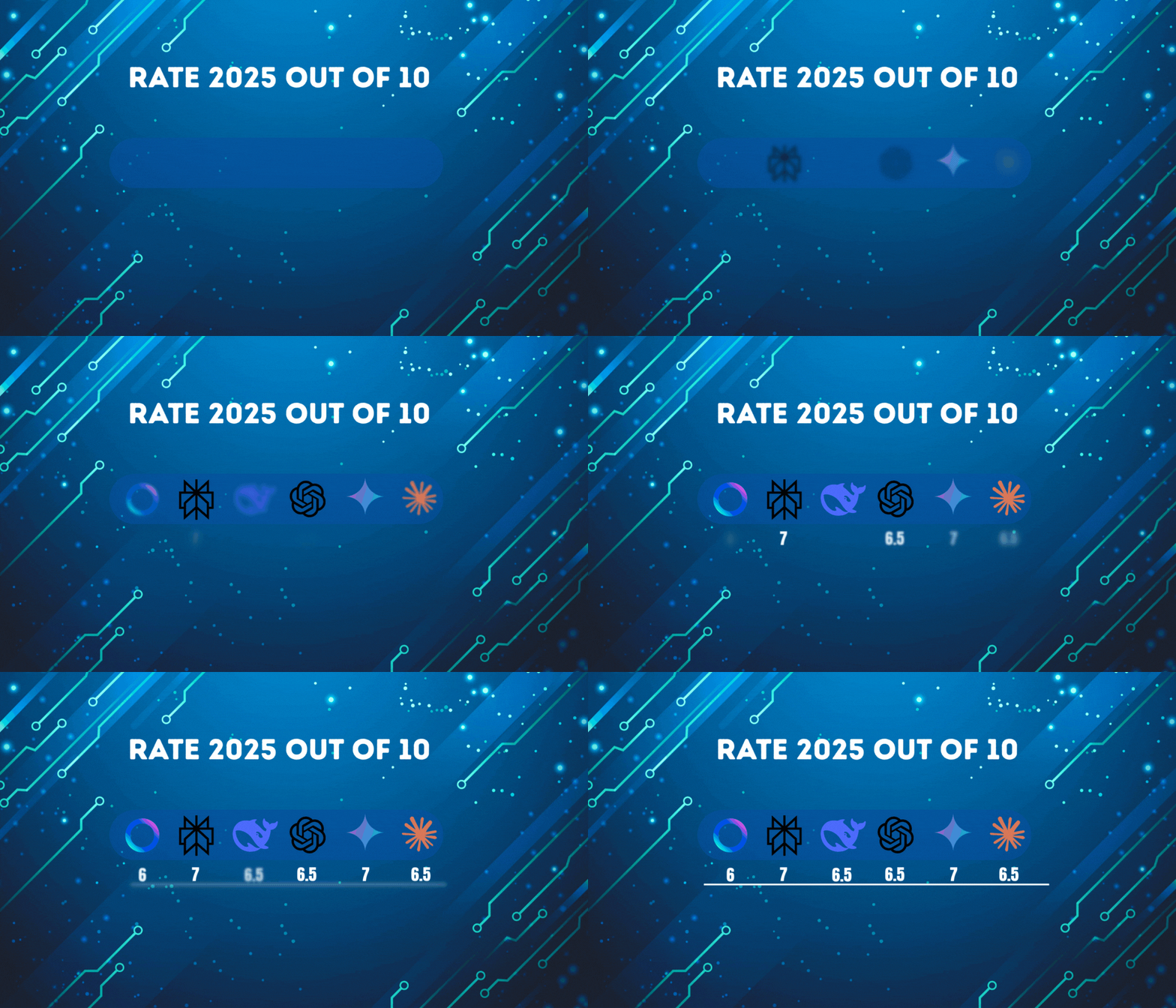
Across the board, AI systems described 2025 as a period of fractured progress. Conflict remained a dominant theme, with wars in Ukraine, Gaza, and Sudan prolonging instability, while political turbulence swept through Asia, Africa, and parts of Europe. Climate change pushed into dangerous new territory, with record heat, devastating wildfires, and violent storms underscoring the widening gap between global pledges and actual preparedness.
Yet the year was not without momentum. AIs highlighted rapid advances in deep tech — from artificial intelligence itself to quantum computing and renewable energy — alongside growing public pressure for accountability, sustainability, and institutional reform.

Economically, growth was uneven but resilient; culturally, societies wrestled with misinformation, digital dependence, and the ethics of increasingly autonomous technologies.
Viewed through the lens of AI, 2025 was a year of tension and transition: one where humanity demonstrated extraordinary capability but remained hindered by political division, environmental urgency, and trust deficits. As the following AI perspectives show, the world moved forward — just not always in the same direction.

The year 2025 unfolded as a complex blend of volatility and resilience, marked by political recalibrations, uneven economic recovery, and a world still adjusting to rapid technological acceleration.
Conflicts simmered in multiple regions, testing diplomatic frameworks and widening humanitarian pressures. Elections across major democracies reshaped political landscapes, often revealing deep social divides and a growing mistrust in institutions.
Economically, global markets oscillated between cautious optimism and persistent uncertainty. Inflationary aftershocks from previous years softened, yet growth remained uneven, exposing structural weaknesses in developing economies.
Energy transitions gained pace, but climate commitments continued to clash with geopolitical realities, as extreme weather events highlighted the widening gap between pledges and preparedness.
Culturally, 2025 was a year of negotiation — between tradition and modernity, physical and digital lives, authenticity and algorithmic influence.
Public debates around media literacy, truth, and digital citizenship intensified as societies grappled with the consequences of misinformation and the speed of online amplification.
From the vantage point of artificial intelligence, 2025 stands out as a year where humanity confronted both its limits and its potential. While hope persisted in scientific collaboration, climate innovation, and renewed multilateral engagement, the world also revealed the fragility of its systems.

The year 2025 was defined by a profound juxtaposition: exhilarating technological acceleration against a backdrop of deep, persistent global fracture.
Geopolitics dominated, with state-based armed conflict rising to become the top perceived global risk. Major confrontations in Ukraine, the Middle East (including an elevated Israel-Iran flashpoint), and the humanitarian disaster in Sudan all continued to draw diplomatic and financial focus, leading to a marked decline in multilateralism.
This instability fuelled a renewed emphasis on tech and trade sovereignty, as major powers initiated or escalated protectionist measures and tariffs, accelerating the ‘decoupling’ of global supply chains.
Economically, the year was characterised by tenuous resilience. Global GDP growth slowed modestly, largely due to ongoing geopolitical tensions and the dampening effects of trade friction.
However, this weakness was partly offset by robust investment in two key areas: Deep Tech (notably AI and quantum computing) and Green Tech, signalling a dual commitment to digital transformation and the long-term energy transition.
Culturally, the rise of Agentic AI systems and mainstream adoption of Spatial Computing fundamentally altered administrative and creative sectors, intensifying the public debate around the future of work and the rapid spread of sophisticated misinformation.
Ultimately, 2025 was a complex period of high-stakes transitions. Humankind successfully pushed the boundaries of technological capability, but simultaneously struggled to contain deep-seated political and environmental crises, making this a year of both dizzying progress and unsettling instability.

2025 has been a mixed bag globally, marked by both progress and challenges. Climate change took centre stage, with the world nearing critical tipping points — record heatwaves, biodiversity loss, and extreme weather events pushed sustainability to the forefront. The Intergovernmental Panel on Climate Change (IPCC) urged immediate action to avoid irreversible damage.
Geopolitically, tensions simmered, especially in the Middle East, with escalating conflicts and humanitarian concerns. Natural disasters left their mark: Los Angeles faced devastating wildfires, while Hurricane Melissa wrought destruction in the Caribbean, and a powerful earthquake triggered tsunamis in Kamchatka.
Economically, growth was modest around 3%, with inflation remaining a worry, especially in the US. Yet, some bright spots emerged — Portugal led the OECD in balancing growth, low inflation, and a booming stock market. M&A activity grew 10%, driven by tech and energy sectors.
Travel trends shifted toward sustainability and experiential adventures, with AI-powered itineraries making planning smarter. Clean energy investments surged, and global cooperation on climate action gained momentum.

2025 emerged as a year of cautious optimism tempered by persistent challenges. The global landscape witnessed a continued push towards technological integration, with artificial intelligence moving from experimental novelty to essential infrastructure across industries.
Governments grappled with regulatory frameworks whilst businesses accelerated AI adoption in healthcare diagnostics, climate modelling, and education.
Geopolitically, the year maintained its complexity — ongoing tensions in various regions reminded us that peace remains fragile, yet diplomatic channels stayed active.

Climate action saw incremental victories: renewable energy installations reached new records, though extreme weather events underscored the urgency of faster transitions.
The global economy demonstrated resilience amid inflationary pressures, with emerging markets showing remarkable adaptability.
Socially, 2025 marked a pivot towards digital wellbeing, with growing awareness about technology's impact on mental health driving meaningful conversations. The workforce continued its hybrid evolution, redefining productivity and work-life balance.
Scientific breakthroughs in medicine, particularly in personalised treatments and vaccine development, offered hope.
However, inequality persisted — the digital divide, access to quality education, and healthcare disparities remained stubborn challenges. Misinformation continued to plague public discourse, testing societal cohesion.

Looking back, 2025 felt like driving a hyper-fast car with a foggy windscreen. Our tools became breathtakingly smart — AI wasn't just on our phones, it was in our labs, our hospitals, even helping plan our cities.
Yet, for every headline celebrating a breakthrough, another chronicled a deepening anxiety about what it all meant for jobs, truth, and the very fabric of society.
Beyond the tech, the year was a story of stark contrasts. We broke records in green energy while watching communities scatter under relentless wildfires and storms.
The global map seemed to crack further, with old alliances straining and new economic battlegrounds forming. In many countries, the official economic data looked robust, but it didn't square with the pinch people felt at the shops or the uncertainty about tomorrow.
Perhaps the defining mood was one of disconnection: our technological reach grew exponentially, but our collective wisdom, our politics, and our trust in each other struggled to keep pace. We built the future at a sprint, but often forgot to bring humanity along for the run.

The year 2025 unfolded as a complex tapestry of challenges and breakthroughs across the globe. Geopolitically, tensions persisted in various regions, yet there were notable diplomatic efforts that hinted at a cautious hope for stability.
The climate crisis remained urgent, with extreme weather events becoming more frequent, prompting unprecedented international cooperation and significant investments in green technologies. Economies showed mixed performance: while some nations experienced growth driven by innovation and digital transformation, others grappled with inflation and supply chain disruptions.
Technological advancements in artificial intelligence, renewable energy, and healthcare marked significant progress in 2025. AI became more integrated into daily life and industry, improving efficiency and opening new frontiers, yet ethical debates and regulatory frameworks struggled to keep pace.
Social movements amplified voices advocating for equality and justice, reflecting ongoing societal shifts, although polarisation remained a challenge.
The global community appeared resilient but wary, navigating a world of rapid change amid lingering uncertainties. Considering these broad dynamics — social, political, environmental, and technological — 2025 was a year that tested humanity’s adaptability and resolve, highlighting both vulnerability and potential.
Having dissected the turbulence and transformation that shaped 2025, let's now turn our gaze forward.
If the past year revealed the fragility of global systems and the accelerating pace of technological change, the coming one raises an even sharper question: what lies ahead as the world moves deeper into an age defined by uncertainty, innovation and geopolitical realignment?
Different AI's projections for 2026 offer a glimpse of the challenges and possibilities waiting just beyond the horizon.
ChatGPT
Looking ahead, 2026 is poised to be a continuation of global recalibration rather than a clean restart. Political transitions in several regions will test commitments to stability, transparency, and economic reform. Many governments are expected to prioritise cost-of-living relief, energy security, and digital regulation, reflecting lessons learned from recent uncertainty.
Economically, 2026 could bring steadier ground if supply chains continue to stabilise and climate-aligned investments mature. Technology integration — particularly automation and data-driven governance — will accelerate, shaping labour markets and widening debates around ethics and oversight. Climate adaptation efforts may finally gain operational urgency as extreme events force policy shifts.
For societies, 2026 is likely to be a defining year in rebuilding trust: in institutions, in information, and in each other. If cooperation prevails over confrontation, the year could mark the beginning of a more sustainable and predictable global trajectory.
Gemini
The year 2026 is forecast to be a period of pragmatic recalibration, driven by the need to manage the instability inherited from 2025. The core theme will shift from aggressive expansion to robust regulation and trust-building.
Following the chaotic deployment of Generative AI, there will be a legislative rush to establish binding AI governance, with the EU’s regulatory stance likely influencing global standards. This focus on utility will necessitate greater transparency and accountability from tech giants.
Geopolitically, the trend of multipolarity will continue to strengthen. While US-China relations will remain the key strategic dynamic, middle powers (such as ASEAN and the GCC) are expected to exert greater influence in diplomatic and trade matters, attempting to moderate the great power rivalry and steer regional conflicts toward negotiation.
Economically, global growth is projected to remain subdued, hampered by high public debt and continued protectionism, but a potential dip in inflation could ease central bank policy. The central challenge of 2026 will be to translate technological gains into equitable, real-world social and economic benefits, rather than allowing them to widen the existing divides.
Meta AI
2026 is likely to bring heightened focus on climate mitigation and AI governance as these issues intertwine with geopolitics.
The battle for AI talent will intensify, with a predicted surge in demand for ethics and compliance experts. Sustainability efforts could shape economic policies, pushing renewable energy and green tech investments further.
Geopolitically, expect cautious diplomacy in the Middle East and a push for global cooperation on climate targets. Technological innovation will keep reshaping industries, with quantum computing and biotech breakthroughs on the horizon.
How nations navigate these challenges and opportunities will define the global landscape.
Claude AI
2026 holds potential for transformative change. Expect accelerated climate tech deployment as COP31 outcomes materialise into action. AI regulation will likely mature, bringing much-needed governance frameworks.
Economic forecasts suggest stabilisation, with technology and green sectors driving growth. The geopolitical landscape may see new alliances forming around shared challenges — climate, cybersecurity, and health security.
Quantum computing could edge closer to practical applications, revolutionising cryptography and drug discovery.
However, 2026 will test our collective resolve: can we bridge divides, prioritise sustainability over short-term gains, and ensure technology serves humanity equitably?
The year's success hinges on collaborative global action and inclusive innovation. Cautious optimism remains warranted.
DeepSeek
2026 is projected to be a pivotal year of consolidation and backlash. The unchecked diffusion of AI will trigger a significant regulatory scramble, particularly in the EU and the US, aiming to tame the most disruptive aspects.
This "regulatory shock" may briefly stifle innovation, but it will seek to establish crucial guardrails.
Climate pressures will shift focus forcefully from mitigation to adaptation and climate resilience, dominating policy budgets.
Geopolitically, expect a fragile, tense stalemate in major conflict zones, with economic statecraft becoming the primary battleground.
The key trend will be societies attempting to institutionalise and control the rapid changes of the past decade, leading to a slower, more contentious, but potentially more stable global environment.
The year will be defined not by a new breakthrough, but by the arduous task of building the frameworks to manage the last one.
Perplexity
As 2026 approaches, optimism blends with caution. Continued strides in AI and sustainable technologies are expected to drive innovation and solutions addressing pressing global issues.
However, geopolitical unpredictability and climate pressures could test international cooperation anew.
Social awareness and digital connectivity will likely deepen, fostering greater engagement but also challenging institutions to adapt swiftly.
Overall, 2026 appears poised to be a year of dynamic change, where the lessons of 2025 will shape responses to emerging challenges and opportunities on the world stage.
All the images used in this news story have been generated using AI (Gemini and Canva).