


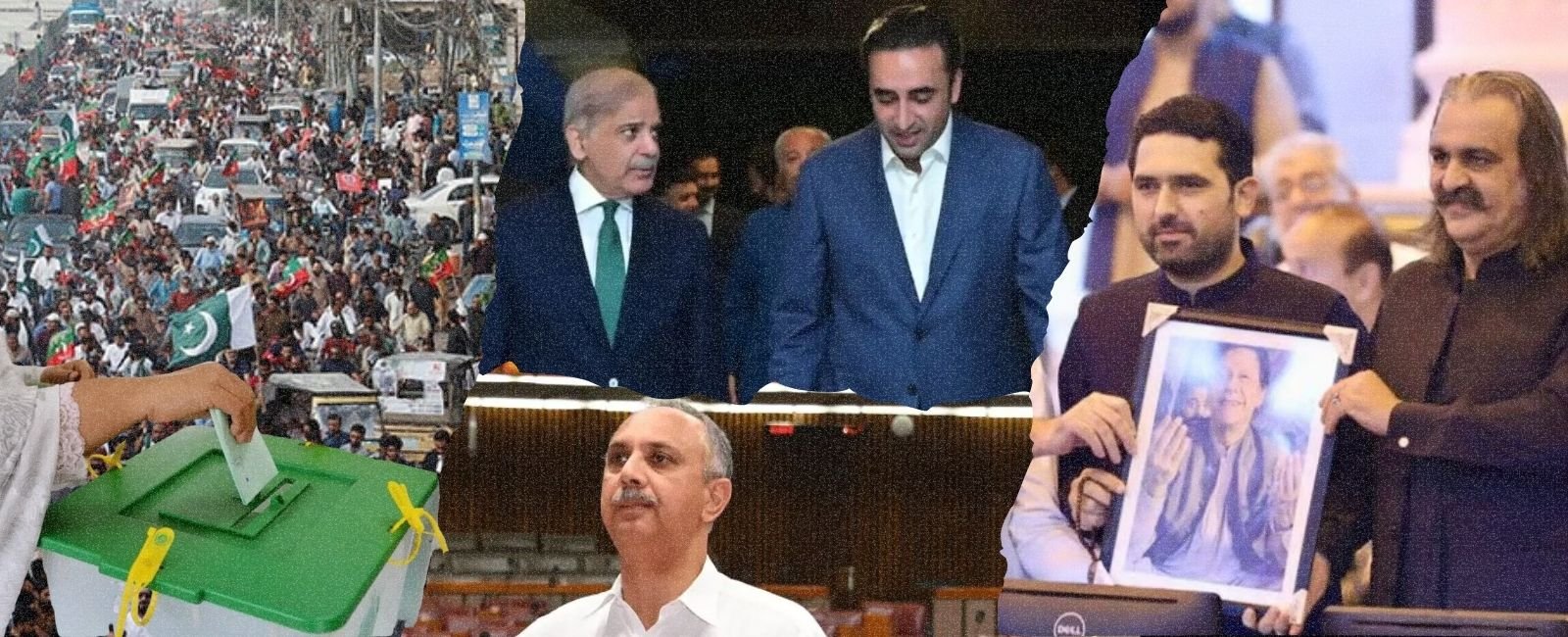
Decoding events that defined Pakistan's political landscape in 2025
2025 emerges as period in which political tensions intensified rather than eased




 Updated Monday Dec 29 2025
Pakistan's political landscape in 2025 was defined by confrontation and polarisation, as courtroom verdicts and contentious legislation overshadowed attempts at consensus.
Despite the previous year's elections shaping initial trajectories, 2025 emerged as a period in which political tensions intensified rather than eased.
The year also offers a clear indication of the trajectory Pakistan's politics is likely to take in the coming years. With ruling parties securing a two-thirds majority in parliament, greater centralisation of power now appears inevitable, along with a continued shrinking of space for dissent," said political analyst Benazir Shah, reflecting on the year's turbulence.
The year began with a clear divide between the Pakistan Muslim League–Nawaz (PML-N)-led federal government and Pakistan Tehreek-e-Insaf (PTI).
In February, the then-National Assembly opposition leader Omar Ayub Khan declared that the "chapter of talks with the government is now closed," citing the government's lack of progress on their demand for judicial commissions on the May 9 riots and the PTI’s November 26, 2024, protest.
This breakdown hardened positions across party lines, setting the stage for months of political confrontation.
Tensions escalated further in July, when an Anti-Terrorism Court sentenced PTI leaders Omar Ayub, Shibli Faraz, and other senior figures to ten years’ imprisonment in the May 9 riots cases.
PTI rejected the verdict as politically motivated, while the government maintained it reflected the rule of law.
The convictions had immediate political consequences. Several National Assembly and Punjab Assembly seats were vacated, leading the Election Commission of Pakistan (ECP) to schedule by-elections later in the year.

In October, Tehreek-e-Labbaik Pakistan (TLP) launched a march towards Islamabad, which spiralled into clashes with police and road closures in Punjab.
The federal government subsequently banned the TLP under the Anti-Terrorism Act, a move justified by authorities for public order.
Aside from the TLP protest, opposition parties struggled to mobilise large crowds, with PTI limited to gatherings in Khyber Pakhtunkhwa (KP) and demonstrations outside Adiala jail, where party founder and former prime minister Imran Khan remained imprisoned.
Political analyst Amber Rahim Shamsi maintained that opposition parties and dissenting groups have been unable to mount street agitation since the PTI protest on November 26, 2024.
"For PTI, the political space has narrowed to a single overriding objective: securing Imran Khan's release," she said.
However, she noted that the picture "looks more reassuring" on the external front.
"Following the May India-Pakistan confrontation, the civil and military leadership appear to have stabilised ties with Washington and recalibrated relations across the region," she added.

KP’s political landscape underwent a turbulent shift in the latter part of 2025 as chief minister, Ali Amin Gandapur, tendered his resignation in early October on the directive of the PTI founder.
Sohail Afridi, a young PTI leader from the tribal belt, was elected as the new chief minister with a commanding majority on October 13 and sworn in two days later.
Since assuming office Afridi repeatedly called for a change in security policy and provincial interests in national decision-making.
Polling for the National Assembly and Punjab Assembly seats — left vacant after the PTI leaders' disqualification — took place in November, with the ruling PML-N winning most of the seats amid a PTI boycott.
Senior journalist Mazhar Abbas, however, cautioned that while these results marked setbacks for PTI, they were insufficient to signal a decline.
"Success or failure on the electoral front remains untested despite setbacks like the by-elections in Haripur and Lahore. No doubt PTI is passing through a difficult time, but certainly neither its politics is fading out, nor its future, as long as Imran Khan is there," he said.
Khan, despite legal battles and incarceration since August 2023, remained at the centre of Pakistan's political discourse throughout 2025. His presence continued to dominate headlines, whether in reports of PTI’s electoral and political strategies or his hard-hitting social media posts about the incumbent government.
"If politics still revolves around Imran Khan, whether pro or anti, and he enjoys a massive following against all odds, he is still relevant," Abbas said.

November brought another flashpoint with the government's proposed 27th Constitutional Amendment.
The amendment created the new position of Chief of Defence Forces (CDF), a role later assumed by Field Marshal Syed Asim Munir.
It also established the Federal Constitutional Court and stipulated that the titles of Field Marshal, Marshal of the Air Force, and Admiral of the Fleet, held by the current chiefs, would be retained for life.
PTI rejected the draft, warning it would undermine judicial independence and alter the constitutional balance.
Nonetheless, the amendment was passed smoothly, without facing any obstacles for the government.
PTI-backed Senator Saifullah Abro, the Awami National Party (ANP), and Jamiat Ulema-e-Islam-Fazl's (JUI-F) Ahmed Khan were among the senators from the opposition benches who voted in favour of the amendment.
Before announcing his resignation from the Senate seat, Abro declared that he backed the constitutional tweak exclusively for Field Marshal Munir and the Pakistan Army.
"If anyone is mistaken, let me say that I came here to vote for Asim Munir, not for anyone else," he said on the floor of the Upper House of Parliament.
An opposition alliance, under the banner of Tehreek-e-Tahafuz-e-Ayin-e-Pakistan (TTAP), announced nationwide protests and vowed to resist what it called an assault on the Constitution.
However, TTAP struggled to gain traction, failing to unite opposition parties or launch a countrywide protest.
Abbas believes that the TTAP has so far failed to bring other opposition parties under one umbrella, nor to launch a countrywide protest.
"Thus, it remains a non-starter so far," he added.
Meanwhile, parliament remained a stage for heated political exchanges, although the opposition was unable to block any legislation.
With the ruling parties holding a two-thirds majority, lawmakers swiftly passed legislation and constitutional amendments, including the 27th Amendment.
Shamsi argued that the parliament worked by the book, but its effectiveness was limited to formal procedures, saying meaningful opposition had been hollowed out through disqualifications, convictions, and the removal of key PTI figures.

At the federal level, the alliance between PML-N and Pakistan People Party (PPP) continued despite visible policy disagreements, including over the National Finance Commission (NFC) award and water-sharing issues.
Analysts observed that while fault lines remained real, the partnership appeared driven more by political survival and the shared objective of eroding PTI’s vote bank.
"The alliance between PML-N and PPP is driven less by shared goals and more by the aim of eroding PTI's vote bank, which has posed the greatest threat to both parties, particularly PML-N in Punjab," Benazir said.
Political instability was not confined to Islamabad.
In Azad Jammu and Kashmir (AJK), the PML-N joined hands with the PPP in October to move a no-confidence motion against the then-prime minister Chaudhry Anwarul Haq.
The motion succeeded in November, paving the way for PPP's Raja Faisal Rathore to take oath as the new AJK prime minister.

Towards the end of the year, PTI's tensions with state institutions intensified after its founder’s inciting statements against them.
In response, Inter-Services Public Relations (ISPR) Director General Lt Gen Ahmed Sharif Chaudhry criticised the PTI founder and his party for promoting an "anti-army rhetoric", calling Khan "mentally ill" and a national security threat.
PTI condemned the remarks as "ridiculous allegations" and "unfortunate," insisting that Khan remained a legitimate political figure.
At the same time, discussions around imposing governor's rule in KP surfaced as PML-N leaders cited governance concerns.
Law Minister Azam Nazeer Tarar said that it was a constitutional option if warranted, though PTI-led provincial figures insisted there was no need for such action.
Analyst Abbas, however, warned that the governor's rule in KP would be a disaster, saying such moves have never been successful in any province.
"It can further lead to anarchy, particularly given the developing situation in Afghanistan. It is better if the Centre and KP governments resolve pending issues through negotiations above political considerations," he said.
Khan faced further legal setbacks towards the end of December, with 17-year sentences handed to him and his wife, Bushra Bibi, in the Toshakhana-2 case, adding to his ongoing 14-year term in a land graft case.
By the end of 2025, Pakistan closed the year with deeply entrenched polarisation and limited dialogue between government and opposition.
Courts, streets, and legislatures collectively shaped a year defined more by confrontation than consensus, indicating that political polarisation is likely to remain central in the coming years.