



The digital shift: Redefining news beyond the newsroom
Some journalists are moving to digital spaces to reclaim their voices and challenge the monopoly of traditional newsrooms





 Updated Saturday May 23 2026
"When digital first came to TV, we journalists did not accept it. We thought it was an insult to be called a 'YouTuber’… We were unable to understand its utility, its reach, or its impact. We truly believed we would have to lower our standards to do YouTube,” said Islamabad-based journalist Asad Ali Toor.
The statement reflects a broader shift taking place across Pakistan’s media industry, where journalists once rooted in television are now rebuilding their careers on digital platforms. Toor started his journalism career in 2005 and later worked as a senior producer at a private TV channel.
Now, he has transitioned to YouTube — the very platform he and many of his colleagues once looked down upon — where he covers judicial and governmental affairs, breaking news, and interviews.
Toor said that there was a time when the label “YouTuber” did not sit comfortably inside Pakistan’s mainstream newsrooms. According to some newsmen, not only what Toor says, YouTubers were not even considered journalists by journalists' bodies, who thought journalism was restricted to only broadcast, print, and radio.
Television carried credibility as it was built on structure, hierarchy, and institutional backing. On the other hand, digital and social media platforms were still seen as informal, even unserious spaces. However, broadcast media was uncertain and had limited freedom.
"In newsrooms, there are a lot of checks. Your reporting can go on air after going through a certain check. You cannot decide for yourself whether your story or your information will go on air,” the broadcast-turned-creator journalist said.
Toor’s friends saw that the mainstream was a "dead end" for his style of journalism, and the traditional path was no longer sustainable for him. So, when they encouraged him to start his own channel, the hesitation was immediate but not unique.
In Pakistan’s media landscape, similar transitions have quietly been unfolding. This result is not merely about changing a platform but stripping away traditional definitions of journalistic practice and reinventing its boundaries, its authority, and its relationship with audiences.
From TV to YouTube
For Toor, the change on the outside started from within. Dedicating more than 20 years to mainstream media, he noticed how journalism within newsrooms was losing its meaning and losing what it stood for.
He argued that the structure of mainstream media was losing its significance. He also pointed towards a deep-seated financial crisis in the industry.
“The salaries in mainstream media are poor. If someone was earning Rs80,000 10 years ago and is still on the same pay today, how has he progressed?” Toor said.
So, the transition to a social media platform occurred; for some, it was a choice, but for others, the only option after either losing their jobs or seeking more freedom. The support came from his friends, who helped him with a basic setup and pushed him until he finally began uploading videos on his YouTube channel.
For senior journalist Amber Shamsi, who has experience working with both international and local media systems, the departure from mainstream was due to a different kind of exhaustion.
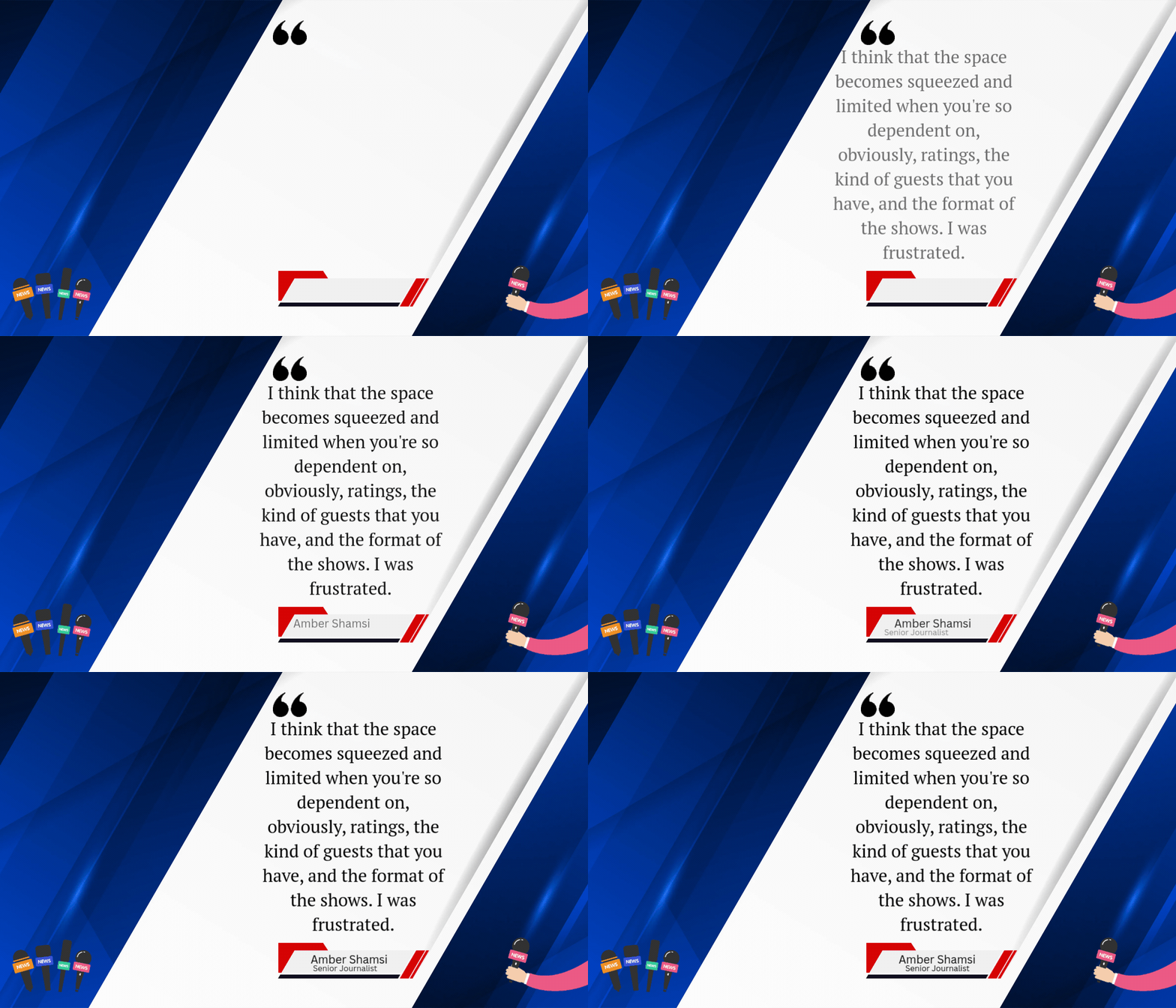
“I felt that I was able to do some really good and impactful work. However, I think that the space becomes squeezed and limited when you're so dependent on, obviously, ratings, the kind of guests that you have, and the format of the shows. I was frustrated,” she described.
In her account, editorial freedom was replaced with commercial pressure. Where decisions were supposed to be guided by journalistic principles, they were passed through contextual nuances, influenced by ownership and advertising demands.
“The business models of newsrooms that are very dependent on government advertisements, partly dependent on the ownership structure and the lack of separation between editorial and ownership or editorial and marketing,” Shamsi explained.
Shamsi started her career as a print journalist, working as an investigative reporter and subeditor. She eventually moved to digital and international platforms. She became well known to the public after she started hosting TV news shows.
Following her success in broadcast media, she joined the Centre of Excellence in Journalism (CEJ) at IBA, where, for many years, she was keen to train the young generation of journalists.
It was while working with Pakistani journalists in developmental sessions that Shamsi sensed a growing desire for independent paths. On top of this, watching audiences pivot towards digital spaces, she realised a new kind of journalism was waiting to be born in this technological advancement, and she stepped forward to grow into it.
Breaking newsroom control
For field reporters like Saqib Bashir — a legal analyst and former president of the Islamabad High Court Journalists Association (IHCJA) — the transition came after years spent at the centre of Islamabad’s high-pressure judicial proceedings. For him, the shift was driven by a system that sacrificed speed and ownership.
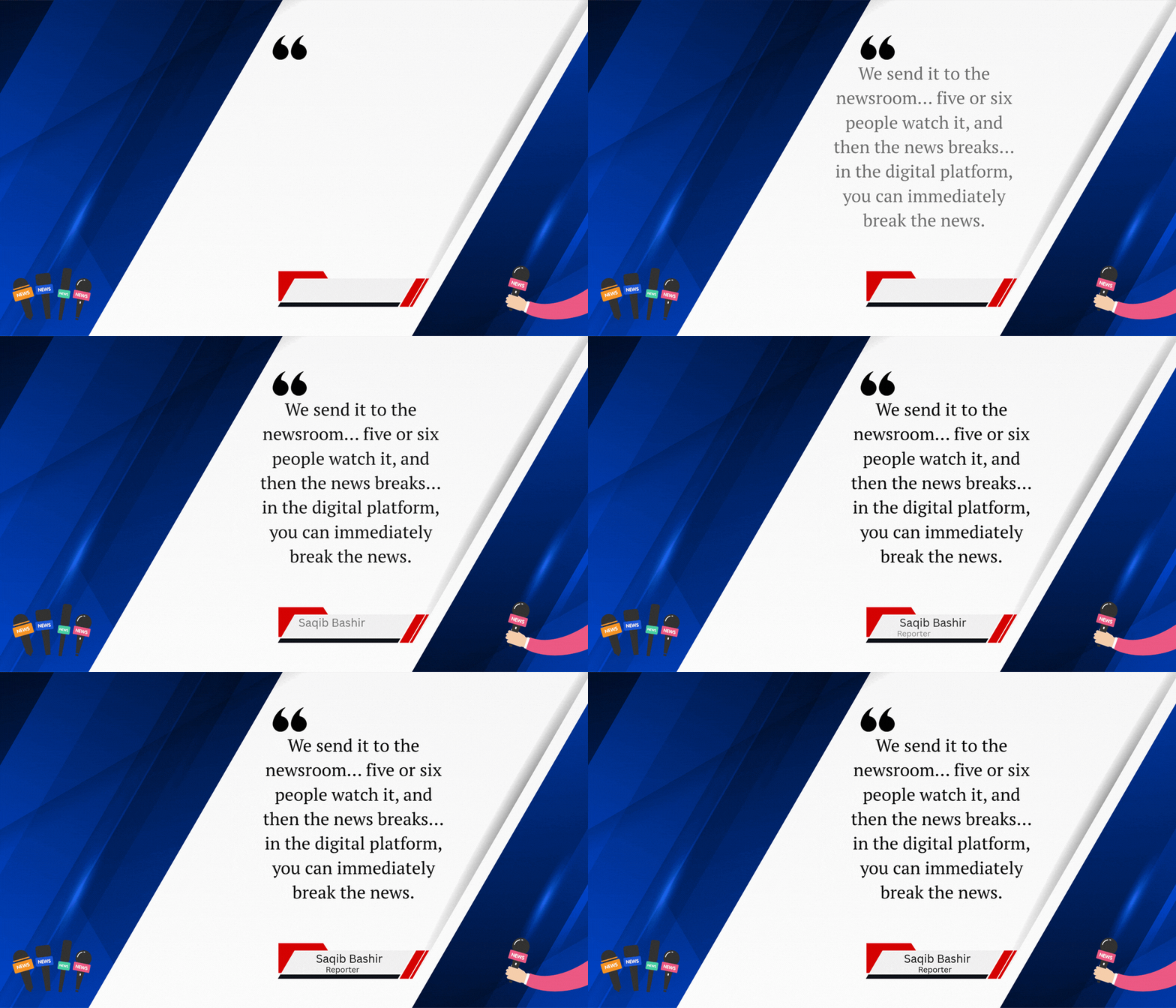
“We send it to the newsroom… five or six people watch it, and then the news breaks… in the digital platform, you can immediately break the news,” he said.
Through his YouTube channel, Bashir has reclaimed credit for his work. He explains how recognition changed, and it's not about big news organisations anymore. On digital platforms, people connect directly with the reporter as the face of the story. “You can immediately break the news. You can take credit for it. For journalists, the credit for exclusive stories is very important.”
The step away from these newsrooms was a step into the new classroom of social and digital platforms. The spirits were high, but the reality of navigating these new spaces came with a learning curve.
As Shamsi highlights, journalists had to change what they were taught. Changing the inverted pyramid architecture of the story and skilfully adapting it to these digital platforms. How a journalist is also a part-time designer and marketer.
“A lot of media programmes miss digital marketing… but also how to understand design. How to make an effective carousel? That is also storytelling,” Shamsi said.
She stresses that digital tools like Instagram’s carousels and TikTok need a different kind of “hook”. The “extra” add-ons like design, monetisation and platform-specific marketing are part of the journalistic package.
The transition to digital is less of a destination and more of a constant pursuit.
For Toor, the most immediate technical challenge wasn't navigating the platform but the fundamental requirement of YouTube as a platform. The act of recording in front of a camera.
“There is always a reluctance in me. There is pressure of the camera when it is on,” Toor stated.
This reluctance highlights a broader reality: the digital landscape moves faster than any single journalist can keep up with. They were still in the middle of adapting their craft to technicalities when the AI revolution disrupted the process.
Toor represents a generation of journalists still catching up to AI. He admits to 0% usage of AI in his work, but also acknowledges it as a lack of skill. “I have used it 0%. And I will call it my failure… It will change the world of information, but you should also do your manual cross-check and verify.”
Adapting to algorithms
As for Bashir, who was working with brief news updates and then X’s word limits, he now works within video lengths. While X allows standard users only 280 characters, the shift to YouTube introduces an even tighter constraint. The first 60 seconds of viewer attention.
Video format demands it through the "hook," where a journalist has only moments to stop a user from scrolling past. This creates a new storytelling hurdle, and within this storytelling, his challenge was one of language bridging.
“In court proceedings, because it is very technical, people don’t know the terminology… We have to make it so easy for people that even if they are in a village, they can understand what happened,” Saqib explained.
On YouTube, the audience demands the "why" and the "how", but they need it in plain language.
After crossing these bridges came the decision of what was being put out there. In the newsroom, the editor decides what's important, but on social media platforms, the conclusion is reached by audience feedback.
Toor believed in ethics as resisting the crowd. He described a deliberate strategy of ignoring comments, as they can mislead the consciousness.
“My strategy is that I don’t read comments... My thought process is that even if I do something wrong someday, people might like it, they will comment that they like it, and I will feel like I did something good,” Toor claimed.

While viewership peaks on Supreme Court and military matters, he points out how hard news on topics like Iran-US negotiations often result in low viewership. Yet he still treats it as essential.
“Some people say why is there a need to cover it, but I say it’s important, so I will cover it,” Toor added.
While Toor refuses to let the audience become its new boss, Shamsi, on the other hand, believes in structure to engage the crowd. She realised the digital social media audience doesn't want “bare-bone facts” but rather a story that invites.
“Digital storytelling is very different …you have a hook that drives curiosity, you raise the action, and then you reach a climax,” Shamsi explained.
She found herself guiding a new generation of “Gen Z” journalists away from a “viral first” mindset towards a more quality-driven approach. “It isn't about virality, but about depth. Young people tend to lack that context, depth and experience. So, we try to combine both as much as possible.”
Journalism beyond institutions
Shamsi's strategy was the marriage of trending and responsible reporting, but for Bashir, the apparent declining trust in mainstream media could be recovered by what he believed was serving the crowd. What works on digital media is credibility.
“If they want to listen to a topic, they will listen to a journalist who tells everything on YouTube,” Saqib claimed.
The strategy is simple: building a narrative with factual weight and heavy research. The audience wanted details. So, he served a niche that the mainstream abandoned.
“If you want to understand or listen to any issue, and you want to get as much information as possible, people go to digital platforms like YouTube,” Saqib said.
However, this freedom of choosing your own strategies was accompanied by the ground reality of not being part of a team anymore. From an executive producer with a whole team under him to “one man army”, Toor was honest about the lack of refinement in his content. “The screen has its own requirements… visuals, pictures, graphics. I am not able to meet those requirements, but for that, the team is very important.”
Toor had also lost access to mainstream audiences. The only thing helping him look past the stagnant following in his first two years on YouTube was his hope in consistency. “I have made 3.5 to 4.5 lakh subscribers. It took me 5 years…You have to be consistent. People will recognise you.”
However, Shamsi highlighted more of an operational risk. Large organisations provide the legal covering needed during threats. Without institutional backing, that shield often disappears.
“At every step, the organisation supported me. I was receiving death threats online as well as calls to my office, and my office then decided on a safety plan,” She recalled.
'Don't start independently'
Even with the efforts of making digital journalism sustainable, Shamsi warns emerging journalists not to skip newsrooms entirely. “When you work in the mainstream, you learn how to deal with pressure, how to do work, multiple skills, multiple roles at work, how to manage people as well… it teaches you a few street smarts that are necessary. So don't start independently.”
Shamsi was inclined towards having the full experience, but for Bashir, these concerns had lower precedence. Sure, traditional newsrooms provided teams, but what mattered more was giving personal recognition.
“People who were not acknowledged on mainstream media have made their worth through social media,” Bashir said.
Similar to Toor, Bashir also went through the invisible grind of building his audience. A platform where you have to earn one person at a time.
“It wasn't easy to get an audience on these platforms… It's a difficult and long process. After that, the credibility matters,” Bashir said.
People didn't follow him because of a big newsroom name. They followed him because he proved his word was authentic.
The transition of Toor, Shamsi, and Bashir is an indication of a collapsing monopoly. Driven by censorship, technological shifts, and the changing needs of a youth audience with shorter attention spans. These journalists moved to digital spaces to reclaim their voices. In doing so, they took the monopoly of journalism away from the traditional newsrooms.
However, the shift hasn't stopped there. The same tools that allowed professional journalists to go independent are now in the hands of the common man.
We are entering an era where the monopoly of journalism is being taken away from journalists themselves. It is no longer their exclusive niche. Journalism has transitioned and returned to its most raw form, a conversation belonging to the public.
Ajwa Matiullah and Javeria Rauf are students pursuing Mass Communication studies at the National University of Sciences and Technology.