


Hostage economy: The business of human desperation
AI weapons of mass suspension. A father. And the paid sanctuary they call Meta Verified




 Updated Tuesday Jun 09 2026
The call no parent wants to receive
I was in a meeting when my 20-year-old daughter started to call me and kept calling. As I could not pick up, she sent multiple messages asking me to call back. She is doing LAW from LUMS and lives in the university hostel. She was to give her last paper of the 2nd semester before moving back home for summer break. So naturally, I got worried and hoped everything would be alright. As the meeting concluded, I called her back. She paid her usual salams, but her voice felt heavy as if she had been crying or had been trying hard not to, and then, with a trembling voice, she told me that both her Instagram accounts got suspended.
A personal vlog account with 3 years worth of efforts, documenting a difficult journey she once navigated, starting from winning the head girl election as an outsider against established candidates in the largest campus of the city, followed by academic setbacks in grades of getting 1D, 1C and 1A in A1 (A’Levels first year) to turning it around to 2A* and 1A in the A2 (2nd year). a rejection from LUMS, then deciding to take a gap year to increase her odds of getting admission and finally securing the acceptance. It had around 10K legit followers. The other account was made this past January, a dedicated admissions and counselling hub for prospective university students. It grew exponentially to more than 5.5K followers in a short span because of the genuine value it provided to the students. Losing those accounts was no less than losing her identity, which she had so carefully built over the years. The grief that she felt broke my heart too.
She had an entire summer's worth of empowering content planned. Then, in a single algorithmic heartbeat, her digital presence was abruptly removed from the platform. No warning. No explanation that made sense. No human being to talk to. Just a generic account integrity policy violation notice, and an appeal button that presented her with no choice but to proceed with the appeal. That was the entirety of her recourse. It followed with identity verifications through a real-time video selfie and a photo ID submission before pushing her appeal into a digital limbo.
Buying access to humanity
She came back, and over the next few days, I watched her waiting desperately for a positive response to spending hours researching on how to get her accounts back.
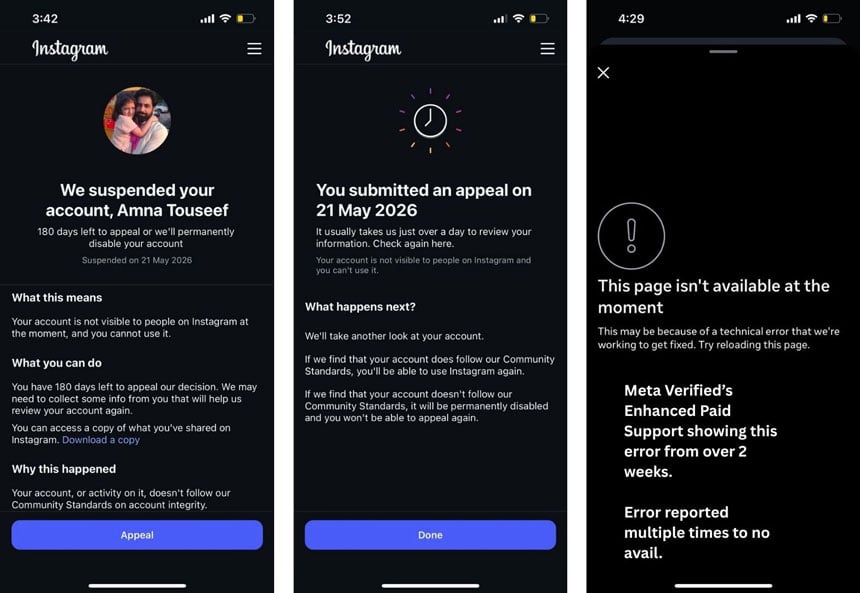
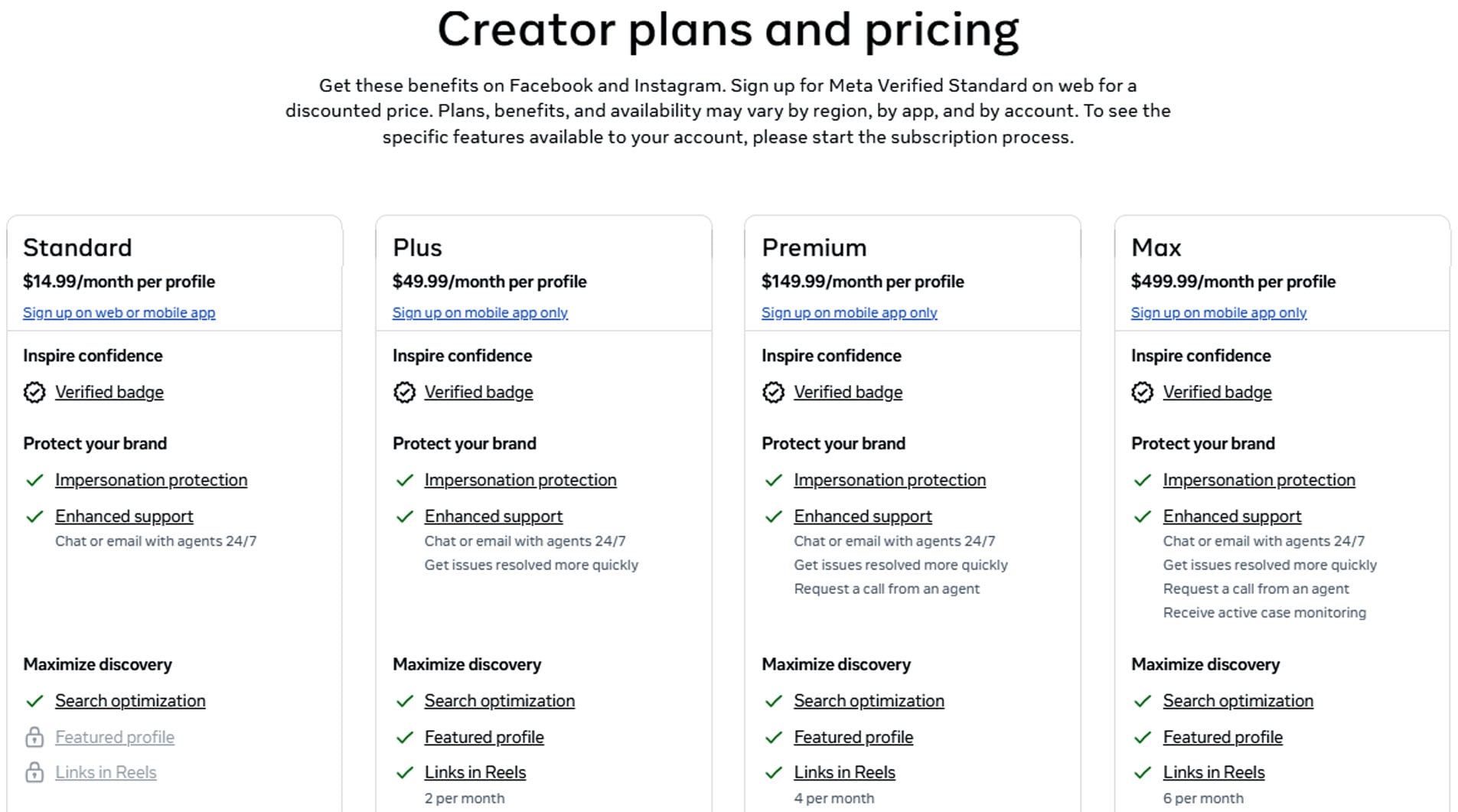
Every digital community she encountered pointed to a singular, deeply cynical conclusion: you must purchase the Meta Verified premium subscription service. It was the only way to bypass the bots and speak to a real human being to beg for your digital life back. Some even suggested buying the highest corporate tiers for a "guaranteed resolution".
That's when I realised something very unsettling. At first, I assumed this was a glitch. Platforms make mistakes. Systems break. Appeals get delayed. But the more I researched, the harder it became to see this as an isolated failure. What I discovered was something arguably more concerning: whether intentional or not, it is a system whose incentives increasingly appear to produce outcomes of user helplessness rather than user empowerment. And my daughter, along with countless other creators, is just collateral damage that has already been accounted for by the platform.
So I decided to get to the bottom of it, and the findings were revealing. But before I explain what I found, let me tell you a story to help you understand it better.
The fruit of fire
Imagine a town with a modest but manageable fire problem. Trained inspectors walked the streets, identified hazards, and intervened before small sparks became structural fires. Then an ambitious businessman arrived. He noticed that while fires are relatively rare, the consequences are devastating. So he launched a low-cost fire insurance company. Residents appreciated the peace of mind, and many signed up. The business started to grow steadily.
But, to some, steady growth is not enough. To expand further, he needed more people to feel vulnerable. The safer the town became, the less urgency people felt to buy what he was selling. In a strange way, the inspectors have become his biggest economic obstacle.
So a new set of strategies emerged. He invested in a company that manufactured automated fire sensors and began promoting studies arguing that human inspection is outdated, expensive and inefficient. At the same time, he introduced a premium insurance package that offered direct phone access, priority claim handling and faster payouts. Standard customers still received support but through IVR, and claim payouts were kept behind increasingly complex and time-consuming verification processes.
The town authorities, attracted by his promises of modernisation and lower costs, gradually reduced the number of inspectors and deployed the automated sensors instead. His sensors. They were fast. They were scalable. They were inexpensive. They were impressive. But they were not particularly good at distinguishing a backyard barbecue from a genuine emergency.
False alarms become common. Residents begin losing trust in the system. Real fires were missed. Small incidents escalated. Property damage increased. The town responded by deploying even more sensors. As anxiety grew, more residents purchased insurance. Claims volumes rose. Processing times increased. Frustrated customers begin upgrading to premium plans simply to gain faster access to assistance.
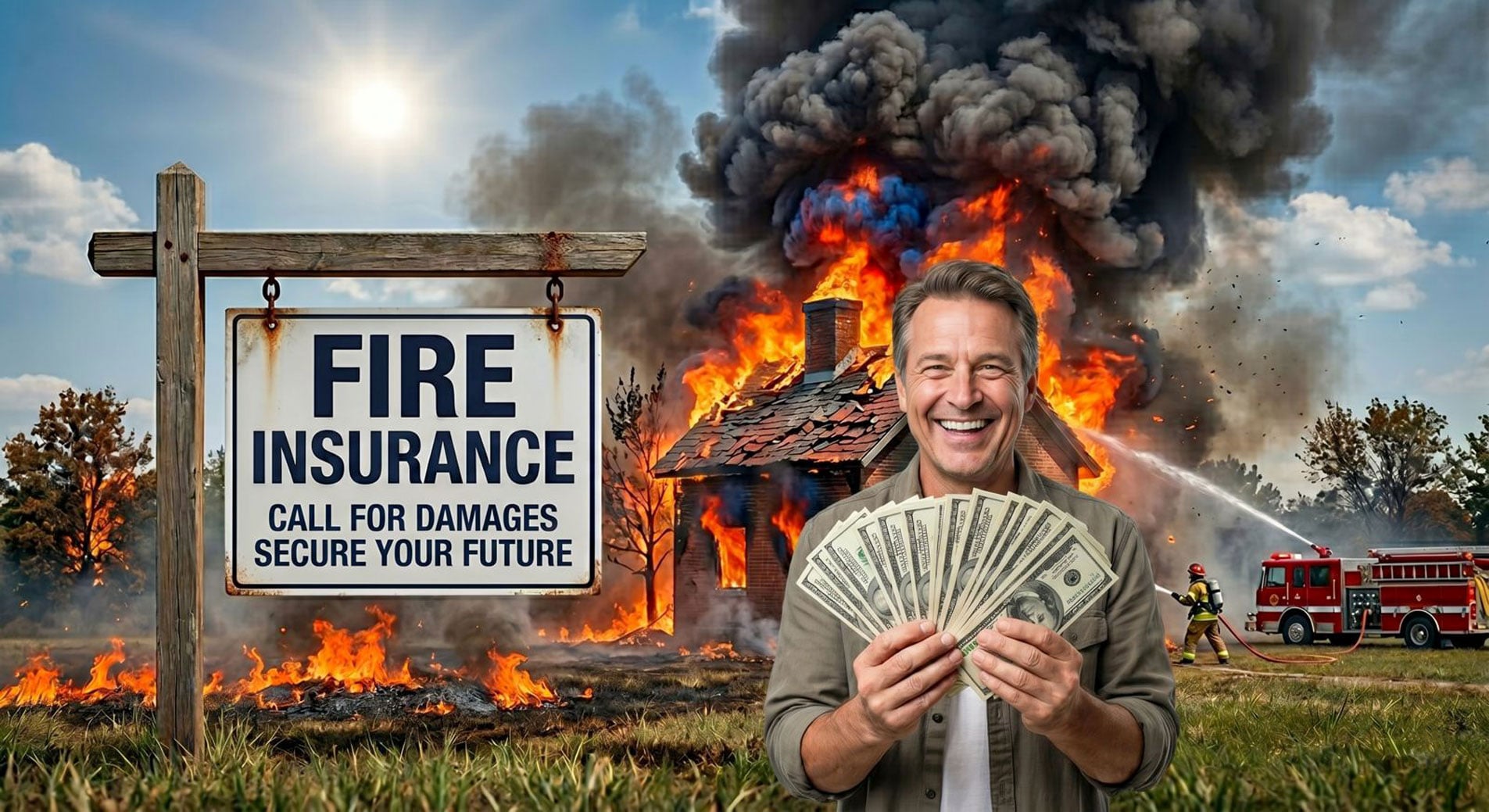
When civil society finally connected the dots and dragged him to court, the entrepreneur was ready. He did not create the fires. He didn't even need to. He simply helped create an environment in which fires became more common while ensuring he was already selling the most attractive remedy to the people affected by them. Every step of his strategy was structured as an independent, defensible business decision. Fewer inspectors reduce cost. Automated sensors improve efficiency. Premium support is a legitimate business model. Each decision appears reasonable in isolation. Yet together they create a self-reinforcing system that benefits from the very problems it claims to solve, yet next to impossible to prove in a court.
The legal case collapsed, and he walked away celebrated as the saviour who arrived with insurance when the town needed it most and helped residents recover their losses.
The Holy Rehal Paradox
This is a predatory structure that rests on four interdependent legs that function exactly like a holy rehal. The traditional X-shaped wooden book rest, you must have seen your grandparents using to elevate sacred text. This is what I call the Holy Rehal Paradox to explain structures where harm is visible, widely acknowledged, yet structurally resistant to being proved in the court of law.
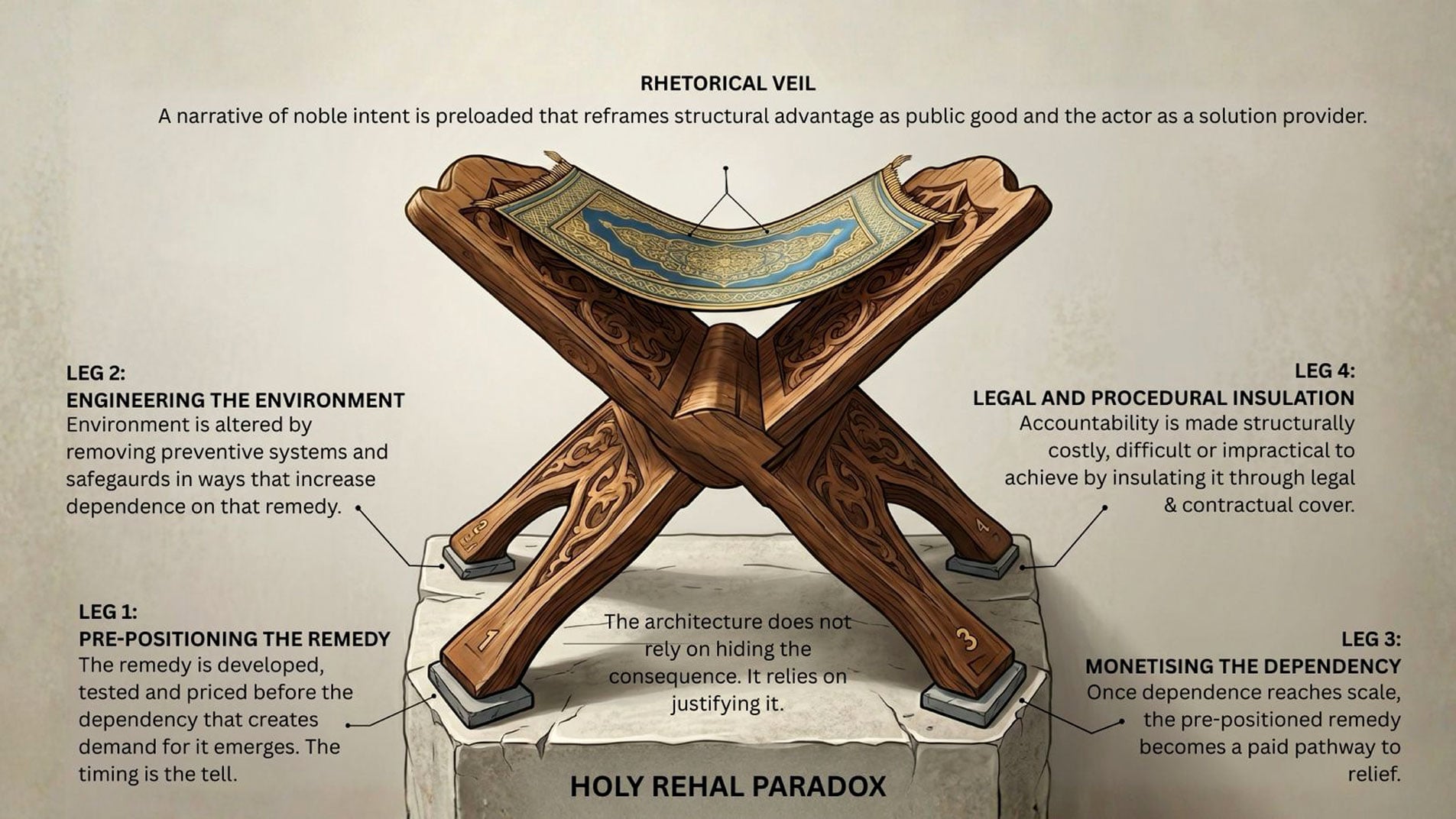
The first leg is pre-positioning the remedy. Before the crisis exists at a scale that demands attention, the actor already has a product, service, or infrastructure that will become essential once the crisis arrives. This is not serendipity. The remedy is built, tested, priced, and ready before the suffering that will create demand for it has been allowed to escalate. The timing is the tell: the solution precedes the problem it claims to solve.
The second leg is engineering the environment. The actor does not necessarily ignite the crisis with a single dramatic act. More commonly, they quietly, incrementally and with justifications remove the systems, safeguards, and alternatives that would have prevented or contained the crisis. They do not always create the fire. More often, they dismiss the fire inspectors and wait. The crisis then grows through the absence of prevention rather than through the presence of malice, which is an important distinction for legal and rhetorical purposes, as we will see.
The third leg is monetising the dependency. Once the crisis reaches scale, the actor's pre-positioned remedy becomes the only available relief. The dependency is not accidental. It was created by the removal of alternatives in leg two. The actor now collects payment from people who have no other viable option, which is the most durable and profitable form of market capture possible: not a market where you compete, but a market where you are the only exit.
The fourth leg is Legal and procedural insulation. Before any of the first three legs are deployed, the actor has pre-selected the legal and contractual framework that will make accountability structurally difficult or impossible to achieve. This leg works in both registers simultaneously. Legally, the actor structures its conduct to fit within existing statutory shields that were not designed to protect this kind of harm but whose language is broad enough to cover it. And procedurally, the actor exploits the gap between the individual act and the systemic harm: since each step in the sequence is individually defensible, the aggregate architecture resists prosecution even when the pattern is clear to any observer willing to stand far enough back to see it whole.
And just as a rehal supports sacred scripture, all four legs are wrapped in a rhetorical veil: a narrative of noble intent that reframes structural advantage as public good and the actor as a solution provider, not the problem creator, so that criticising the actor requires first appearing to criticise the relief it offers.
In our fire story, that layer was public safety and recovery of the losses. The cause was real but its nobility was manufactured. The entrepreneur used the unimpeachable virtue of public safety to justify dismantling the very workforce that kept people safe.
The Holy Rehal Paradox can therefore be defined as a four-leg institutional architecture in which a remedy is positioned before a crisis, the environment is altered in ways that increase dependence on that remedy, the resulting suffering is monetised through that dependency, and accountability is insulated through legal & contractual cover, while maintaining moral legitimacy through deliberate narrative design. The paradox lies not in visible harm but justifiable harm: the damage is widely recognised, often openly discussed, and sometimes extensively documented, yet remains extraordinarily difficult to challenge because each individual component of the architecture is independently defensible. So the architecture does not rely on hiding the consequence. It relies on justifying it. The harm is real. The pattern is visible. Yet the system remains largely immune to correction, and that is the Holy Rehal Paradox.
Well, at this point, you might be thinking that I have made up something out of thin air to prove a point. So let me put the Holy Rehal Paradox (HRP) to the test with a well-documented episode of corporate consolidation from the past.
Ripping up the rails
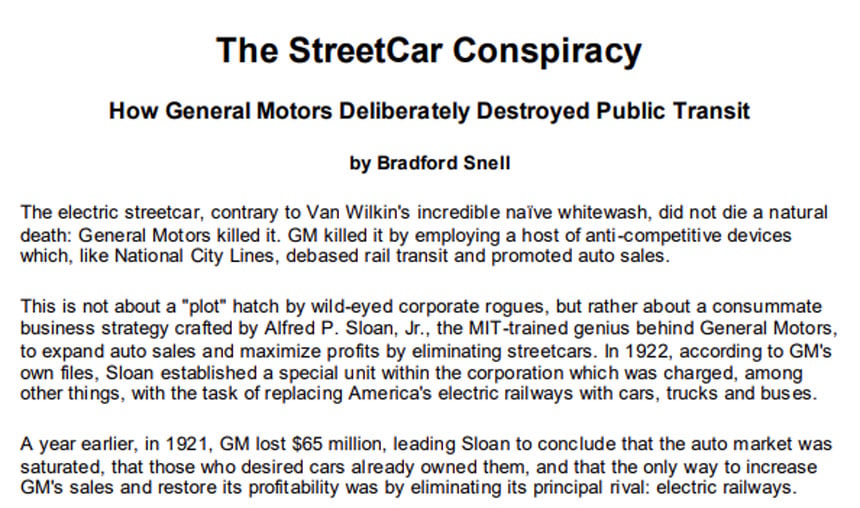
In the late 1930s, a holding company called National City Lines (NCL) began acquiring the companies operating electric streetcar systems across 45 American cities. Under their management, many of these systems were converted to diesel bus routes, a transformation that critics argue became a major catalyst in the dismantling of a public transport network that once spanned 1,200 separate electric street and interurban railways, 44,000 miles of track, 300,000 employees, 15 billion annual passengers, and $1 billion in annual revenue. Let’s run this history through the HRP lens.
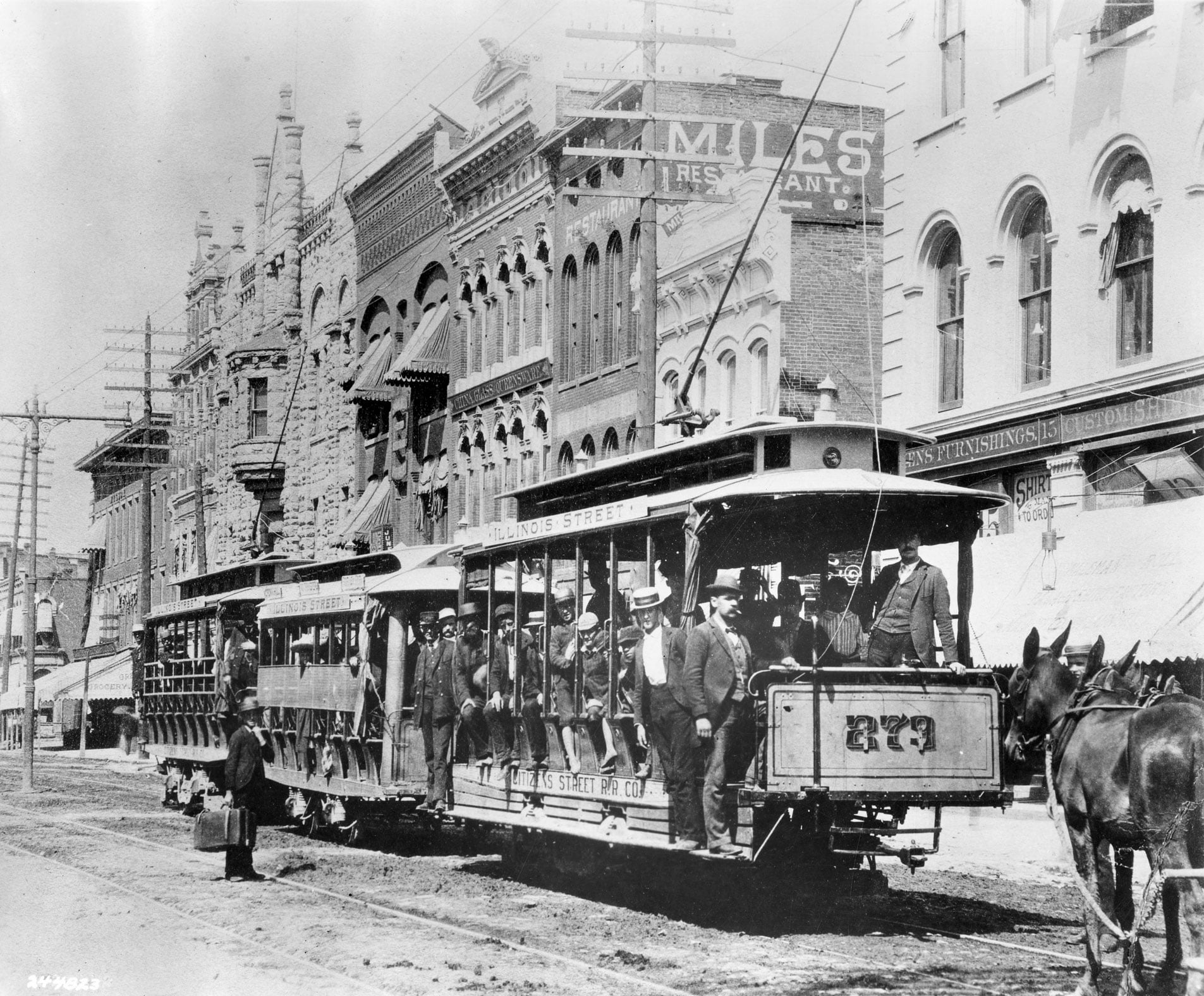
Leg 1 - Pre-Positioning the Remedy: Long before the rail networks were dismantled, the companies that made up NCL had already built the alternative infrastructure. General Motors was manufacturing diesel buses, Mack Trucks was making freight trucks, Standard Oil was refining petroleum, and Firestone was producing rubber tyres. Bradford Snell, a former US Senate antitrust attorney, argued in his influential report on what became known as the Streetcar Conspiracy that by the early 1920s, GM made a conscious decision to replace the thriving transport system with their alternative automobile system. The remedy preceded the manufactured crisis by nearly two decades.
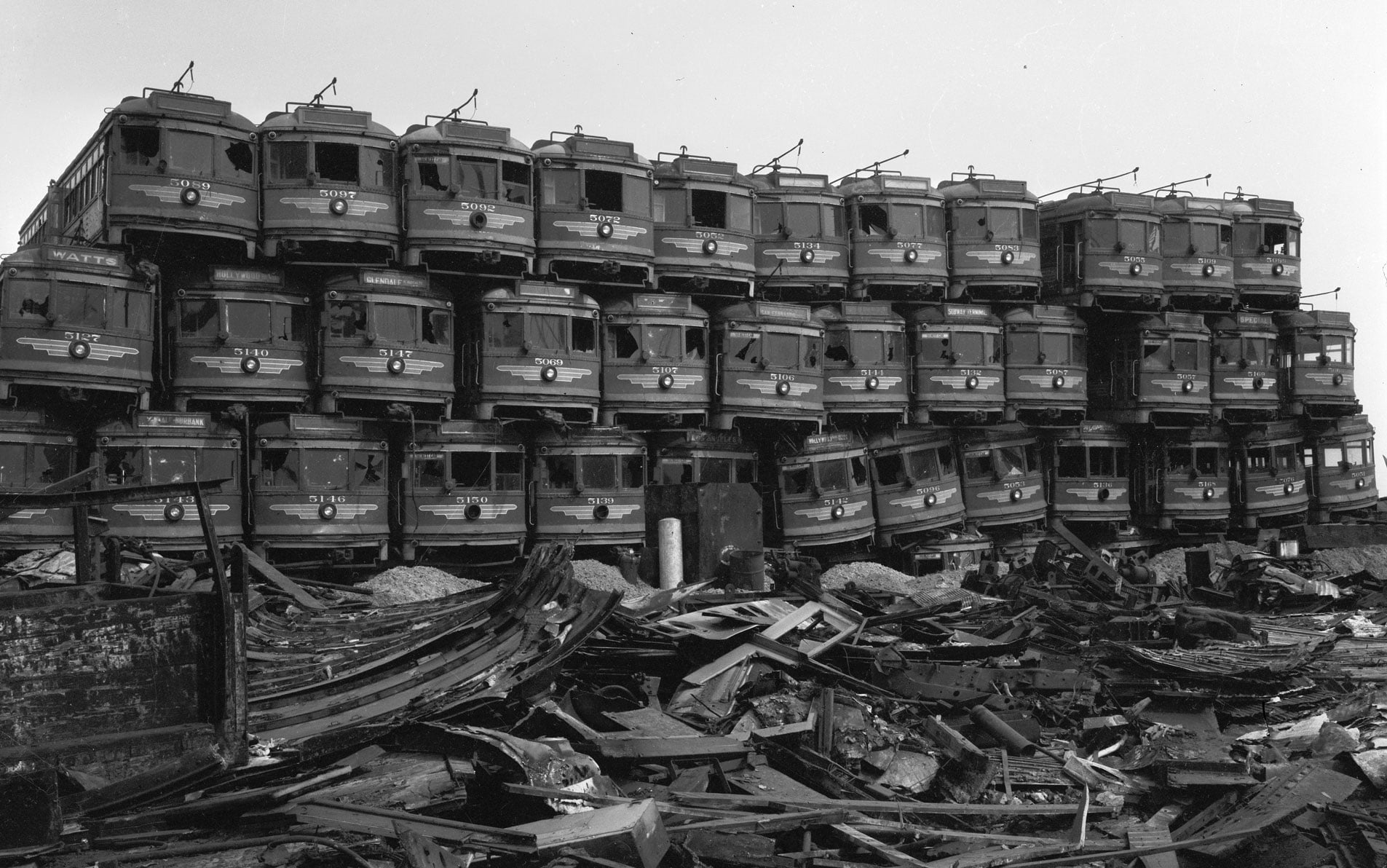
Leg 2 - Engineering the Environment: Once NCL gained control of city transit systems, it allegedly deferred maintenance, allowed rolling stock to deteriorate, and let service quality plummet. To the public, the decline looked like natural economic stagnation. As ridership fell, NCL argued that converting to diesel buses was the modern, flexible choice. Once converted, the rail systems were ripped from the ground, an extraction that historians argue was not primarily about scrap value, but about making restoration physically and politically impossible.
Leg 3 - Monetising the Dependency: With the rails destroyed, urban commuters were left without options. The automobile was no longer a choice; it was a baseline requirement for economic survival. Deprived of rail, passengers bought GM cars, burned Standard Oil fuel, rolled on Firestone tyres, and moved their goods on Mack Trucks. Through the HRP lens, the result appears as a harvest of a dependency cultivated by erasing alternatives.
Leg 4 - Legal and procedural insulation: When legal reckonings arrived, the corporate architecture resisted prosecution. The companies were convicted of a narrow supply-chain conspiracy (monopolising the sale of buses and fuel to their own subsidiaries) but were acquitted of the systemic charge of conspiring to monopolise the transit industry itself. Each transaction had been structured to look like an independent, defensible business decision.
And the sacred scripture in this case was provided by GM, flipping the whole narrative, arguing they had not destroyed the streetcar, but had merely provided buses to "alleviate the disruption left in their wake". Yet, as argued by historians and antitrust researchers, the conditions that produced that disruption were themselves substantially shaped by the actions of NCL and companies that backed it. GM successfully presented itself in court as a provider of a modern solution to a problem in which it was deeply implicated.
If you look closely, similar patterns can be found across different systems around us. But for now, we return to mass suspensions of Instagram accounts. The question is whether these AI-led enforcement systems represent isolated operational failures or a recurring structural mechanism that is already visible in pattern, increasingly documented in outcome, and difficult to dismiss as a coincidence.
The business of desperation
In February 2023, Meta introduced Meta Verified. A subscription priced between $11.99 and $14.99 per month. While marketed with cosmetic perks like a blue checkmark, its most significant feature was access to live human customer support. Read that again. Access to a human being. Something that was once a basic operational responsibility of any platform hosting your livelihood, repackaged as a paid subscription feature. This was not a response to an unidentified need. Meta knew precisely what its users needed most. It watched that need grow and documented it in its own CSE reports.
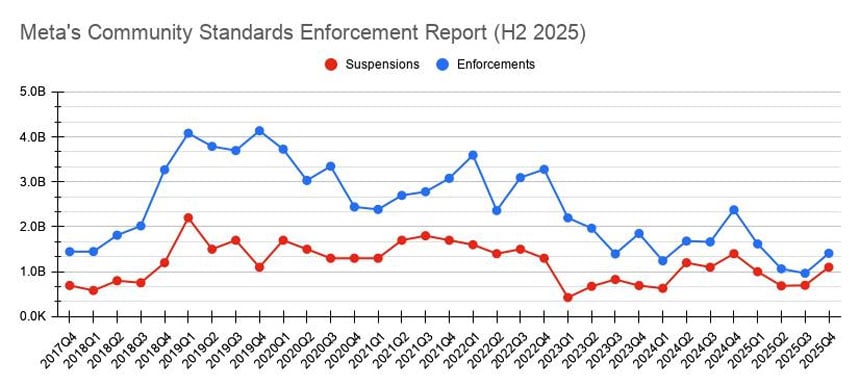
As per Meta’s own data, Meta took 8.55bn enforcement actions on its platforms in 2018 alone. Among those 3.34bn actions were related to account suspensions. By the end of 2022, when ‘Meta Verified’ was introduced, it had already dealt with more than 60bn enforcement actions, including 28B+ account suspension-related actions. That is an average of 1bn enforcement actions in total, including 467 million related to account suspensions. These actions were managed by a mix of Meta employees and third-party contractors, helping the system to run smoothly. There was no imminent need for human support access when it was already available. But a solution around this was built, priced, and ready long before this scale shaped into a crisis and made demand for human support inevitable. That’s your first leg of Pre-Positioning the Remedy.
Beginning in November 2022, Meta initiated what would become a five-wave restructuring that eliminated more than 33,000 positions over four years. The first wave, in November 2022, cut 11,000 employees, 13 per cent of the entire workforce and the largest single reduction in the company's history at that point. The second wave followed in March 2023, removing 10,000 more positions across trust and safety, AI ethics, and platform integrity teams in the same weeks that Zuckerberg was publicly celebrating the Year of Efficiency. A third wave in January 2025 eliminated 3,600 more employees. Two further rounds in 2026, a combined 1,700 in January and March, and 8,000 more in May, cut the integrity team, cybersecurity, and content design divisions while simultaneously cancelling 6,000 open roles Meta had planned to hire. Industry-wide, trust and safety job postings collapsed by 70 per cent compared to 2022.
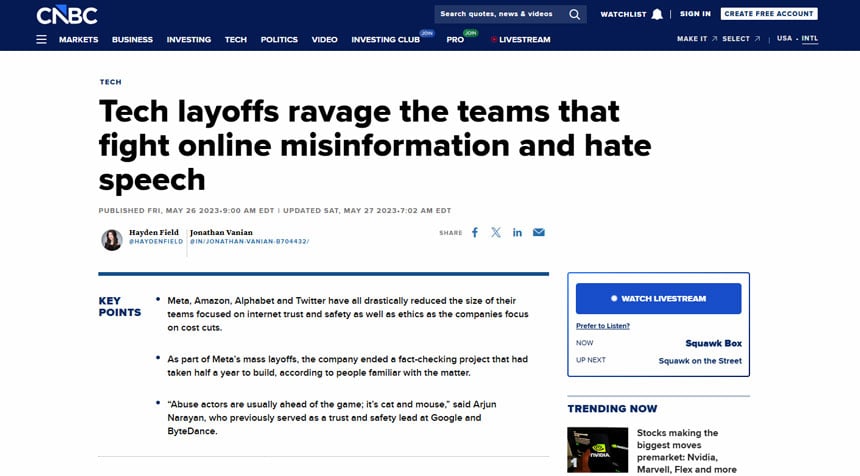
The year 2022 did not just start the process of eating up jobs alone. It also quietly and precisely did another thing in the background. Engineers on Meta's team, combating misinformation, had been ready to launch a key fact-checking tool that had taken six months to build. It was a system that would have allowed credible third-party organisations to flag questionable content before it spread. The efficiency mandate killed it before it launched. And by March 2026, Meta formalised this transition completely by announcing an explicit policy to replace third-party human moderation entirely with AI systems built on its LLaMA (Large Language Model Meta AI) architecture. Meta systematically reduced its reliance on human review systems and increased dependence on automated systems whose limitations were already well understood.
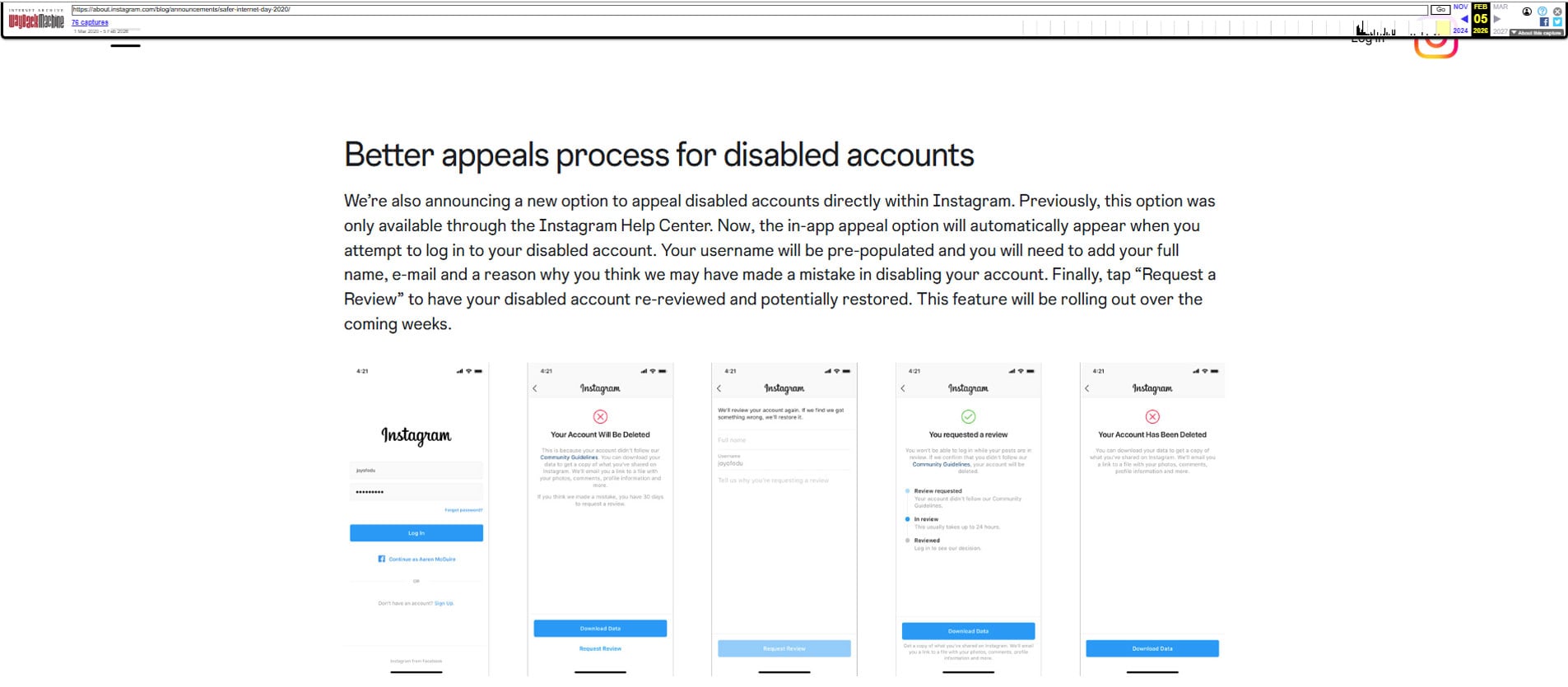
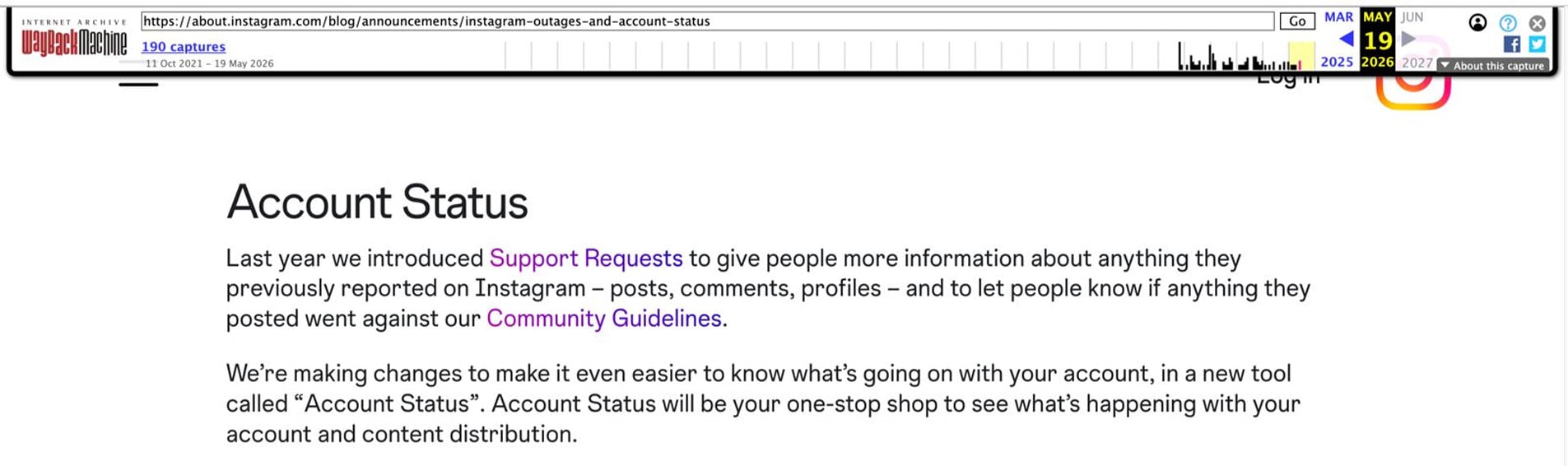
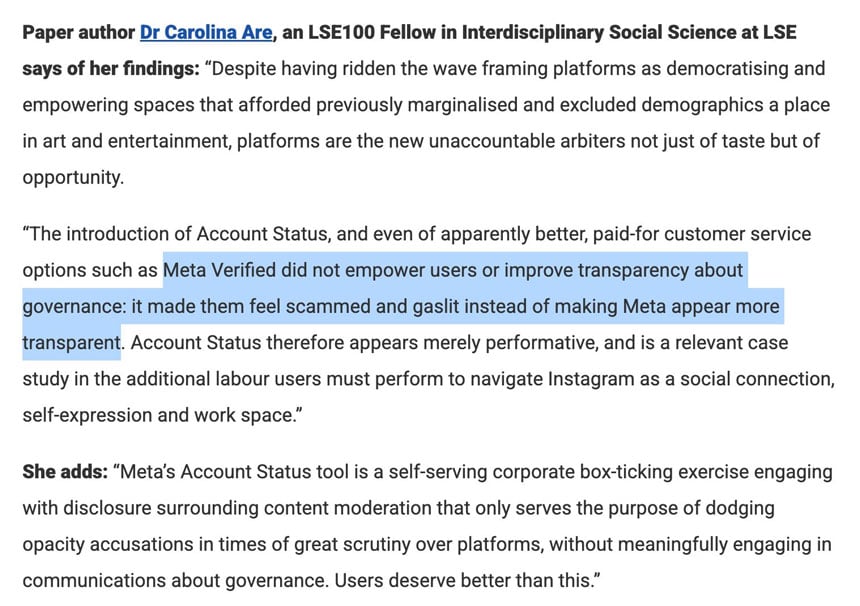
Now wait here for a moment. Let me share another thing from the past that Meta was very proud of. In February 2020, on Safer Internet Day, Instagram publicly announced a redesigned appeals process for disabled accounts. One that included a free-text field for users to explain their situation, a three-stage tracker showing 'Review Requested, In Review, and Reviewed', and a stated 24-hour resolution window. That system was subsequently replaced by an 'Account Status' page, three green checkmarks showing Content, Reach, and Features, all of which seem healthy and clear. A real-time health monitor. Except that the moment your account is suspended, access to that status page is revoked. The monitor goes dark at the precise moment you need it most. In a recent study published by LSE, Instagram’s Account Status tools were criticised as opaque, ineffective and discriminatory by creators. But in all honesty, Meta did not fail to build a humane appeals process. It built one, knew it worked, announced it proudly, and then replaced it with an ‘Account Status’ window that locks shut when the crisis arrives.
The consequence was predictable. In mid-2025, what observers began calling The Great Meta Ban Wave erupted across the platform. Meta deployed automated moderation filters designed to prioritise high-speed detection of severe violations, so it suffered from massive contextual blind spots. The automated system began misclassifying routine family photos, car pictures, artistic images, and small business portfolios as egregious violations.

At platform scale, Meta's publicly stated 87-90% accuracy rate sounds reassuring. It isn't. The consequences were not hypothetical. In Meta's own Q1 2025 Integrity Report, the company acknowledged that in December 2024, the month before the ban wave erupted, one to two out of every ten enforcement actions "may have been mistakes." Meta's subsequent H1 2026 Transparency Report confirmed that false positives more than doubled during a brief period of Q4 2025 "due to a bug." When millions of enforcement actions are taken daily, a 10 to 20 per cent error rate is not a rounding problem. It is a systemic failure measured in tens of millions of wrongful actions. In its own report, Meta acknowledged taking over 1.1 billion fake accounts enforcement actions in Dec 2025 on Facebook alone. By its own error rate admission, there must have been 110 million to 114.3 million accounts wrongfully suspended by this. My daughter is one such data point in that error rate. She didn't feel like a data point to me, and for sure to the audience she carefully built around her content.
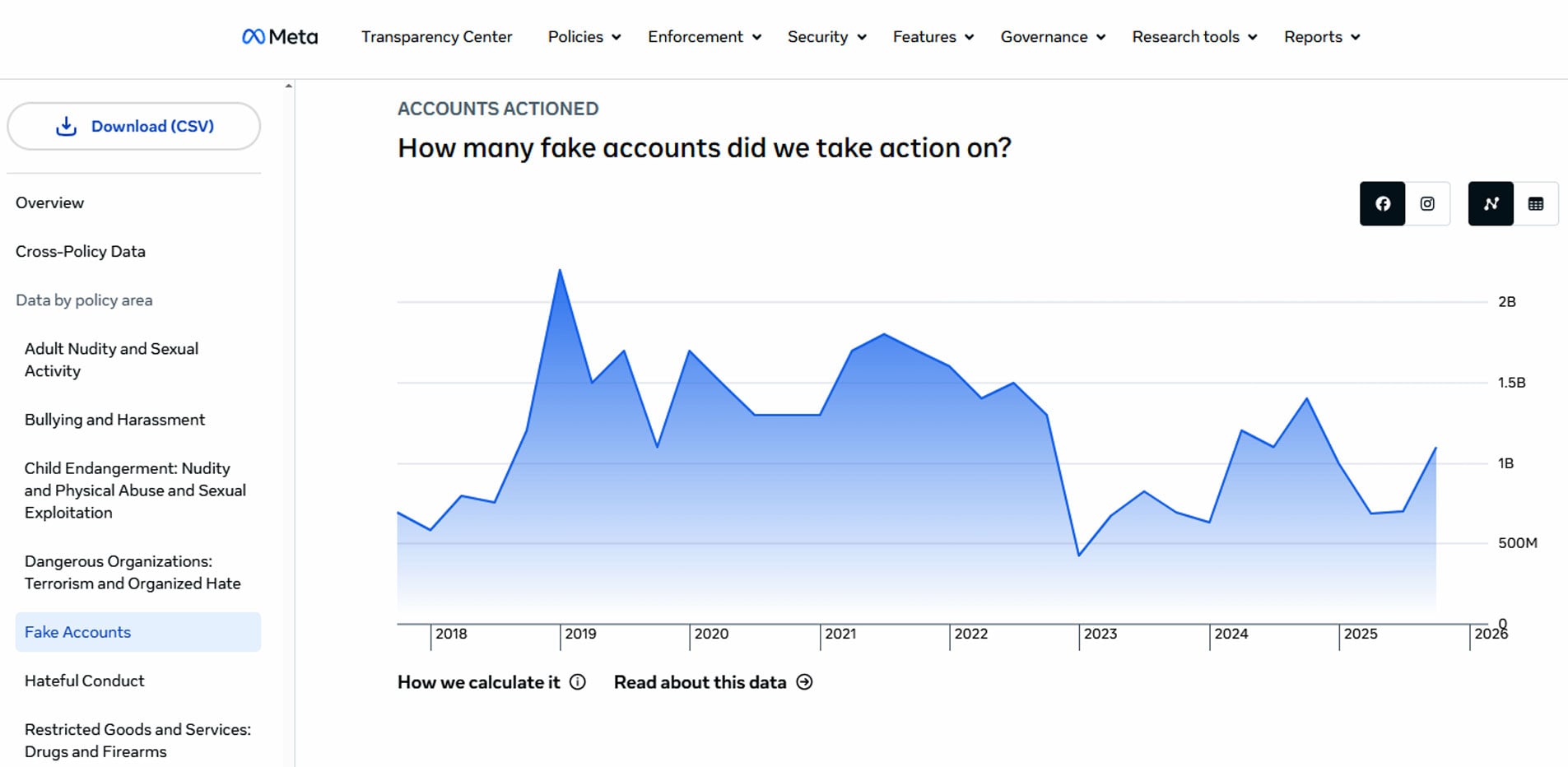
If you watch more closely, you can spot even a greater problem. In 2019, there were 6.5bn removals compared to 2025 with 3.5bn removals. Meta was actually taking fewer actions against fake accounts in 2025 than during its historical peaks. Yet, the public outcry in 2025 was vastly worse. Why? Because under the old human BPO framework, those billions of actions accurately struck fake bots. In 2025, the automated filters began misclassifying authentic human creators at scale, transforming corporate maintenance into visible collateral damage. That is not negligence. From the HRP lens, that is the second leg, Engineering the Environment.
The numbers are staggering but what they cannot fully convey is the specific texture of this kind of loss. When a physical business burns down, the community can see the damage. There is a site, a ruin, evidence. When the algorithm makes a mistake, a digital identity is erased. The loss is both total and invisible. In Pakistan specifically, Instagram has become a primary economic platform for an entire generation of young entrepreneurs, educators, and creative professionals who cannot afford traditional business infrastructure. An account ban is not an administrative inconvenience; it is an economic execution.
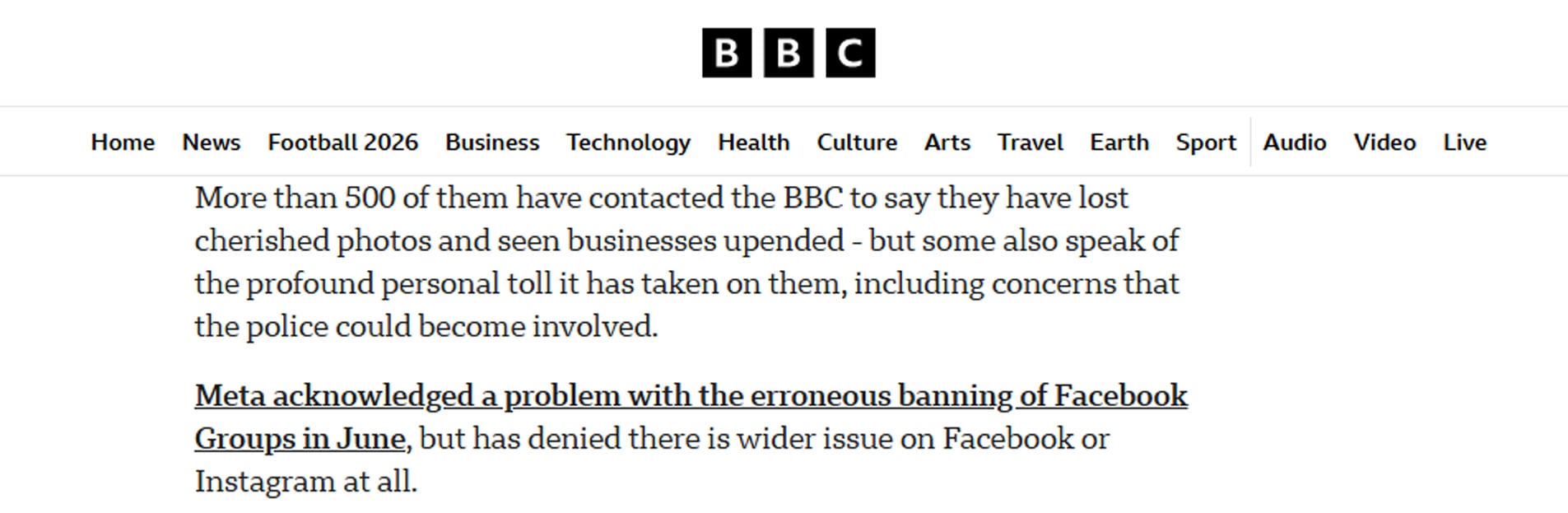
The psychological dimension runs deeper than the financial one. More than 500 users, affected by the 2025 ban, contacted the BBC alone, documenting the terror of being falsely flagged for child exploitation violations, which in itself is a grave misclassification that carries reputational stigma long after the account is restored. Several users contacted by journalists reported fear that law enforcement might become involved. That fear is not irrational. The false accusation was not a technical error notice. It was a moral characterisation, made at algorithmic speed, about who a person is. The stakes are not abstract; they are profound.
There is also a dimension of this harm that is specifically gendered and specifically economic in ways that deserve naming. The creator economy, and Instagram specifically, became one of the few professional environments where women in traditionally underrepresented markets could build income streams, professional identities, and community platforms without getting the institutional gatekeepers involved. They had found in these platforms a rare form of leverage. The ban hit these categories of users disproportionately, not because the algorithm was deliberately targeting them, but because the algorithm was indifferent to the distinction between a decade of honest work and a violation. Indifference, at this scale, functions as discrimination even when it is not designed as such.
This also did not go unnoticed by malicious actors who discovered they could weaponise this. Coordinated mass-reporting campaigns using bot networks deliberately triggered Meta's high-sensitivity filters, forcing instant automated suspensions of targeted profiles, silencing activists when their voice was needed most or crushing business competitors before they could grow.
Among creators who were not banned "yet," the wave produced something harder to document but arguably more corrosive. The baseline understanding that a single algorithmic misfire or a competitor's mass-reporting campaign can instantly erase years of labour has shattered their confidence. Every time they watch another legitimate account disappear, they learn the same lesson that their livelihood exists at the pleasure of an algorithm they cannot inspect, challenge, or meaningfully appeal, and the result is a culture of permanent anxiety. Creators began auditing their own archives, removing photos that seemed algorithmically risky, avoiding content themes that might trigger misclassification. The chilling effect extended to the most ordinary parenting content, family documentation, fitness and health imagery. This is the societal toll that escapes the revenue figures: a gradual narrowing of authentic expression in spaces that were built on the promise of it, produced not by explicit censorship but by the rational fear of an unpredictable automated authority that offers no warning, no explanation, and no reliable recourse. The platform that built its network on real human moments is now incentivising its most committed users to be less human in what they share, so they present a smaller target to a machine that cannot tell the difference between a mother and a predator.
When the AI pulled the trigger, users were funnelled into a broken automated appeal pipeline. The ironic part is that the appeal itself is to be reviewed by the exact same machine-learning systems that issued the initial ban. A self-perpetuating loop, completely isolated from human oversight. The ones who survived the suspension, were ready to act preemptively to secure their livelihood. Driven to desperation, they did what the architecture strongly incentivised them to do: pay for access to a human being who could supposedly save their business or help prevent the suspension.
Yet, for many who paid, the remedy proved to be an illusion. Investigations documented that paying Meta Verified subscribers received little to no help during peak ban waves. Support agents, lacking the authority to override high-level AI decisions, delivered scripted rejections. Users paid money to receive nothing and they ended up paying even more money to get to a real human-led review. The company that had reduced its investment in human-led oversight was now generating substantial revenue from users seeking relief from the consequences of its failures.
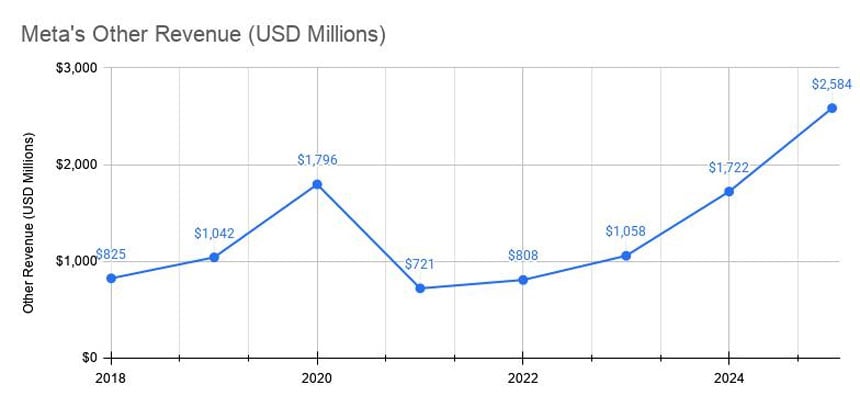
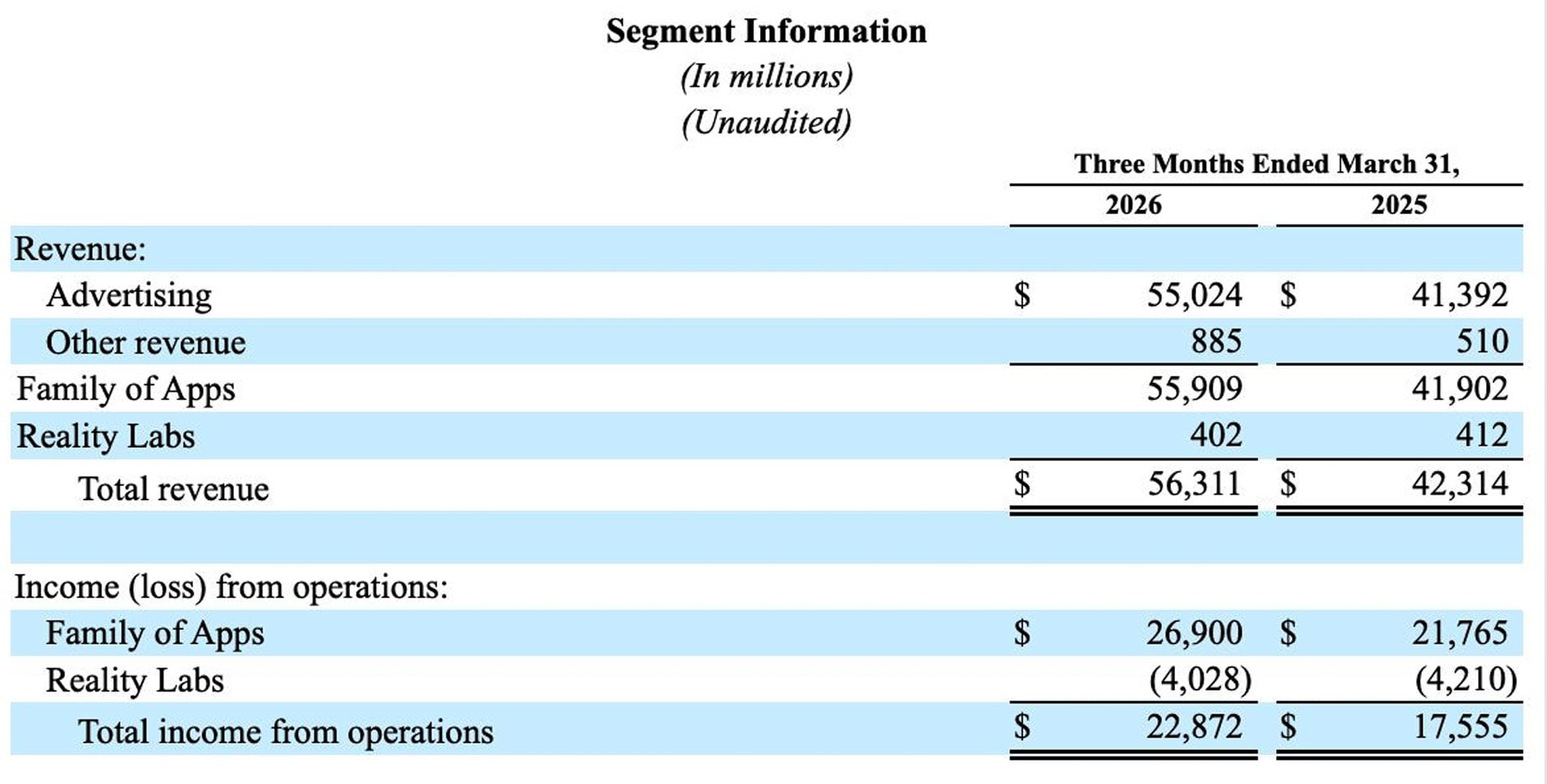
In Q1 2026, Meta reported quarterly revenue of $56.31 billion. It is a 33% year-over-year surge. Its "Other Revenue" segment, which captures Meta Verified subscriptions along with WhatsApp business, experienced a 74% year-over-year explosion, climbing to $885 million for the quarter alone. The suffering was profitable. Whether intended or not, the architecture generated outcomes from which Meta materially benefited. That’s your third leg right there, Monetising the Dependency.
Meta's legal armour is multi-fold. It starts with the Terms of Service having a powerful consent clause. When a user creates a Meta account, they agree to a document that explicitly grants Meta broad and essentially unreviewable discretion to suspend or terminate that account for any reason. Courts have repeatedly upheld these agreements as enforceable contracts, finding that users who accepted the terms cannot subsequently claim a right to continued access that the terms never granted. This means that the most obvious harm, of wrongful account termination, is effectively non-actionable in contract law, because the contract explicitly authorised exactly what Meta did. The user, in legal theory, consented to the possibility of termination when they created the account.
Then comes Section 230 of the Communications Decency Act (47 U.S.C. § 230), which layers a second shield on top of the first. The statute was written in 1996 to encourage early internet platforms to moderate harmful content without fear of liability, on the theory that a platform which tried to police its content shouldn't be penalised for imperfect policing. What it has become, through decades of expansive judicial interpretation, is something far more powerful: a near-complete immunity shield for any content-related decision a platform makes, including wrongful account terminations. The irony is that Meta is now using a law designed to incentivise responsible content moderation as a shield against accountability for irresponsible content moderation.
Meta's insulation does not stop at contracts and statutes. It is also geographic. The company operates a platform used by billions of people across virtually every country on earth, yet meaningful avenues of recourse remain concentrated in a relatively small number of jurisdictions. An Instagram creator in Berlin may benefit from the European Union's Digital Services Act, transparent appeals obligations, regulatory oversight, and the possibility of formal complaints to public authorities. An Instagram creator in Lahore, Nairobi, Dhaka, or Cairo is governed by the exact same algorithms, subjected to the exact same enforcement systems, and contributes value to the exact same corporation, yet often has no equivalent grievance framework, no dedicated regulator, and no practical mechanism for independent review. Meta's influence footprint is global; its accountability footprint is not.
This creates a remarkable governance asymmetry. The platform exercises infrastructure-level power over professional identities, commercial relationships, customer bases, and creative archives across territories where it maintains limited legal obligations beyond its own Terms of Service. The algorithm does not distinguish between users based on geography, but their rights often do. A wrongful suspension affecting a creator in Brussels increasingly exists within a framework of statutory protections. The same suspension affecting a creator in Pakistan may leave that user dependent almost entirely on the internal policies of the platform itself. The result is a world in which access to due process depends less on the nature of the harm and more on the side of the border on which the affected user happens to live. Not only is Meta protected by contracts and laws, but it is also protected by geography itself. So here is the fourth and final leg: Legal and procedural insulation.
Rhetorically, Meta utilises the exact same posture reversal executed by General Motors. Zuckerberg and his executive team consistently frame their aggressive pivot to AI content moderation not as a cost-cutting measure designed to inflate profit margins, but as a compassionate, forward-thinking commitment to public safety and digital health. They position their automated systems as essential tools built to combat severe online harms and shield children at greater speed and scale. By pre-loading this narrative, they ensure that any systemic criticism of their AI false-positive rate or their decimated human teams requires the critic to appear as though they are defending malicious content or downplaying child safety. Criticise the algorithm, and you appear to oppose the protection it claims to offer. So here comes the noble cause. Once again, the institution that weakened prevention presents itself as the provider of relief.
The Private Club Syndrome
Historically, Meta has treated access to its platforms as a revocable privilege, much like entry to a private club, and it is not alone in this approach. This tendency exists, to varying degrees, across most major platforms. Yet for millions of people, these systems function as far more than clubs. They are where businesses operate, communities gather, professionals build reputations, and citizens participate in public discourse. We can call this pattern the Private Club Syndrome: a form of platform governance in which access to digital infrastructure is treated as a revocable privilege rather than a durable right, even when users depend on it for livelihood, identity, and economic activity.
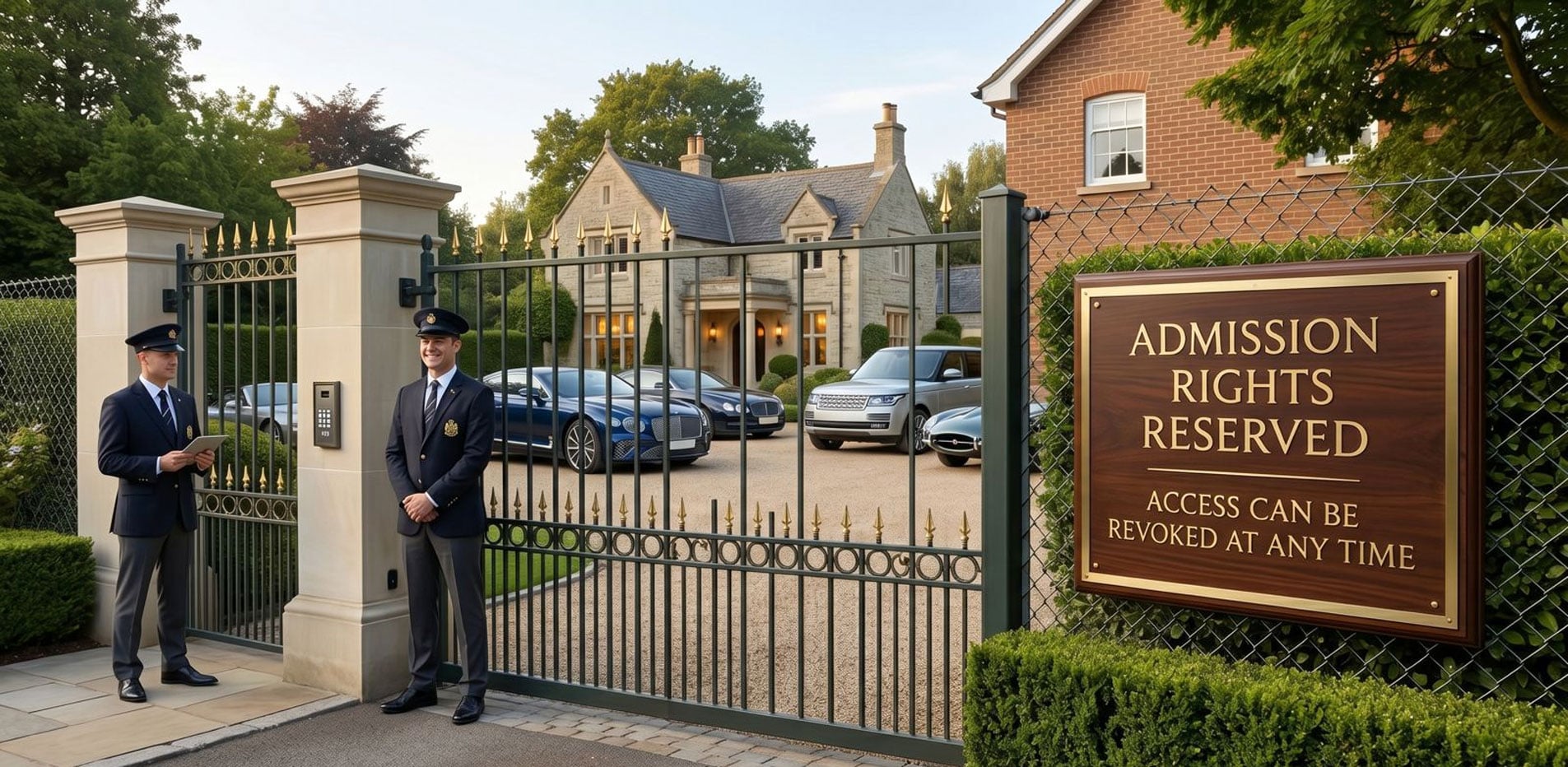
The syndrome emerges when platforms engineer dependency, monetise the consequences of that dependency, and then hide behind private club logic to resist accountability. This layout is precisely what the London School of Economics recently unmasked as 'performative transparency' as a superficial framework that places the entire operational labour burden on the user while shielding the platform from actual due process. The HRP also exposes this very syndrome by mapping how an infrastructure of public reliance is quietly transformed into a legally insulated network of corporate extraction.
There is also a legal and philosophical tradition, still developing but increasingly urgent, that holds that platforms of Instagram's scale and societal centrality have become something more than private companies selling a discretionary service. They have become digital infrastructure. When a platform hosts the professional identity, the commercial relationships, the customer base, and the creative archive of millions of people who have no comparable alternative, the decision to terminate that account is not a consumer product choice. It is an act of economic and social consequence comparable to having your telephone line terminated, your postal address revoked, or your ability to operate a stall in the market withdrawn. And in all those analogies, the law has long recognised that the operator of essential infrastructure owes the person dependent on it a duty of process. Still not a guarantee of continued access, but a guarantee of transparent grounds, proportionate response, and a genuine right to contest the decision.
This is the concept sometimes described as treating platforms as public squares, or as common carriers, or as hybrid utilities. The details matter more than the label. What the framework requires is not that Meta moderate less, or that harmful content be tolerated, or that the algorithm be abolished. It requires that the distinction between a post being removed and an account being suspended be treated as what it actually is: a distinction of severity, not just degree. Removing a post is a content decision. Suspending an account is a verdict on a person. Content decisions may be subject to a mere policy violation, though still be contestable, but verdicts require grounds, specificity, and a clear path to appeal that is not circular. And for accounts that represent commercial livelihoods, where the harm of a wrongful suspension is measured in lost income, lost clients, and lost years of work, they arguably require a threshold of evidence proportionate to that harm before the nuclear option is deployed.
From Sheikhupura to Silicon Valley
The infrastructure for a better model already exists; in fact, it has existed for nearly two decades. It is an alternative philosophy deeply rooted in community trust that addresses this exact problem. Eighteen years ago, I conceived this while sitting in Sheikhupura, a small city near Lahore. I intended to build a self-governing digital community without the unsustainable burden of centralised, manual moderation. The result was stop.pk, one of Pakistan's earliest and largest social networks of its time, which served around 150,000 users at its peak.
It operated on a weighted reputation architecture that reduced central moderation to near zero without sacrificing community health. Every piece of content carried a thumbs-up or thumbs-down option, but the weight of each vote was not equal; it was directly proportional to the earned reputation score of the user casting it. Reputation was earned solely through consistent, trusted participation, making it virtually impossible to game. A hundred fraudulent bot accounts pushing a piece of spam upward could be instantly neutralised by a single thumbs-down from an editor or a trusted community member, because that single vote carried the accumulated weight of verified credibility. Content visibility, posting privileges, and moderation authority all flowed from this trust currency. Users who had earned the system's confidence posted directly, while newer users required initial community validation. Accounts that repeatedly violated community norms saw their posting ability restricted automatically and not by a corporate algorithm optimised for velocity, but by the aggregate judgment of the community itself. Suspension remained a manual act requiring a volunteer moderator to make the final call, but by the time that human decision was needed, the reputation system had already done the diagnostic work. The result was a self-governing ecosystem where moderation felt like oversight rather than cold enforcement.

Stop.pk demonstrated that community trust, when properly weighted and earned, can govern content far more humanely than any algorithm. Meta has billions of dollars and access to the world's finest engineers, yet it still built a moderation system architecturally inferior to what was built from a small room in a remote area. A system where speed supersedes human judgment, where no reputation history protects a decade of honest work from a blind algorithmic misfire, and where the only viable path to human review is a monthly subscription fee.
But if Meta has to stick with its new version of moderation and has those nuclear bots deployed for mass suspensions, this should come with the full disclosure of everything that substantiated the ban and not just a generic policy citation. It needs to have the specific content or the specific rule it allegedly violated. The appeal process itself deserves particular scrutiny to go beyond the binary option, with the provision to submit contextual information and the ability to attach supporting evidence against the violation. Once the appeal is submitted, from that point onward, the user deserves a structured timeline of all of the upcoming stages, like a trackable case, with a reference number, a visible status, and a named stage in the process. The same way a courier tells you where your package is, a platform should tell you where your appeal is. For accounts representing active commercial livelihoods, this tracker should also include an estimated resolution window and a direct escalation pathway if that window is missed.

What Meta’s own data reveal is that the problem is not new. In fact, the scale is also not new. As per Meta’s own data, they have been dealing with such large numbers for as long as a decade or to the extent of the data they have disclosed. But the public outcry never came to the point anywhere; it is near now. The reason is simple. The symptoms are known. Meta had the cure. They publicly announced it, and celebrated it as a safety milestone on Safer Internet Day in Feb 2020. A structured, multi-stage appeal tracker showing users where their case stood at every stage. Sadly, it was replaced with a system that is designed to profit from that same problem. A platform that can serve three billion users personalised content in milliseconds can certainly restore a transparency tool they already built, tested, and celebrated for years if they really want to.
The self-destruct mode
Meta’s ecosystem thrives on authentic creator content, the kind produced by people like my daughter, who built a following by sharing a genuine and difficult personal journey with no monetisation. It is one of the things that makes social media platforms worth using. It is what differentiates them from advertising networks. It is the reason people open the app first thing in the morning. A platform that makes its creators feel like hostages does not lose them all at once. It loses them gradually, and it loses the best ones first: the ones with the largest followings, the most alternatives, the most professional credibility, and the most to lose by staying in a system that treats their life's work as a liability to be managed by a machine.
Data on creator behaviour already reflects this shift. Surveys of creator communities consistently show accelerating platform diversification, with YouTube, TikTok, and decentralised alternatives like Bluesky all reporting growth as creators consciously reduce their dependence on any single platform. Bluesky alone grew from 10 million to over 37 million registered users between September 2024 and mid-2025. The direction of travel is clear, even if no single dataset isolates Meta enforcement events as the sole cause: creators are no longer building exclusively where Meta's audience is. They have started building presence elsewhere, quietly reducing their dependence on a single platform that has demonstrated it cannot be trusted as a permanent home. That diversification of creators is also a slow-motion withdrawal of the content that makes Meta's advertising inventory, its largest revenue pipeline, worth buying.
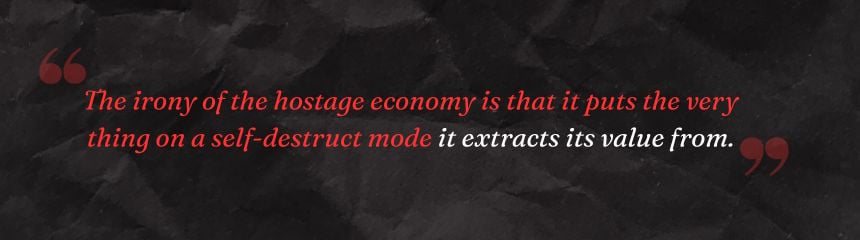
The irony of the hostage economy is that it puts the very thing on a self-destruct mode it extracts its value from. Advertisers pay for access to engaged, authentic audiences. When the creators who built those audiences leave, or self-censor, or simply stop making the kind of content that built their following in the first place, the audiences become less engaged. The platform becomes progressively more homogeneous, more cautious, more commercial, and less interesting. Meta is, in a real sense, monetising its own decay. The $885 million it extracted from the category that includes Verified subscriptions in a single quarter is real revenue; the erosion of authentic creator trust is a slower variable that does not appear on any quarterly earnings call, and it never will. But it will accumulate like compound interest on unpaid debts, and the real cost will soon start to reflect in every financial metric that matters. And platforms, unlike manufacturing companies, have almost no recovery path once they lose the cultural credibility that makes them where people choose to be.
The writing on the wall
The common thread between the streetcar conspiracy, and Meta's ban wave is a design logic that exploits a fundamental feature of legal systems: they are built to assess individual acts, not aggregate systems. Courts ask whether a specific contract was enforceable, whether a specific post violated a guideline. The Holy Rehal Paradox operates at the level of sequence and architecture to expose this insulation, which is precisely what our standard legal systems are structurally ill-equipped to reach. So until regulatory frameworks mandate independent technical audits, transparent error-rate reporting, and legally binding due process, creators and small businesses will remain trapped within a dependency structure that increasingly resembles a hostage economy. All of us are at the mercy of an infrastructure designed to optimise corporate efficiency and generate high-margin revenue from the misery and desperation that the system appears increasingly willing to tolerate. But for how long?
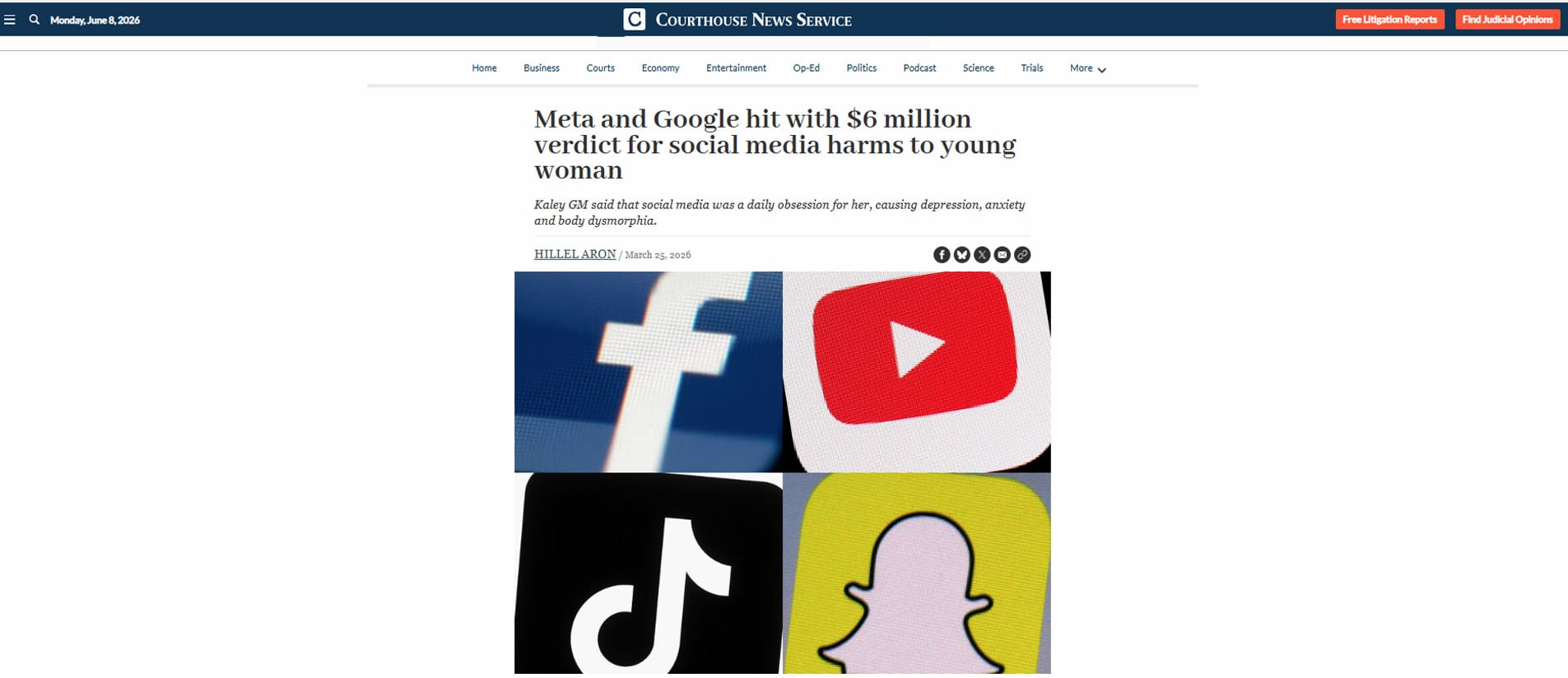
In March 2026, a California jury in the landmark K.G.M. v. Meta trial ordered Meta and Google to pay $3 million in compensatory damages and $3 million in punitive damages (totalling $6 million) for the addictive design of Instagram and YouTube. The verdict shifted the legal framing away from third-party content and toward product liability and negligent design, effectively narrowing the practical reach of Section 230 immunity in algorithmic harm cases. In the weeks that followed, Meta filed an appeal, but the reasoning has already begun to propagate through multiple new class-action filings adopting similar product-liability arguments.
In Europe, the Digital Services Act has already operationalised this direction. In late 2025, the European Commission issued its first binding enforcement action under the DSA against X over deceptive design. Civil society organisations, including the European Consumer Organisation (BEUC), have simultaneously used DSA complaint pathways to coordinate cases on behalf of wrongfully suspended creators, accelerating pressure on enforcement systems following what has been widely referred to as the 2025 Meta ban wave. So, things are finally changing. The veil is being removed. That is the writing on the wall.
However, the central question here is not whether the users with terms of service will ever be recognised as stakeholders of an infrastructure but it is whether a corporation should be permitted to profit from a set of harms it has become increasingly unwilling to prevent.
A structural indictment
As I finalise this piece, I must add a postscript that arrived before I could publish it. After nearly two weeks of waiting and even purchasing a Meta Verified subscription in the process, my daughter's original accounts remained suspended. She created a new account with a new email. She uploaded her first reel. An honest, direct message telling her audience what had happened and that, despite being hurt, she was determined to keep creating. Just about 24 hours later, 25,000+ views, 800+ followers, over 200 comments, and hundreds of personal messages of support, her new account got suspended again. Her audience had found her back. The community she built over three years had shown up for her again. But Meta's algorithm had to show up again as well. It probably read that organic surge on a new account as suspicious activity and decided to play ‘Inception’, pushing her digital identity into the Insta limbo to the nth level.
Meta’s weapons of mass suspension with all of its multi-billiondollar resources failed for yet another time to distinguish between a genuine creator and a bad actor, just as weapons of mass destruction do not distinguish between combatants and civilians. At this point, even if her accounts were restored tomorrow, something harder to restore has already been damaged. And that is her confidence that the platform is worth trusting. That is ultimately a greater loss for Meta than for her. As far as I am concerned, being a father, I am still trying to pull every thread I can find, trying to reach a human review for her accounts before the automated system closes over the case entirely. Most people do not have the resources or means to do this just to fix a machine's blind mistake. And in a civilised society, they shouldn’t need to. The fact that a legitimate and fully functional digital presence can be pushed into a digital void, even temporarily, is not a minor glitch in a complex system. It is a structural indictment.
Touseef Ikram has spent more than two decades building digital communities, media products, and technology initiatives. His work explores misinformation, platform governance, community moderation, and the ways large-scale digital systems shape public discourse and human behaviour. He can be reached at [email protected] or @chodhry on X
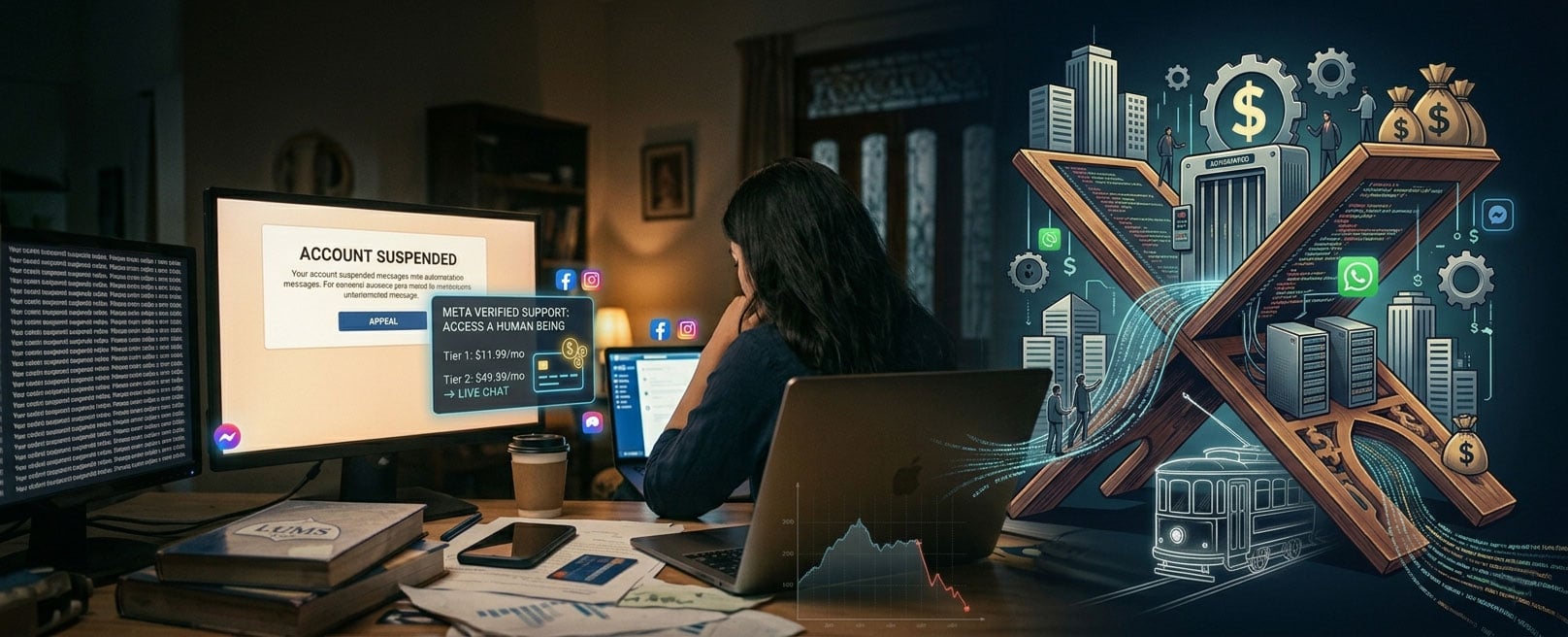
The banner image is AI-generated.