Govt reduces petrol price by Rs4 per litre; diesel kept unchanged
New fuel prices take effect from June 6, says Petroleum Division in notification
Published June 05, 2026
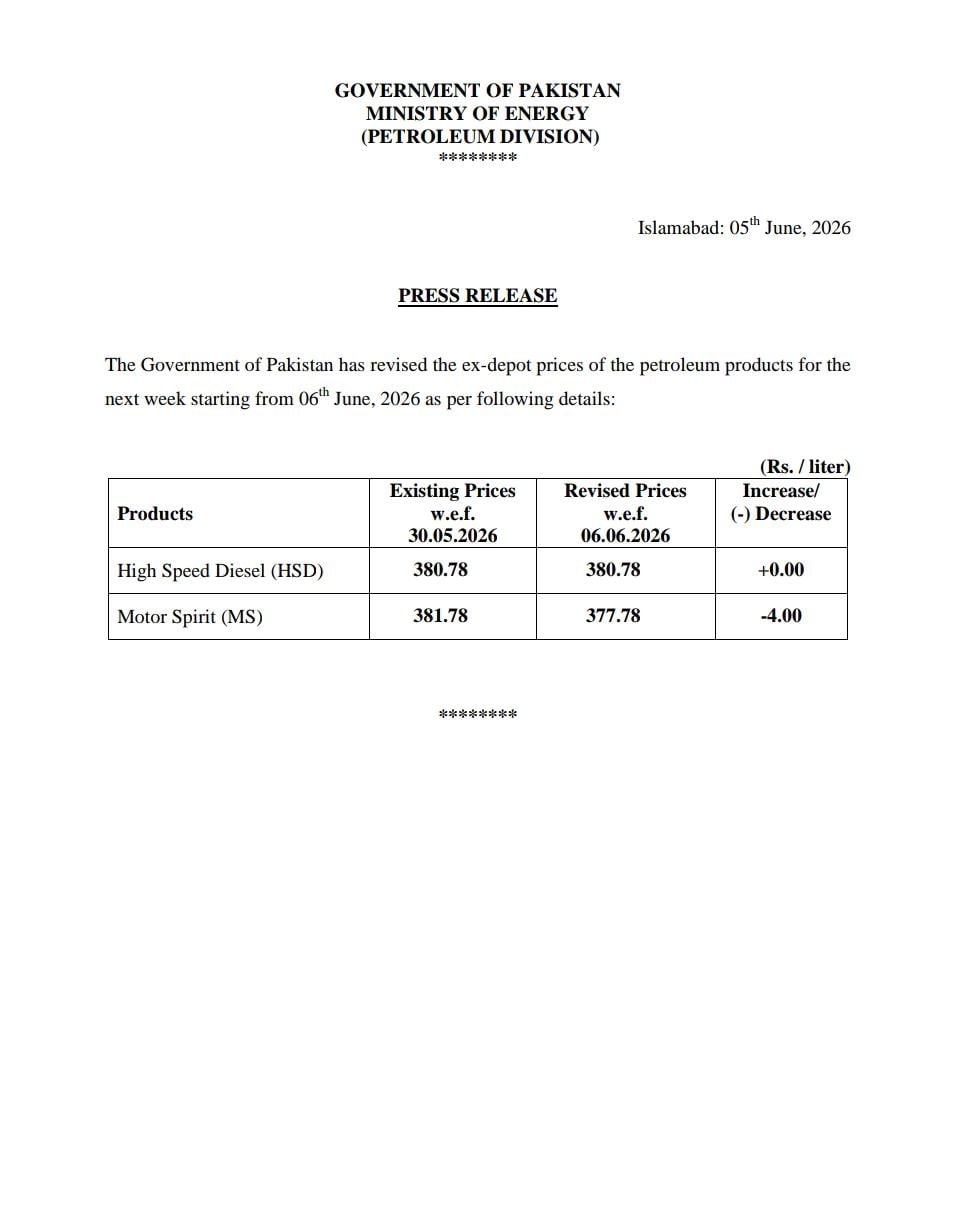
- New petrol price fixed at Rs377.78 per litre.
- Diesel price kept unchanged at Rs380.78.
- New rates to come into effect starting June 6.
The federal government on Friday slashed petrol price by Rs4 per litre, while keeping the price of high-speed diesel (HSD) unchanged.
In a notification issued on Friday, the Petroleum Division said that the new fuel rates will come into effect from June 6 for the next week.
Following the reduction, the price of petrol has been lowered to Rs377.78 per litre from Rs381.78. The price of high-speed diesel, however, remains unchanged at Rs380.78 per litre.
Kerosene oil prices have also been increased by Rs8.70 per litre. Following the increase, the new price of kerosene has been set at Rs280.70 per litre.
The government has been reviewing petroleum prices on a weekly basis since the US-Israeli conflict with Iran on February 28.
The conflict also triggered a global fuel crunch after the closure of the Strait of Hormuz, a key route through which around one-fifth of the world's oil and gas supplies pass during peacetime.
Last week, the government cut the prices of petrol and diesel by Rs22 per litre each, describing the reduction as a gift to the nation on the third day of Eid ul Adha.
In notification issued on May 29, the Petroleum Division lowered the price of petrol to Rs381.78 from Rs403.78, while the high-speed diesel price was cut to Rs380.78 from Rs402.78 per litre.
The same day, the Oil and Gas Regulatory Authority reduced the price of kerosene oil by Rs41.44 per litre, fixing the rate at Rs272 per litre, compared to the earlier rate of Rs313.44 per litre.
Petrol is mainly used by commuters in small vehicles, rickshaws and two-wheelers. Higher fuel prices significantly impact the budgets of middle and lower-middle-class households, who rely on petrol for daily travel.
On the other hand, a significant portion of the transport sector relies on high-speed diesel. Its price is considered inflationary since it is predominantly used in heavy goods transport vehicles, trucks, buses, trains, and agricultural machinery such as tractors, tube wells, and threshers.
Global oil prices slipped on Friday after Oman said operations at Mina al Fahal port were proceeding normally following a Reuters report that oil loadings had been suspended after an explosion.
Brent crude futures fell 1.2% to $93.84 a barrel and US crude dipped 1.9% to $91.22 per barrel, with both contracts set to post their first weekly gains in three weeks, according to report by Reuters.