


The 'freelancer' who cannot refuse
A pre-budget dispatch from the gig economy’s bottom rung




 Updated Wednesday Jun 10 2026
As the country braces for the budget, Pakistan’s growing army of app-based delivery riders faces a calculation few policymakers appear to be making: the fiscal plan contains nothing for them, and they already cannot afford to break even.
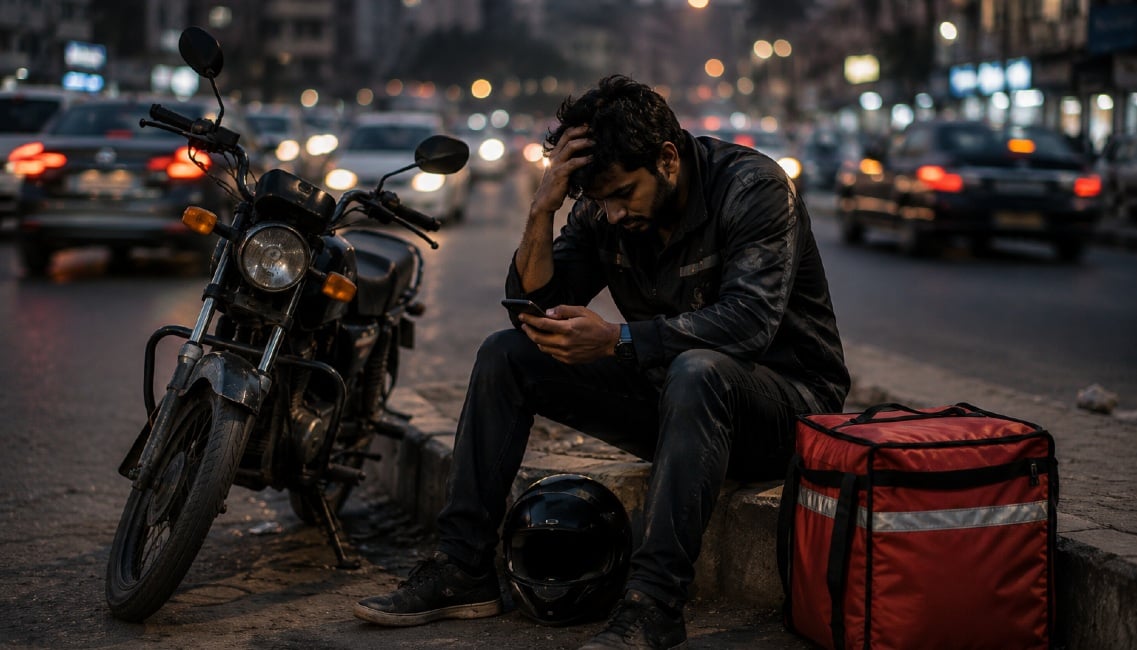
Outside an online app’s mart in Karachi’s Gulistan-e-Johar, a group of riders has gathered, eyes on their phones. Usman* speaks from experience. The young, slight-framed rider has worked here for three years now. “People tend to spend less because of inflation that follows the budget,” he says, intensely, clutching his cellphone with both hands as the screen opens on the interface where the platform assigns him work. “I make 20 to 25 deliveries every day.”
A business graduate, he earns Rs70,000 to Rs80,000 gross each month but works 12 to 14 hours a day to do it, navigating Karachi’s broken roads on a 70cc motorcycle and a delivery box. Fuel, phone charges, vehicle and its maintenance fall on him, not the platform. He takes home Rs50,000 to Rs60,000.
“Because I am a freelancer,” he says, making his point deliberately, drawing the attention of his colleagues, who have drifted closer to listen. The word hangs in the air, chosen, it seems, because no other word exists in their vocabulary for what he is.
Before becoming a rider, Usman worked at an outsourcing company near FTC on Sharea Faisal as a customer service agent for a telecom network. His contract was third-party. “There are not enough good opportunities in the current job market,” he says, glancing at his phone.
“Not complaining, but this is hard work,” says Habib*, a heavyset, middle-aged rider, a Pashto speaker by his accent, settling himself on the boundary wall outside the mart as he speaks. It is evening. The worst of the early June heat has passed, and a cool breeze has come.
“In this heat, roaming the city’s roads through dust gusts. It’s not easy. If we get sick, we cover it ourselves. There is no health insurance — only accident cover, and only if the rider is registered with the platform.”
In this heat, roaming the city’s roads through dust gusts. It’s not easy. If we get sick, we cover it ourselves.
— Habib, a ride who works for a private company
He pauses. It is an alleged common practice: a registered rider sub-contracts his slot to someone else, leaving the substitute with no cover at all. This, however, is officially not allowed.
Nineteen-year-old Zain*, who recently passed his matriculation exam, said the platform did not adjust delivery rates when petrol prices spiked. He blamed the spike on the US attack on Iran and the closure of the Strait of Hormuz. “Our per-delivery rate stayed the same. We covered the extra cost ourselves.”
The riders said the platform charges customers at least Rs100 per delivery. What reaches the rider is less — how much less, none of them could say. Zain didn’t explain the gap in words. He held up his phone. The screen showed what the last delivery had earned him: Rs47.
Neither he nor his colleagues could explain the formula. Priority delivery costs customers even more, but riders see none of that premium. “The benefit goes to the platform,” one rider said. In priority orders, the rider is shown the first address, then the next, with no additional pay.
The physical conditions carry their own costs. Pakistani law requires employers to provide drinking water and bathroom facilities, but these riders claim to have neither. Water is available only at the mart; everywhere else, they are on roads lined with restaurants that will not let them in. Street crime adds another layer. One rider said he and two colleagues were robbed at gunpoint outside this same mart on the eve of Eid. The snatchers took his Rs50,000 cellphone and Rs10,000 in cash. The platform covers cellphone losses up to Rs15,000, he said — but only after a claims process requiring a police report and several other documents, which another rider said takes at least three months.
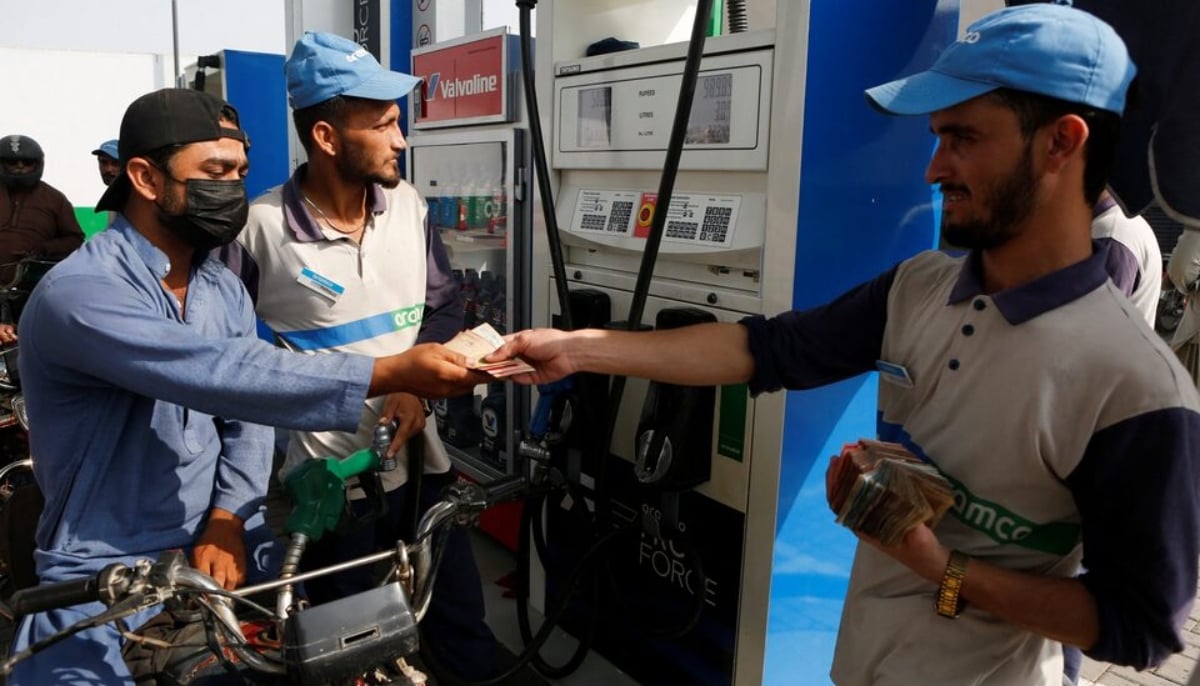
When asked what the riders wanted from the upcoming budget, nearly all said the same: higher commission and a lower daily target. The riders said the platform sets a target of 45 deliveries a day to earn its highest incentive, a number they called impossible to hit without destroying themselves. “To reach that, you would have to work 18 to 20 hours a day,” one said. “That is tantamount to breaking oneself.” Nobody pushed back.
“The budget may benefit [govt] salaried people. Not us,” they said.
The law does not recognise riders as employees. They are classified as independent contractors, or, in Usman’s words, “freelancers”, and so the platform bears no legal responsibility for them.
“If you speak, your ID will be blocked, and you will not be able to work," one rider says. "We cannot refuse orders. On the third refusal, we will be put off.”
A freelancer, in other words, who cannot speak, cannot refuse, and can be switched off.
That contradiction does not surprise Zehra Khan, general secretary of the Home-Based Women Workers Federation, who has spent years organising workers in the informal economy. “Their employer is clearly there,” she says. “This is just a game of definition. They put workers in the freelancer or independent contractor category to relieve themselves of the obligations that Pakistani labour law provides.” Neither the government nor political parties, she adds, speak to workers before the budget; they meet the employers. “This explains where their inclination is.”
Neither the government nor political parties speak to workers before the budget.
— Zehra Khan, general secretary of the Home-Based Women Workers Federation
The omission, in other words, appears not to be an accident. Dr Kaiser Bengali, an economist who has advised governments on budget and planning, frames the wider architecture. “Pakistan is run by a dozen-odd vested interests — sugar, paper, fertiliser, automobiles, textiles, land and property. All else are outside, scrambling for crumbs.”
The riders scrambling for crumbs apparently fall into a hole in the law, or rather, the absence of one. According to Sindh Employees Social Security Institution (SESSI) Director Waseem Jamal, the same mart in Gulistan-e-Johar is registered with the institution, but the platform refused to pay contributions for the riders, arguing they were not employees. Jamal acknowledged the gap but said labour authorities had used the courts as a workaround. “Before 2005, a courier company also did not recognise their riders as employees but we argued in court that they were, because they followed the company’s directions,” he said, adding that his department was working to bring gig workers into the social security net through existing legal avenues while explicit legislation remained absent.
In August 2021, the Social Security Act was amended to register self-employed workers. It made little difference. Employers pay Rs2,400 per month in contributions on behalf of employees; self-employed workers must pay Rs1,500 themselves. No gig workers have registered, apparently because of that burden.
Dr Asim Bashir Khan, a public-finance economist who has served on Sindh’s Provincial Finance Commission, argues the money to close the gap exists if there is the will to do so. There is nothing in the budget for informal gig workers, he said, while the formal workforce technically can get relief through the minimum wage. Unregistered and without any capacity-building support, these workers save their employers from investing in them at all.
“Of course, if they learn some technical skill, why would they work as a rider then?!” he said, pointedly. The Sindh government, he suggested, could fill the SESSI contribution gap from its endowment fund, which stands at Rs59 to Rs60 billion.
“It’s only a matter of political will.” He raised the Benazir Income Support Programme as another vehicle, but questioned why its reach remained so narrow. “Why only women? Why can’t workers like these be included?” Riders could also be reached through fuel subsidies, income support and government-funded health and education — rights the ‘freelancer’ status denies them entirely. “But the IMF conditions are making it difficult,” Zehra added.
Abbas Haider, director of the Pakistan Institute of Labour Education and Research, welcomed efforts to extend social protection to platform workers as “both necessary and timely,” but warned that expanding coverage would mean little without fixing the institutions meant to deliver it. “In Sindh alone, around 800,000 workers are registered with SESSI, yet only a fraction are able to access the full range of benefits,” he said. Expansion, he argued, must come with “investments in institutional reform, improved governance, adequate financing and stronger service delivery mechanisms.”
A more inclusive social protection system will be most effective when workers themselves have meaningful avenues to participate in shaping and monitoring the policies that affect their lives.
— Abbas Haider, director of the Pakistan Institute of Labour Education and Research
Protection alone, Haider added, is not enough without the power to demand it. Pakistan’s Constitution guarantees the right to association, yet many workers still cannot exercise it; unionisation, by International Labour Organisation (ILO) estimates, remains at around. “A more inclusive social protection system will be most effective when workers themselves have meaningful avenues to participate in shaping and monitoring the policies that affect their lives,” he said.
And the law on paper, Zehra warns, is no guide to the law in practice. She points to the Home Based Women Workers Act, hailed as a milestone when it passed, and never implemented. The rot runs to the ground level, she said.
“For example: A food and bakery chain is immune to labour inspection and the implementation of labour laws, because the officers get free food from it.” She chuckled helplessly.
The Sindh Labour Code, now being debated, will not fix that — it will deepen it, she argues.
“It explicitly provides cover to third-party employment. At a time when the definitions of labour, employer and workplace need to be streamlined, this code is bent on making it more complicated, depriving the workforce of their hard-won rights.” The state, she said, is never neutral.
It sides with the capital, and in the case of these riders, it showed its hand with the FIRs. “This is, nonetheless, a modern slavery mechanism.”
Usman may ride into the budget on the phone that owns his hours, still calling himself a freelancer because no one has given him a truer word. Everybody works for somebody. The problem is who owns that they work for them.
* Names have been changed to protect identity.
Zubair Ashraf is a journalist. He posts on X @zubairrashraf
Disclaimer: The viewpoints expressed in this piece are the writer's own and don't necessarily reflect Geo.tv's editorial policy.
The banner image is AI-generated.