


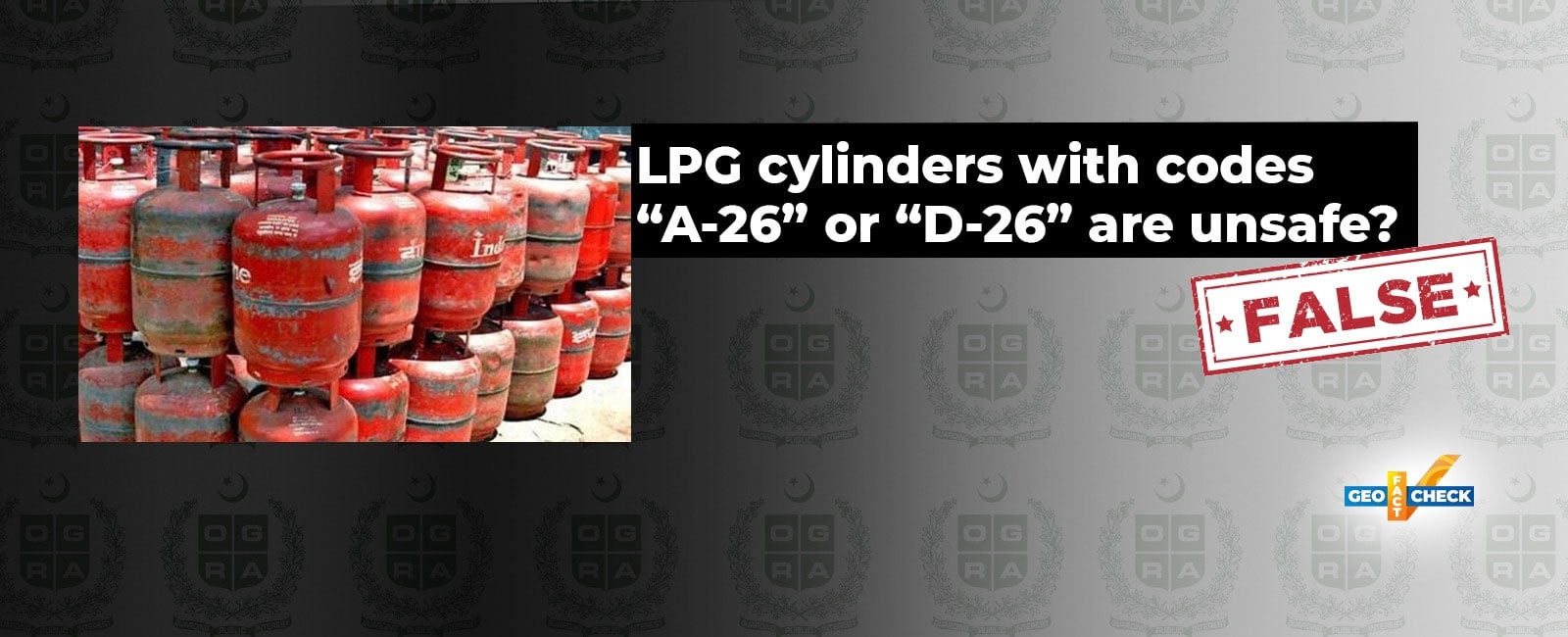
Fact-check: OGRA refutes viral claim about LPG cylinder expiry dates
An official and expert say that cylinders manufactured without OGRA approval may not meet safety standards and could pose serious risks to users





 Updated Monday Jun 08 2026
A post circulating on social media claims that codes such as “A-26” or “D-26” printed on household gas cylinders indicate an expiry date in 2026 and warns that such cylinders are expired, unsafe to use, and at risk of exploding.
The claim is inaccurate.
Claim
On May 31, an Instagram account shared a graphic carrying the text: “If you see a code like A-26 or D-26 written on a household gas cylinder, it means the cylinder will expire in a specific month of the year 2026. Keeping an expired cylinder can also cause a major explosion at any time.”
The post further claims that many people only pay attention to refilling their gas cylinders and fail to check the cylinder body or code, which it describes as the most important safety indicator.
Fact
Codes such as A-26 or D-26 are not embossed on liquid petroleum gas (LPG) cylinders in Pakistan. Instead, the safety and validity of LPG cylinders are monitored through manufacturing information and periodic testing requirements.
Uzma Ashfaq, the joint executive director of corporate and media affairs at the state-run Oil and Gas Regulatory Authority (OGRA), told Geo Fact Check via email that markings such as A-26 or D-26 are not used on LPG cylinders in Pakistan.
“However, LPG cylinders are embossed with details such as the date of manufacture, manufacturer's name, next test date, company name, serial number, batch number, weight, and water capacity,” she said.
Ashfaq added that LPG cylinders manufactured in Pakistan follow internationally recognised standards, including DOT 4B, DOT 4BW and DOT 4BA specifications, which are considered safe for use.
She said certified cylinders do not pose an explosion risk when used properly because they are manufactured according to international standards and undergo periodic testing.
While Irfan Khokhar, chairman of the LPG Distributors Association, also confirmed to Geo Fact Check by phone that all OGRA-approved LPG cylinder manufacturers comply with international standards.
“Their cylinders are produced through more than 20 processes and meet international standards,” he said. “They do not suddenly explode under normal conditions and are designed for long-term use. However, they must be refurbished and tested periodically, including after five years.”
Khokhar added that cylinders manufactured without OGRA approval may not meet safety standards and could pose serious risks to users.
Verdict: LPG cylinder markings such as A-26 or D-26 are not used in Pakistan to indicate an expiry date, nor do they signify that a cylinder becomes unsafe in 2026.
Follow us on @GeoFactCheck on X (Twitter) and @geo_factcheck on Instagram. If our readers detect any errors, we encourage them to contact us at [email protected]