Russia sends American and two cosmonauts to space station
Astronauts will spend about eight months at ISS as part of the station's 75th crew rotation
Published July 14, 2026
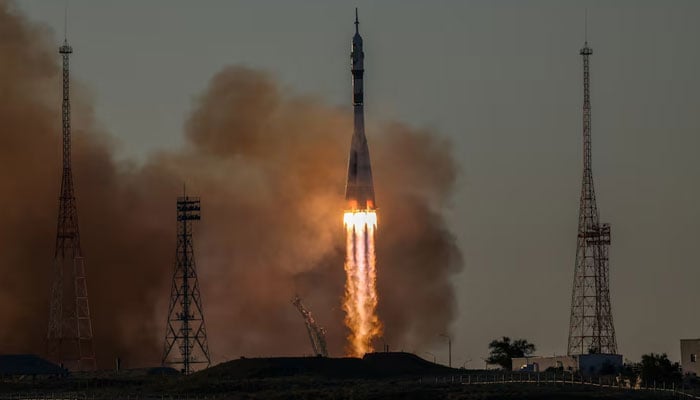
WASHINGTON: Russia sent two cosmonauts and an American astronaut to the International Space Station on Tuesday from Kazakhstan, resuming crewed flights from a recently repaired launchpad with a rare joint attendance by the heads of NASA and Russia's space agency.
US astronaut Anil Menon and cosmonauts Pyotr Dubrov and Anna Kikina lifted off from the Baikonur Cosmodrome aboard Russia's Soyuz MS-29 spacecraft at 10:47am EDT (1447 GMT), bound for the ISS, where they will spend about eight months as the station's 75th rotation crew.
The crew arrived at the football field-sized space laboratory just over three hours later as they orbited over the Mediterranean Sea, joining three Americans, two Europeans and two Russians already aboard.
NASA Administrator Jared Isaacman traveled to Baikonur to meet Roscosmos director Dmitry Bakanov and watch the launch, the first visit to Russia's launchpad by a NASA chief since 2018. Tensions over the Russia-Ukraine war had largely prevented Bill Nelson, former President Joe Biden's NASA chief, from such visits.
The Expedition 75 mission was the first spaceflight for Menon, 49. Isaacman, a billionaire private astronaut, flew on a SpaceX capsule in 2024 with Menon's wife, SpaceX engineer Anna Menon, and two others in the Polaris Dawn mission, a private spacewalking voyage funded by Isaacman.
"Anil has spent his entire life preparing for this moment," Isaacman wrote on X after the launch. "He is a scholar, military officer, physician, pilot, husband, father and will undoubtedly become one of the great American astronauts."
The mission is the second spaceflight for both Dubrov, 48, and Kikina, 41, the only woman among Russia's 23 active cosmonauts. Kikina was the first Russian to fly on SpaceX's Crew Dragon to the space station in October 2022, a mission that renewed joint US-Russian astronaut flights.
ISS cooperation continues
Cooperation on the 27-year-old ISS between NASA and Russia's space agency Roscosmos has survived years of tensions between the two countries, including Russia's war in Ukraine, primarily out of technical necessity. US solar panels power the entirety of the ISS while Russian thrusters help keep the station in orbit.
Both countries also see the ISS as key to maintaining their prized human spaceflight programs, despite the growing militarization of Earth's orbit that has created anotherflashpoint between Washington and Moscow.
Air leaks aboard the aging ISS have tested relations between NASA and Roscosmos, with the two agencies at times disagreeing over how to identify and fix the source of leaks.
Last month NASA ordered its astronauts to prepare for a possible evacuation during a dispute with Russia over how to repair one such air leak. A cosmonaut onboard was planning to use a saw to access a compartment believed to be housing the source of the leak, raising concern among NASA officials.
The health of the space station, which is poised for retirement soon after 2030, was likely on the agenda in Isaacman's talks with Russian space officials. A video posted on Telegram by Roscosmos shows Isaacman talking with Bakanov, flanked by senior Roscosmos officials.
NASA and Roscosmos did not immediately respond to questions about the meeting.
Bakanov visited Florida last summer to watch a joint US-Russian astronaut launch on a SpaceX capsule. He met with then-acting NASA chief Sean Duffy to discuss the ISS and cooperation on the moon, though no agreements or new projects came out of the meeting.
The last time Russia launched a crew out of Baikonur Cosmodrome's Site 31, the rocket badly damaged the historic launchpad, knocking Moscow's only crew-capable launch site out of service amid months of repairs. Russia resumed launches from the pad in March with an uncrewed ISS cargo mission.