Pakistan busts India's IWT narrative, warns against weaponising transboundary rivers
Ambassador Sheikh says India distorting IWT, calls unilateral suspension unlawful, urges New Delhi to rescind its measures
Published August 29, 2026
- Sheikh says India distorting treaty's history, structure, purpose.
- Pakistan's US envoy says IWT remains “valid, operative, binding”.
- Ambassador says treaty has no provision for unilateral suspension.
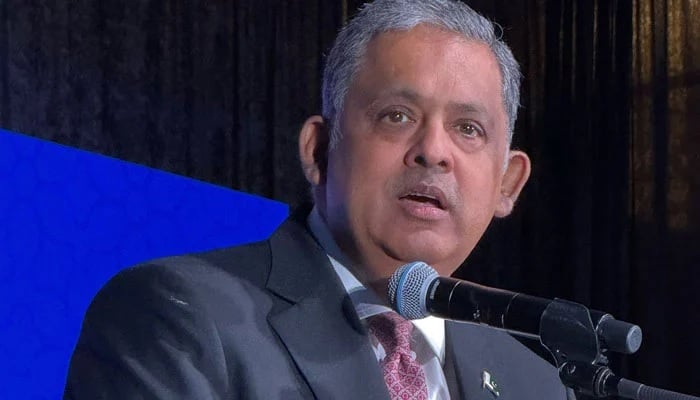
Pakistan's Ambassador to the United States, Rizwan Saeed Sheikh, has rejected India's portrayal of the Indus Waters Treaty (IWT) as an asymmetric arrangement, accusing New Delhi of distorting the agreement's history, structure, and purpose in an opinion piece published in Newsweek.
“India has been advancing this narrative with increasing frequency since its unlawful pronouncement in April 2025 to hold the Treaty ‘in abeyance.’ It appears intended to retrospectively justify a unilateral action that finds no basis either in the Treaty itself or in international law,” Sheikh wrote in the article.
“The IWT is a binding international agreement concluded on September 19, 1960 after decade-long negotiations facilitated by the World Bank. It was neither an act of Indian generosity nor a concession to Pakistan.”
“To describe this arrangement as inherently unfair is to disregard circumstances in which the Treaty was negotiated and the carefully calibrated balance embodied in its provisions,” he said.
Sheikh rejected India's claims that Pakistan had obstructed Indian hydropower development. “Equally misplaced is the assertion that Pakistan has sought to impede India’s hydropower development.”
“Pakistan’s recourse to dispute-settlement mechanisms under Article IX is not obstruction but the exercise of rights expressly afforded by the Treaty,” the envoy added.
“India cannot reasonably claim the benefit of the Treaty's provisions permitting hydropower development while dismissing the technical limitations and dispute-resolution procedures that form part of the same negotiated framework.”
Sheikh said India's unilateral decision to place the treaty in abeyance could not change its legal status.
“The IWT contains no provision allowing either party unilaterally to suspend it, place it ‘in abeyance,’ or terminate it.”
“India's unilateral announcement of April 2025 therefore cannot alter the Treaty's legal status or extinguish the rights and obligations arising under it. The Treaty remains valid, operative and binding,” Sheikh opined.
He also criticised India's use of political and security disputes to justify its position.
“Any unrelated political or security allegations cannot absolve a state of its obligations under a binding international agreement.”
“Baseless allegations of terrorism or other bilateral disputes cannot create a unilateral right to suspend, disregard or rewrite the IWT,” he said.
Sheikh warned that undermining the treaty could have wider regional consequences.
“Undermining a time-tested water treaty, with a malicious aim of weaponising transboundary rivers, would not only reduce certainty and predictability, but also pose a serious threat to peace and stability in an already volatile region.”
Pakistan, he said, remained committed to the agreement.
“Pakistan remains committed to the faithful implementation of the IWT in its letter and spirit. India should rescind its unilateral measures, return to full compliance with its Treaty obligations, and engage through the institutional and dispute-resolution mechanisms established under the Treaty,” Ambassador Sheikh stressed.