Houthis harden Red Sea foothold, Riyadh promises retaliation, Egypt backs call
Mohammed bin Salman and President Sisi call for freedom, security of navigation in Red Sea and Bab el-Mandab
Published September 16, 2026
- Riyadh vows firm action after repeated Houthi missile, drone attacks.
- Houthis seize Yemen's Red Sea coast and Bab el-Mandeb last week.
- Saudi-led coalition says Houthi attacks wounded 13 in three areas.
Saudi Arabia and Egypt's leaders called Tuesday for free navigation in the Red Sea, after Riyadh vowed a firm response to attacks by Yemen's Houthis, who now control the southern entrance to the key waterway.
The Houthis have been engaged in renewed fighting with Saudi-backed Yemeni government forces since the country's civil war reignited in July, when the group also declared a maritime blockade on Riyadh and began targeting its ships in the Red Sea.
In a lightning offensive last week, they seized control of the entirety of Yemen's Red Sea coast and the Bab el-Mandeb Strait, which has become vital to Saudi crude exports as the wider Middle East war chokes the Strait of Hormuz in the Gulf.
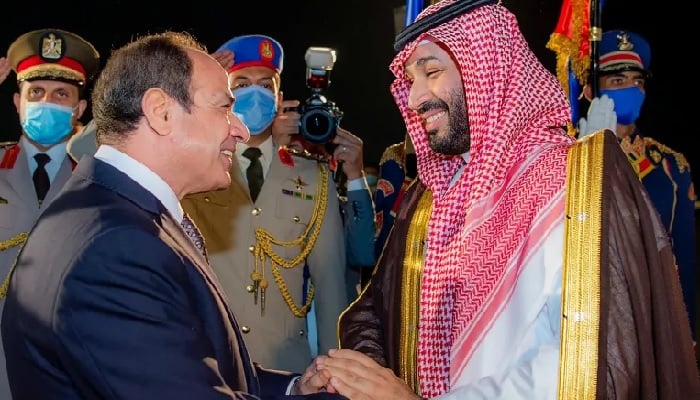
Crown Prince Mohammed bin Salman met Egyptian President Abdel Fattah al-Sisi in Cairo on Tuesday, where the two discussed the latest crisis.
They called for 'ensuring the freedom and security of maritime navigation' through Hormuz and Bab el-Mandeb, the Egyptian presidency said, adding that Sisi affirmed Egypt's support for measures taken by Saudi Arabia 'to protect its security and stability'.
The revival of Yemen's war, dormant since 2022, has left Riyadh rushing to respond. Last week, US media reported that the crown prince made a personal request to President Donald Trump for US intervention, but it was turned down.
The Houthis have insisted that there is no threat to navigation in Bab el-Mandeb except for Saudi vessels, though any attacks in the waterway are likely to make it less attractive to shippers.
Disruption in the strait could cause Egypt to feel the pinch too, as the Red Sea serves as the gateway to the Suez Canal, upon which Cairo relies for crucial foreign revenue.
Canal revenues are currently around half of what they were before the Houthis first started attacking Red Sea shipping in 2023, a campaign they said was in solidarity with Palestinians during Israel's war against Hamas in Gaza.
On Tuesday, Qatar warned of dire consequences if Bab el-Mandeb was closed, saying it would be 'catastrophic for the entire world'.
'Hostile and extremist'
Saudi Arabia, meanwhile, is also facing continued Houthi attacks on its territory.
Riyadh issued attack alerts on Tuesday for Makkah and the Jeddah and Taif governorates, among others, before quickly lifting them.
On Tuesday evening, it issued further attack alerts for Abha city, Khamis Mushait governorate and Jazan province, promptly lifting them.
A Saudi-led anti-Houthi coalition confirmed Tuesday that missile and drone attacks in three areas the previous day wounded 13 civilians.
The Houthis have also targeted oil infrastructure in Saudi Arabia, the world's leading crude exporter, helping push global prices above the $100-a-barrel threshold.
The Saudi-led coalition said it would deal with the attacks 'firmly to protect the sovereignty of the Kingdom', and would take 'all necessary operational measures to deter this... hostile and extremist approach'.
The Houthi military spokesman Yahya Saree said late Tuesday that Saudi Arabia launched 52 airstrikes on Yemen over the past 24 hours, accusing it of targeting civilian sites, including schools and bridges.
But Riyadh's strikes have failed to reverse the group's gains.
A US military task force is working to enhance intelligence-sharing and planning assistance for Saudi forces as they face attacks, a US official told AFP Tuesday.
The return to fighting has displaced 100,000 people internally, according to the UN.
The Yemen war dates back to the Houthi seizure of the capital Sanaa in 2014, with Saudi Arabia leading a coalition that intervened the following year on the government's side.
Houthi 'response will continue'
Hazem al-Assad from the Houthis' politburo said the 'Yemeni response will continue and escalate as long as they (Saudi Arabia) persist in their aggression against our people'.
The fighting in Yemen comes as the wider Middle East war remains at a stalemate, though Trump on Monday said he was open to holding talks with Iran, maintaining that Tehran 'wants to make a deal'.
Iran's top security chief Mohsen Rezaei, however, replied that 'there will be no negotiations until Iran's conditions are met. That is all there is to it.'
Tehran has long supported the Houthis, a member of its anti-Israel 'axis of resistance', including with weapons and technology, but has denied any role in the current war.
Experts dispute the extent to which it is behind the renewed fighting.