


Robbery is temporary, fear is forever: Human cost of Karachi street crime
For a person who is robbed, the crime may last only a few minutes, but its consequences can last much longer




 Updated Tuesday Sep 29 2026
A stolen phone can change more than what is in someone's pocket.
For some Karachi residents, being robbed has meant avoiding public transport, changing routes or stopping late-night travel. For others, it has meant spending more on transportation, changing jobs or deciding not to report an incident again.
Across Karachi, street crime has affected students, workers, shopkeepers, professionals and even police officers. Cases have been reported from Korangi and Landhi to Orangi, Gulshan, DHA, Clifton, and Jauhar.
And for victims, the problem does not necessarily end when the robber leaves.
According to the Citizens-Police Liaison Committee (CPLC), Karachi recorded 38,513 motorcycle thefts, 6,419 motorcycle snatchings and 17,675 mobile-phone snatchings in 2025. The same data recorded 1,859 car thefts and 309 car snatchings, along with 567 homicides and 100 extortion cases.
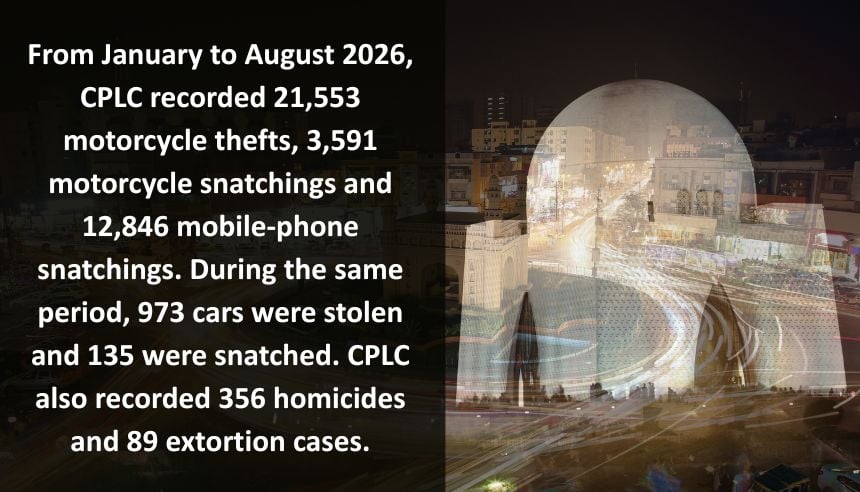
From January to August 2026, CPLC recorded 21,553 motorcycle thefts, 3,591 motorcycle snatchings and 12,846 mobile-phone snatchings. During the same period, 973 cars were stolen and 135 were snatched. CPLC also recorded 356 homicides and 89 extortion cases.
The figures cover different periods. The 2025 numbers are for a full year, while the 2026 figures cover only the first eight months.
They are also figures for reported incidents. They do not show how many suspects were arrested, how much property was recovered or how many cases ended in convictions. They cannot show how many victims chose not to report a crime.
For Ali Faisal, 22, that decision came after he had already reported one robbery.
When reporting crime does not end problem
Faisal, a teacher and private tutor, was travelling on his motorcycle near Dow Ojha Gate when two men on another motorcycle approached him. One displayed a pistol and demanded his phone.
Because the suspects had taken his phone, Faisal could not call 15. He reached home, contacted the police and later registered an FIR.
He says he received no response.
Later, when his phone was snatched again in Korangi, he decided not to report it.
The first robbery also affected his work. Faisal stopped going to one of his tuition jobs because he considered the route unsafe, even though the job was useful for his career.
He now avoids several parts of Karachi that he considers unsafe.
Fatima Khan, a Karachi University graduate and criminologist, said experiences like this can contribute to underreporting.
“Poverty alone does not cause crime,” Khan said.
Drawing on routine activity theory, she said crime becomes more likely when offenders encounter suitable targets and weak guardianship. Mobile phones, motorcycles and cash, she said, can be relatively easy to steal and resell.
A victim who does not expect to recover a phone or see an arrest may decide there is little point in reporting the crime, Khan said. Such incidents can become part of what criminologists call the “dark figure of crime” — crimes that occur but do not appear in official statistics.
“Some victims may think, what is the point of reporting? especially if they believe their phone or motorcycle will not be recovered,” she said.
How Karachi's streets can create opportunities for crime
The streets themselves can also matter.
Azhar Chandio, a PCATP-registered urban and town planner working in Karachi, said poorly lit streets, vacant plots, abandoned buildings, isolated pedestrian routes and poorly maintained public spaces can make crime easier to commit or harder to observe.
He was careful not to suggest that the built environment causes crime. Rather, he said, some conditions can reduce visibility and make it harder for people to see suspicious activity or get help.
Poor lighting is one problem. Broken roads, open drains and waterlogged streets can restrict movement. Vacant plots and abandoned buildings can provide concealed spaces.
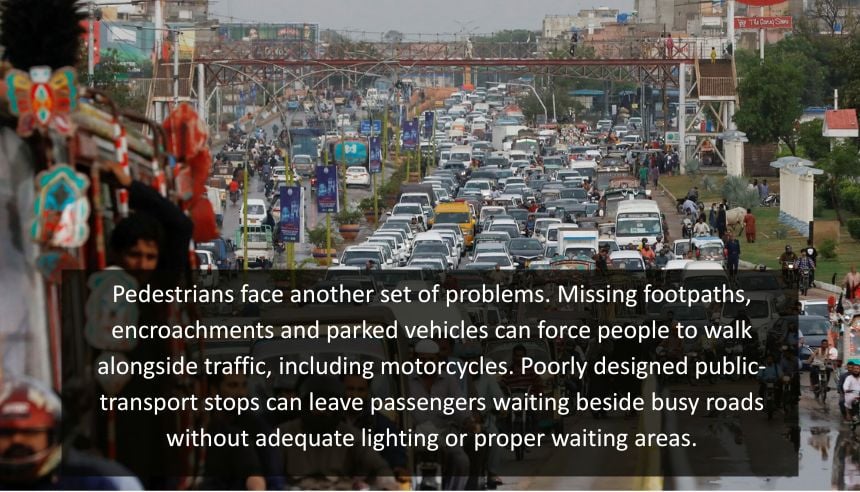
Pedestrians face another set of problems. Missing footpaths, encroachments and parked vehicles can force people to walk alongside traffic, including motorcycles. Poorly designed public-transport stops can leave passengers waiting beside busy roads without adequate lighting or proper waiting areas.
Chandio said the idea of “eyes on the street”, developed by American-Canadian urbanist and writer Jane Jacobs, is particularly relevant to Karachi. Jacobs argued that streets could become safer when they have a steady presence of residents, shopkeepers, pedestrians and other legitimate users who naturally observe what is happening around them.
In Karachi, Chandio said, shops, homes, pedestrians and other everyday activity can create this informal layer of surveillance, with more people present to notice unusual behaviour and potentially deter crime.
But a busy street is not necessarily a safe street. Snatching and robbery can happen there too.
Rather than treating an entire neighbourhood as unsafe, Chandio said individual locations should be examined using crime data, pedestrian movement, lighting, land use and accessibility.
He suggested using GIS mapping to see whether repeated crime locations overlap with problems such as poor lighting, vacant plots and inadequate pedestrian routes.
Chandio also pointed to Crime Prevention Through Environmental Design, or CPTED, which focuses on natural surveillance, access management, maintenance and legitimate activity in public spaces.
Better lighting, continuous footpaths, safer crossings, properly designed transport stops and better management of vacant plots and abandoned buildings are among the measures he recommended.
What police say keeps street crime going
A Karachi police official, who spoke on condition of anonymity, said several factors contribute to street crime despite police operations and increased patrolling.
The official pointed to a lack of employment opportunities in Sindh, limited access to free education and healthcare, political and outside interference in police work, weaknesses in the judicial system and Karachi's growing population.
The official also criticised the judicial process and said Karachi's size and growth made crime control more difficult.
But the CPLC figures do not show what happens to a case after an arrest. They do not establish how many suspects are released, how many cases result in convictions or how much stolen property is recovered.
That part of the picture remains difficult to see from the crime figures alone.
When street crime becomes fatal
For some victims, there is no recovery from the consequences.
In September 2025, 25-year-old Sajjad Shaukat was standing outside his home in Orangi Town with his two children when two men on a motorcycle approached him.
According to police, one demanded Shaukat's phone. When he resisted, the robber opened fire.
Shaukat was critically wounded and later died at Abbasi Shaheed Hospital. CCTV footage showed him holding his infant son while another child stood nearby.
The phone was not taken.
In May 2025, 10-year-old Mohammed Ameen was killed and a woman was wounded in Landhi when robbers allegedly opened fire during a robbery.
Other fatal robbery cases were reported in Karachi during 2025. In Shah Latif Town, a textile-mill cashier was shot dead after robbers allegedly intercepted him while he was carrying cash. In Surjani Town, a policeman was killed while responding to suspected robbers.
In March 2026, 30-year-old Mian Bux was shot dead and his friend wounded after they allegedly resisted a robbery attempt on the Northern Bypass in Gulshan-e-Maymar.
The loss in such cases has little to do with the value of whatever the robbers were trying to take.
When citizens confront suspected robbers
Repeated exposure to street crime has also led some citizens to confront suspected robbers themselves.
In January 2026, a citizen in North Nazimabad shot dead a suspected robber who allegedly held him at gunpoint and demanded his phone and cash. Police arrested the suspected accomplice.
In March, suspected robbers were killed by citizens in separate incidents in Orangi Town and Gulistan-e-Jauhar.
In Orangi, police said armed robbers had robbed people at Qadhafi Chowk before opening fire while fleeing. Passers-by and a shopkeeper were wounded, and area residents returned fire.
The encounters can end with a suspected robber being caught or killed. They can also mean more gunfire and more people getting hurt.
The cost beyond stolen property
The losses are not limited to individuals.
In Jauhar, Aziz Ahmed, 18, works at a jewellery shop that was among several shops targeted in a robbery.
Ahmed estimates that his shop alone lost around Rs3 million.
He says police officials, including an SSP, visited the shop and an FIR was registered, but he has seen no further development in the case.
For a business, a robbery can mean more than the value of the goods taken. There can be lost working hours, extra security costs and the worry of being targeted again.
What the numbers do not show
CPLC's figures provide a measure of reported crime in Karachi. They do not provide a full picture of what happens after the incident.
Faisal stopped going to a tuition job and later chose not to report another phone snatching.
Ahmed says his business lost money and that he has seen no further development in the case.
Shaukat's family lost a father in an incident over a phone that was never taken.
Other victims may respond in less visible ways. They may take a different route home, spend more on transport, avoid going out after dark or simply decide that reporting another robbery is not worth the effort.
Those changes do not appear in a CPLC table.
Neither do the fear, inconvenience and loss of trust that can follow a robbery.
The crime itself may last only a few minutes. For the person who was robbed, it can last much longer.
Syeda Zahra Shamil is a staffer at Geo.tv
Header and thumbnail illustration by Geo.tv