


The return of great power politics: American political scientist reflects on changing world order
“Pakistan has quite good relations with both China and the US and has not been forced to choose between them,” says Professor John J Mearsheimer at Margalla Dialogue



 Updated Thursday Nov 19 2026
Having lived through different international orders for nearly eight decades, Professor John J Mearsheimer, the R Wendell Harrison Distinguished Service Professor of Political Science at the University of Chicago, has witnessed the evolution of the global balance of power. In his two-hour keynote address at the Margalla Dialogue, he took the audience on a journey through the evolution of the international system, from the unipolar moment to the emerging multipolar order and the return of great power politics.
Speaking of the contours of great power politics, the 78-year-old political scientist said that there was no great power politics in a unipolar world — an era he referred to as 1992 to 2017 — a period when the United States was the unipole. “We were Godzilla, and we ran all over the planet interfering in the politics of every state. That was the unipolar moment,” he said, describing America's period of dominance.
Having grown up in a bipolar world, Professor Mearsheimer recalled the time when there were two powers — the US and the Soviet Union — a period that ended in December 1991 as the Soviet Union broke apart. He spoke about the great powers as ‘gorillas’ who “dominate the system and cause lots of trouble”, which is why the world should pay attention to the competition between them. Referring to the US-China competition, the renowned realist called it the ‘principal great rivalry’ for the rest of the 21st century. “For the first time in American history, East Asia is more important to the US than Europe is,” he said, adding that it’s because “China is America’s principal threat”. Bringing up the ‘pivot to Asia’ concept, he made the audience recall that the American “pivot to Asia was all about moving American bases to East Asia, to contain China”.
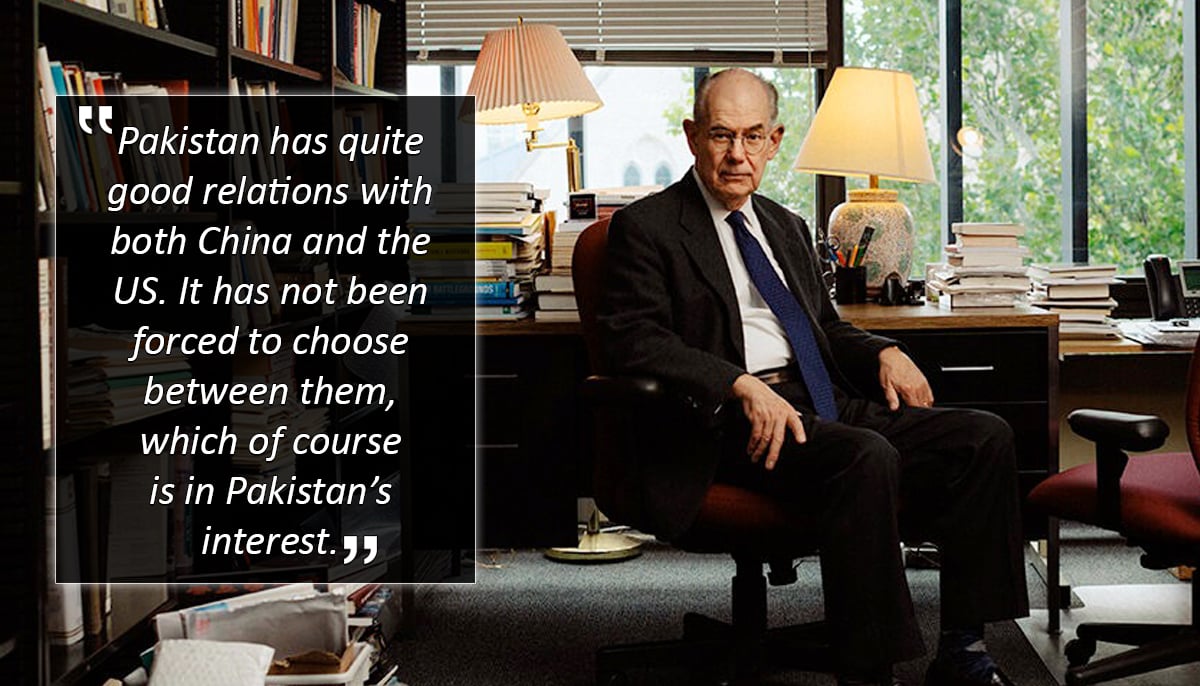
Speaking on the great power rivalry between the US and China, and how it affects Pakistan, Professor Mearsheimer commended Islamabad’s relationship with the two. “Pakistan has quite good relations with both China and the US. It has not been forced to choose between them, which of course is in Pakistan’s interest.” Wearing a cap of a Pakistani strategist, he noted that one should focus on “what will Pakistan’s situation look like moving forward with regard to China and the US, both focused on an intense security competition revolving around East Asia”, not just East Asia, but Asia in general.
Focusing on the Chinese building a blue-water navy, he stated that the Chinese, like the Americans, “want to have significant power projection capability”. With the US currently pinned down in the Persian Gulf and Ukraine, the political scientist noted that it has not been able to concentrate on Asia, resulting in a pivot away from Asia rather than to Asia. “The last thing the US wants is a crisis in East Asia, or trouble with China because the US is so deeply involved in the Middle East and in Ukraine.”
Talking about the US Navy, he highlighted that “the US Navy is not as big as it once was, with it being heavily committed in the Persian Gulf. And those naval forces in the Persian Gulf, in some important cases, have been pulled out of East Asia”. He stated that since the US is ‘strategically overstretched’, the US president, Donald Trump, is nice to President Xi Jinping of China. Once the war in Iran and Ukraine ends, the US “will be free to pivot to Asia”, he stated. And once that happens, Professor Mearsheimer believes the tensions between the Chinese and Americans “will begin to ratchet up in significant ways — and that is not in Pakistan’s opinion — getting caught up between the two”.

The professor also spoke about the US’s addiction. “The US is addicted to war,” he said, recalling to the audience that the current Iran war is the second one since President Trump took office – the first one being the 12-day war last year. “Even after we lost in Afghanistan, got our nose blooded in Iraq, we still have gone to war twice against Iran.”
Shedding light on the US war in Iran, and how that was an irrational decision, the realist professor mentioned that President Trump was convinced by Prime Minister Benjamin Netanyahu of Israel to attack Iran ‘with air power alone, launching the shock and awe campaign to decapitate the regime which would surrender to the US demands’. Historically speaking, Professor Mearsheimer explained to the audience that “there's not a single case where air power alone led to regime change… if you want regime change, you have to invade a country”. He noted that Trump’s key policymakers even thought of carrying out strikes as a “foolish idea”.
Mearsheimer talked about President Trump’s decision to get into this war as a “non-rational decision” which, he believes, will end up in the US “going to lose this war, and Iran is going to win”. Speaking of President Trump and his advisers on a military attack on Iran, he states: “That would be a disaster. It would make a bad situation worse because, number one, we would not defeat Iran. And number two, the Iranians would retaliate, and that would do more damage to the international economy.”

Focusing on Israel’s genocide in Gaza, the professor mentioned that the Israelis, post October 7, 2023, “saw it as an opportunity to ethnically cleanse Gaza” by launching a massive military operation which evolved into a genocide. “The genocide is a means of getting rid of the Palestinians, and it has failed. The Palestinians have not left Gaza. But the Israelis remain committed to driving the Palestinians out. That is why they are treating the Palestinians in Gaza today in the most horrendous ways. And of course, they are also launching pogroms on the West Bank because they want to drive the Palestinians out of the West Bank into Jordan if they can. It's important to understand that what the Israelis have done over time with both the Palestinians in the West Bank and the Palestinians in Gaza is effectively to corral them and put them in a concentration camp in Gaza,” he stated, saying that Israel is creating another Nakba. Here, Mearsheimer emphasised that the genocide in Gaza wouldn’t have been possible without the support of the US. “It’s very important to understand that the United States is complicit in this genocide.”
Turning to the current international order, which transitioned from a unipolar to a multipolar world since 2017, the professor stated that there are three great powers on the planet now. “The United States is still the most powerful state; China is a close second; and Russia is the weakest of the three great powers,” he said, discussing the multipolar world resulting in great power politics.
On the ongoing Russia-Ukraine war, the political scientist from Chicago mentioned Russia’s struggle to conquer ‘the eastern 15th of Ukraine’. With the Russia-Ukraine war approaching its fifth year, he questions the ability of the Russian army to overrun Ukraine, Eastern Europe or Central Europe. He rejects that possibility. And why is that? Because the “Russian army is not that efficient. It's not that dangerous,” and he wants the US to have good relations with Russia, but instead what it is doing is “effectively fighting a war against Russia”, he said of the US being “deeply involved in the war in Ukraine… and being effectively at war with Russia”.
And that is “crazy”, as that ends up driving the Russians into the arms of the Chinese, according to Professor Mearsheimer. “If I tell you that the United States and China are the two most powerful states in the system, which they are, from an American point of view, we want to make sure that the Russians are our allies,” being the third great power in the international system, as per his view of a multipolar world. Referring to the basic principles of balance-of-power politics, he argued that the third great power, Russia, may be the weakest of the three, but the US wouldn’t want the Russians to be allies with the Chinese.
The professor described international politics as a "depressing business", given the persistence of conflicts and the tendency of powerful states to disregard the rules they helped establish when those rules no longer serve their interests. He reminded the audience that great powers establish international institutions and shape their rules to serve their interests. However, “if they don't like the law or the rules, they'll just disobey them,” he said, arguing that international rules often carry greater weight for weaker states than for the powerful.
Mariam Khan is a journalist and communications professional working at the Centre for Excellence in Journalism, IBA Karachi. She can be reached on X @mariaamkahn
Header and thumbnail image created using an AI tool.