Pakistan's first astronaut Zeeshan Ali set for historic liftoff aboard Shenzhou-24
Mission scheduled to lift off at 8:18am Beijing time (5:18am Pakistan Standard Time) from Jiuquan on Wednesday
Published November 24, 2026
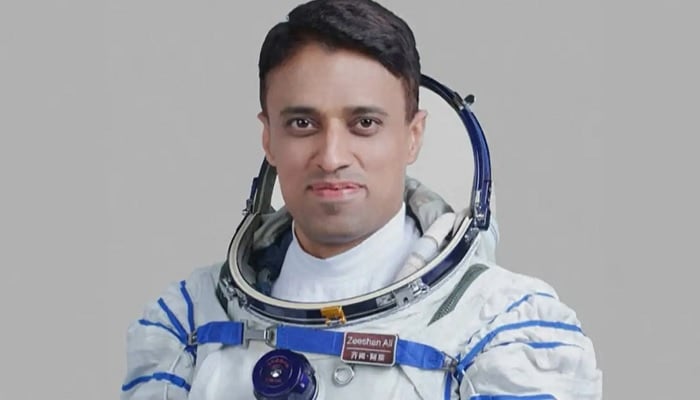
- Ali will join Chinese astronauts Tang Hongbo and Wu Yi as payload specialist.
- Pakistani astronaut expected to spend week aboard Tiangong space station.
- Ali will return to Earth aboard the Shenzhou-23 spacecraft: Suparco.
JIUQUAN: Pakistan is poised to enter a new chapter in space exploration, with its first astronaut, Muhammad Zeeshan Ali, scheduled to travel to China's Tiangong space station aboard the Shenzhou-24 mission on Wednesday, marking the country's first participation in a crewed spaceflight.
The Shenzhou-24 spacecraft is scheduled to lift off at 8:18am Beijing time (5:18am Pakistan time) on November 25 from the Jiuquan Satellite Launch Centre in north-western China, the China Manned Space Agency (CMSA) announced at a pre-launch media briefing on Tuesday.
Ali will join Chinese astronauts Tang Hongbo and Wu Yi as a payload specialist, becoming the first foreign astronaut to visit China's Tiangong space station and the first Pakistani national to travel to space.
Tang Hongbo will command the mission, while Wu Yi will serve as flight engineer. Tang has previously flown on the Shenzhou-12 and Shenzhou-17 missions and is set to become the first astronaut to visit the Tiangong station three times. Wu, a member of China's third batch of astronauts, will undertake his first spaceflight, according to the mission briefing.
The Pakistani payload specialist will undertake a short-duration mission, primarily conducting scientific experiments under Pakistan-China cooperation in space research. According to the briefing, his responsibilities will include participating in routine crew activities, installing experimental samples and research equipment, and carrying out scheduled experiments aboard the orbiting laboratory.
The scientific work will build on four Pakistani biotechnology experiments selected by Chinese institutions from more than 300 proposals submitted to the Space and Upper Atmosphere Research Commission (SUPARCO) by universities across the country.
The experiments focus on research relevant to food security and climate change, according to details previously shared by Suparco officials with Reuters.
Suparco said Ali would spend approximately one week aboard the Chinese space station before returning to Earth aboard the Shenzhou-23 spacecraft.
To prepare for the joint mission, Chinese authorities strengthened the Pakistani astronaut's specialist training in spacecraft and space station operations, scientific experiment procedures and emergency response.
The crew also underwent joint exercises focusing on operational coordination, procedural handovers and handling technical problems.
Language training was another key part of the preparation, with Ali receiving instruction in Chinese commands and technical terminology to ensure accurate communication and execution of procedures.
The Astronaut Centre of China also prepared Chinese-English operating manuals and halal space food for the Pakistani astronaut, taking into account his language and dietary requirements. These arrangements were highlighted during the final full-system launch rehearsal completed at Jiuquan on November 21, according to Chinese space programme reports.
The mission marks the first joint crewed spaceflight involving Chinese and foreign astronauts in the history of China's human spaceflight programme. It will also make Tiangong the first Chinese space station to host a foreign astronaut.
The mission is the culmination of expanding Pakistan-China cooperation in space exploration. The two countries signed an agreement in February 2025 on selecting and training Pakistani astronauts for participation in Chinese space station missions, formally launching the selection process.
Following three rounds of screening and assessment, Ali and Khurram Dawood were selected as reserve astronaut candidates and completed their training in China. Ali has now been confirmed for the historic flight, while Dawood will serve as his backup.
The Shenzhou-24 mission will also bring a change to the Chinese station's crew rotation. One astronaut from the outgoing Shenzhou-23 crew, Zhu Yangzhu, will remain aboard Tiangong for a year-long in-orbit residency experiment, according to details announced alongside the crew selection.
The spacecraft and its Long March-2F carrier rocket were transferred to the launch area on November 17, while the final full-system rehearsal was successfully completed four days later. Chinese authorities said at Tuesday's briefing that the spacecraft and rocket were in controlled condition, the crew was in good shape, and the space station complex was operating normally, with preparations proceeding towards liftoff.
The historic flight is expected to open new avenues for Pakistan's participation in human spaceflight, scientific experimentation and international space cooperation, extending the country's partnership with China beyond satellite development and other space technology projects.