


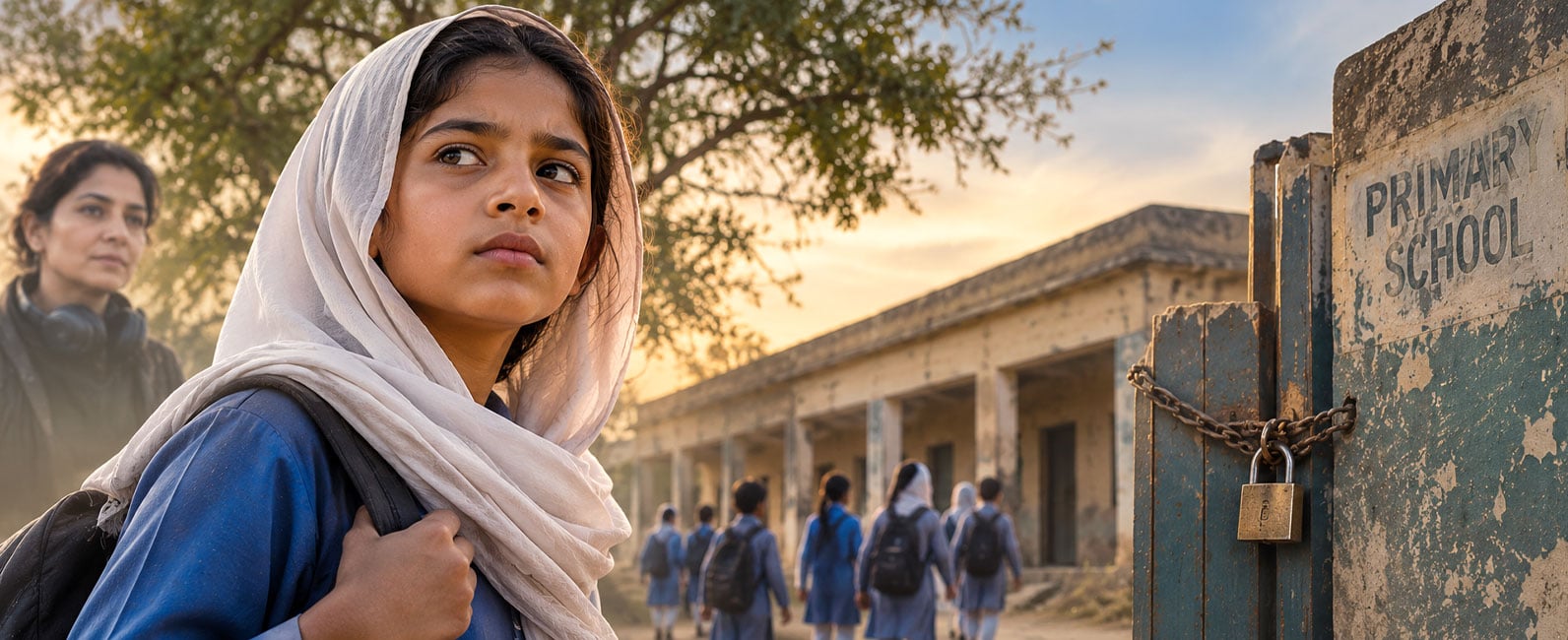
'Ghost School': A young girl's search for education exposes a schooling crisis
Through the film, Seemab Gul explores a pressing question: what happens to a child when the school she depends on is no longer there?



 Updated Saturday Nov 28 2026
A school falls silent, a teacher disappears and a rumour about a jinn becomes the village's explanation for what happened. But Rabia is not convinced. In Seemab Gul's film Ghost School, the young girl refuses to accept the story and sets out to find out why her school has closed and what has happened to the education she was counting on.
Played by Nazualiya Arsalan, Rabia takes her questions to the adults around her, only to discover that finding answers is not as easy as asking for them. As she searches for a way back to the classroom, she encounters people who dismiss her concerns, question the need for girls' education or offer help on their own terms.
Written and directed by Seemab Gul, the film also features Adnan Shah Tipu, Tutu Baba, Ziarat Gul, Taha Khan, Kehan Naqvi, Tariq Raja, Samina Seher, Vajdaan Shah and Muhammad Zamaan.
The film's jinn rumour is fictional, but the closure of schools and the lack of access to education are real concerns in Pakistan. The term 'ghost school', however, does not have one clearly established meaning in official education figures.
What does a ghost school mean in Pakistan?
In a conversation with Geo.tv, Gul said people used the term for different situations. These included schools listed in government records but not found at their registered locations, buildings meant for education but not being used as schools, and institutions that had closed.
She said there was no consolidated record of the total number of ghost schools in Pakistan.
“I don't think any proper investigation or numbers are recorded of ghost schools because no one knows how many schools are registered in the government documents,” she said.
Gul added that she had not conducted a detailed statistical study for the film. As a fiction filmmaker, she wanted to explore the subject through a story rather than present a collection of figures.
Official records provide some context, although they use categories such as functional, non-functional and closed schools rather than one combined category called ghost schools.
According to the Pakistan Institute of Education's Pakistan Education Statistics 2023-24 report, 7,350 public schools across the country were listed as non-functional, while 61 were recorded as closed.
Sindh had 2,934 non-functional public schools, while Balochistan had 3,675. These figures show the number of schools recorded under those administrative categories. They should not be treated as the total number of ghost schools in the country, as the categories do not necessarily describe the same situation.
The wider education crisis also affects millions of children. The Ministry of Federal Education and Professional Training's Girls' Education Statistics and Trends Report 2023-24, released in February 2026, put the number of out-of-school children in Pakistan at 26.2 million.
This figure reflects the wider problem of children being out of education; it does not mean that all of them are affected by non-functional schools.
Gul said the idea for Ghost School developed from her interest in journalism and her travels across Pakistan after the floods. During those visits, she came across ghost schools in Sindh, South Punjab and Balochistan. She also found that the issue was not limited to rural areas, mentioning similar concerns involving schools, colleges and hospitals in Karachi.
“When I asked friends and colleagues what ghost schools were, everyone would give me a different answer. When I didn't receive a satisfactory answer, I decided to make a fiction film about how a school could become a ghost school,” she said.
The real issue behind the film's jinn rumour
In the film, the rumour about the teacher being possessed by a jinn becomes the explanation for the school's closure. As Rabia investigates, she learns that the situation is more complicated than the story being spread in the village.
Gul said the teacher's illness and absence were part of the story. She also said the character pointed towards the issue of ghost teachers, but she did not want to place the blame on teachers alone. In her view, wider problems involving corruption and accountability also needed attention, including the responsibility of people in senior positions such as education ministers.
The film does not claim to explain every reason why schools become non-functional in Pakistan. Instead, it follows a child trying to understand why the school she depends on is no longer available to her.
Why Rabia's story is told through a girl's perspective
Rabia's search for answers also brings out the difficulties girls can face when trying to continue their education.
Gul said she wanted to show a girl who was confident enough to question adults and speak about what she believed.
“I am interested in telling stories from the female perspective on the female experience," she said. "I wanted to show a strong girl asking difficult questions to adults around her, like I used to when I was a schoolgirl in Pakistan.”
One exchange that stands out takes place when the village principal questions the need for girls to study. He suggests that someone still has to look after the crops and catch fish. His remarks give a clear picture of the expectations Rabia is trying to challenge.
Her family circumstances add another difficulty. Her father earns a living working on boats, while her mother works in other people's homes. When Rabia visits the deputy commissioner's office for help, a woman offers to arrange her admission to a school in the city but expects her to work in her house in return.
The offer puts Rabia in a difficult position. She wants to study, but even the opportunity to attend school comes with a condition. It is another example of how the difficulties surrounding her education extend beyond the closure of her village school.
The principal's remarks and the offer at the deputy commissioner's office show two different barriers Rabia faces. One reflects the attitudes that can discourage girls from pursuing education, while the other highlights the economic vulnerability that can make access to schooling conditional.
Bringing the village and its characters to life
Gul said she developed Rabia's character by imagining how an intelligent schoolgirl would react if her village school suddenly closed. She praised Arsalan's professionalism and said the young actress had been working professionally since the age of seven.
The cast spent several weeks rehearsing before filming. According to Gul, the rehearsals helped the actors understand their characters and prepare for their roles.
The film was shot in two villages on the outskirts of Karachi, which were used to create an imaginary fishing village. Cinematographer Zamarin Wahdat worked with Gul on the visual approach. The two spent time watching films and discussing photography references before the shoot.
The village setting is one of the film's noticeable features. The camera captures the surroundings and everyday activities without making the place feel overly arranged. The natural sounds also help establish the setting.
Sindhi folk music and instrumental pieces are used throughout the film. They connect the story with its surroundings without taking attention away from Rabia's journey.
A scene that particularly stands out is the principal's conversation about whether girls need an education. Rather than explaining the issue through narration, the film lets the principal's own words show the attitude Rabia is up against.
The film does have some slow stretches. A few scenes could have been shorter, particularly where the story takes time to move between Rabia's conversations and her search for help. A tighter edit might have given the narrative more pace.
Still, the exchanges between Rabia and the adults around her are among the film's strongest moments. They show her determination through what she says and does, rather than repeatedly explaining what she wants.
The challenges of making an independent film
Gul said financing the film was one of her biggest challenges. She used her personal savings and borrowed money to complete the project.
The shoot also faced unexpected problems. She recalled a crane falling, lights breaking and a lighting truck getting into an accident. According to the filmmaker, these incidents added nearly Rs1 million to the production costs.
The absence of film insurance made the situation more difficult. Despite the additional expenses, Gul continued working to bring the film to the screen.
Her experience points to the financial risks involved in independent filmmaking, where unexpected problems during production can put further pressure on an already limited budget.
A bittersweet ending to Rabia's journey
Gul wanted to give Rabia's story a hopeful ending without ignoring the difficulties faced by children who cannot access education.
“I wanted to convey a hopeful ending to the film and therefore chose a bittersweet ending,” she said.
She explained that Rabia eventually found a way out of what seemed like an impossible situation through her imagination. Gul described this approach as bittersweet magical realism.
Rabia's final appearance in a new school uniform, after cutting her hair, is one of the film's memorable moments. It gives her story a sense of change, although it does not suggest that the wider problems have disappeared.
For me, Ghost School was a 9/10 experience. Its slow pace could have been improved, but I particularly liked the village setting, the performances and the use of Sindhi folk music.
The principal's remarks about girls' education and Rabia's visit to the deputy commissioner's office were also among the moments that stayed with me.
The film does not attempt to present a complete investigation into Pakistan's education system. It tells the story of one girl who refuses to give up on school, even when the adults around her make it difficult.
Through Rabia, Gul brings the issue closer to the audience and leaves them with a question: what happens to a child when the school she depends on is no longer there?
Umair Abbas is a staffer at Geo.tv
Header and thumbnail image created using an AI tool.