UN Security Council meets today on North Korea nuclear test
The 15-member body will meet at 10am (7pm PST) on Monday, the US mission informed
Published September 04, 2017
NEW YORK: The United Nations Security Council will meet today on North Korea’s nuclear test at the request of the United States, Japan, Britain, France, and South Korea, the US mission to the United Nations said in a statement on Sunday.
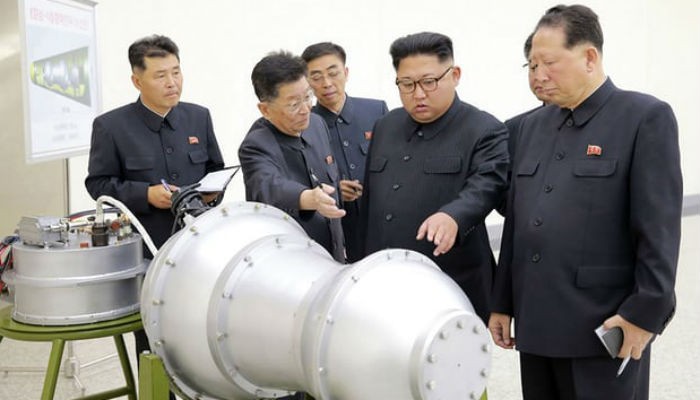
North Korea conducted its sixth and most powerful nuclear test on Sunday — in violation of UN resolutions — that it said was an advanced hydrogen bomb for a long-range missile.
The 15-member security council will meet at 10am (7pm Pakistan Standard Time) on Monday, the US mission said.
North Korea has been under UN sanctions since 2006 over its ballistic missile and nuclear programmes. Typically, China and Russia only view a test of a long-range missile or a nuclear weapon as a trigger for further possible UN sanctions.

US Defence Secretary Jim Mattis said on Sunday that the members of the security council “remain unanimous in their commitment to denuclearisation of the Korean Peninsula.”
He said any threat to the United States, its territories, or allies would be met “with a massive military response.”
The council last month unanimously imposed new sanctions on North Korea over its two long-range missile launches in July. The resolution aimed to slash by a third the Asian state’s $3-billion annual export revenue by banning exports of coal, iron, lead and seafood.
Diplomats have said the council could now consider banning Pyongyang’s textile exports and the country’s national airline, stop supplies of oil to the government and military, prevent North Koreans from working abroad, and add top officials to a blacklist to subject them to an asset freeze and travel ban.
Japan urged Washington last week to propose new sanctions after Pyongyang fired a medium-range missile over north Japan on Tuesday.
The United States traditionally drafts resolutions to impose sanctions on North Korea, first negotiating with China before formally involving the remaining 13 council members.
Following the nuclear test on Sunday, Britain, Japan, and South Korea pushed for new UN sanctions, while China and Russia said they would “appropriately deal” with North Korea.
Daniel Russel — until April the US assistant secretary of state for East Asia and now a senior fellow at the Asia Society Policy Institute — told Reuters, “We should expect an uptick in Chinese and Russian pressure on both North Korea and on the United States.”
“We should also expect ‘more of the same’ from China (and Russia) in claiming that the US is also to blame and calling on Washington to appease Pyongyang with front-loaded concessions and placate it with dialogue, despite the fact that North Korea is clearly only interested in dictating terms, not in negotiating,” he said.
Any new sanctions would build on eight resolutions ratcheting up action against Pyongyang over five nuclear tests, four long-range ballistic missile tests and dozens of medium-range rocket launches.
The past three substantial resolutions have taken between one and three months to negotiate.
A resolution needs nine votes in favour and no vetoes by the United States, Britain, France, Russia or China to pass.
UN Secretary-General Antonio Guterres condemned North Korea’s nuclear test on Sunday as “profoundly destabilizing for regional security” and called on the country’s leadership to cease such acts.