Europe's sovereign access to space ends with Ariane 5's last mission
Ariane 5's final mission was delayed last month because of technical issues and again this week due to weather
Published July 06, 2023
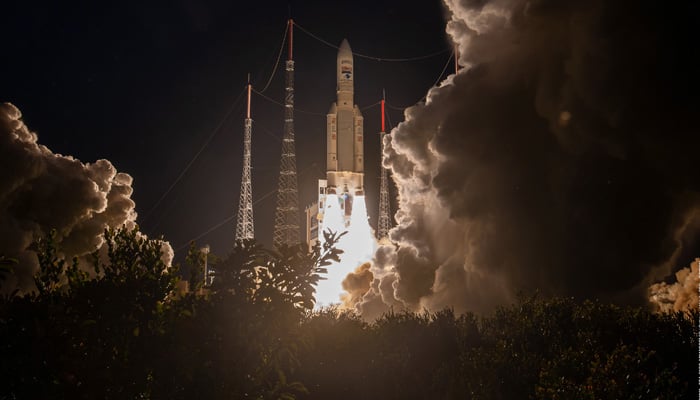
European Space Agency’s (ESA) Ariane 5 has successfully concluded its last mission before retiring after forty years of functionality, deploying two military communication satellites into space, which also brings an end to the continent’s independent access to space.
The 53-metre-tall rocket lifted off Wednesday from the spaceport of Kourou in French Guiana on its 117th and final mission at 7pm local time (2300 GMT), deploying two satellites as per schedule roughly 30 minutes later, a live webcast showed.
Arianespace CEO Stephane Israel said on the webcast: “The three-stage launcher left the launch pad in the French Ariane 5 is now over, and Ariane 5 has perfectly finished its work."
The mission to send France's Syracuse 4B and Germany's Heinrich Hertz (H2Sat) satellites to geostationary orbit caps 27 years of service for Ariane 5, whose successor — Ariane 6 — has been hit by technical delays until 2024 for operational use.
Europe until recently was relying on Ariane 5 and its 11-tonne-plus capacity for heavy missions, as well as Russia's Soyuz launcher for medium payloads and Italy's Vega for small ones.
However, Russia last year withdrew access to Soyuz citing tensions over Ukraine and the upgraded Vega C remains grounded after the failure of its second launch in December, sparking what the head of the ESA has termed a space launch "crisis."
The CEO of Airbus who co-owns manufacturer ArianeGroup with France's Safran said in June: "The gap highlighted Europe's vulnerability in space."
“All pressure is now on Ariane 6," Guillaume Faury told the Paris Air Forum.
The first test flight of the Ariane 6 is likely to take place at the end of this year depending on tests to be carried out in the summer, with the first commercial operation to commence next year.
The final launch of Ariane 5 was delayed last month for technical reasons and again this week because of the weather.
Initially led by France, Germany and the UK, Europe's Ariane series pioneered commercial launches but now faces competition from Elon Musk's SpaceX, leading the development of a more inexpensive Ariane 6 to better compete with the Falcon 9.
Development of the family of launchers began in 1973, with the first Ariane 1 lifting off in 1979.
Ariane 5's first flight ended in failure in 1996 as the rocket went off course after 40 seconds and destructed itself.
But the new workhorse took part in several launch milestones including the James Webb Telescope in 2021, in partnership with Nasa and the Canadian Space Agency, as well as Europe's comet-chasing Rosetta mission, which deployed a landing probe in 2014.