Blood Moon to grace skies in parts of world on March 3
Limited visibility expected in Pakistan as celestial event to take place during day time
Published February 27, 2026
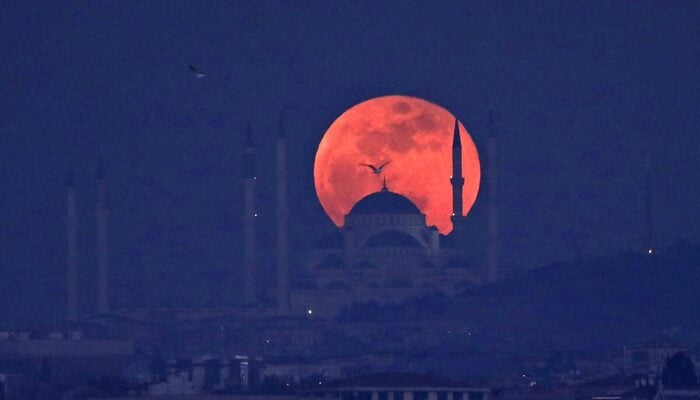
Skywatchers across the globe will have the chance to witness the first total lunar eclipse of 2026 on March 3, when the full Moon will gradually darken and turn a deep reddish hue during the celestial event.
A total lunar eclipse will occur on March 3, 2026, turning the full Moon's colour to reddish-orange as the Earth moves directly between the Sun and the Moon.
The celestial event will be visible across large parts of the world, offering skywatchers a striking view of the so-called "Blood Moon".
According to Nasa, a lunar eclipse takes place during a full Moon when Earth casts its shadow over the lunar surface. As sunlight passes through Earth’s atmosphere, shorter wavelengths scatter while red and orange hues reach the Moon, giving it its distinctive coppery glow during totality.
Details shared by Pakistan Meteorological Department (PMD) suggest that the eclipse will begin with the penumbral phase at 1:44pm Pakistan time, when the Moon enters Earth’s outer shadow and begins to dim slightly. The partial eclipse will start at 2:50pm, followed by the start of totality at 4:05pm. The eclipse will reach its peak at 4:34pm, while totality will begin to end at 5:03pm. The eclipse will conclude completely at 7:23pm.
Since much of the eclipse will occur during daylight hours in Pakistan, it may not be directly visible in most parts of the country. However, observers may be able to see the later stages during the evening, depending on local moonrise timing and weather conditions. The PMD noted that the eclipse will be partially visible from different cities.
Globally, totality will be visible in the evening from eastern Asia and Australia, throughout the night across the Pacific region, and in the early morning in North and Central America and far western South America. The eclipse will appear partial in central Asia and much of South America, while it will not be visible in Africa or Europe.
Astronomers say a lunar eclipse can be observed with the naked eye without any special equipment, provided there is a clear line of sight to the Moon. Viewing from darker locations away from bright lights, or using binoculars or a telescope, can enhance the experience.