Fossil struck by Australian chicken farmer turns out to be colossal ancient tusked lizard
Published August 09, 2023
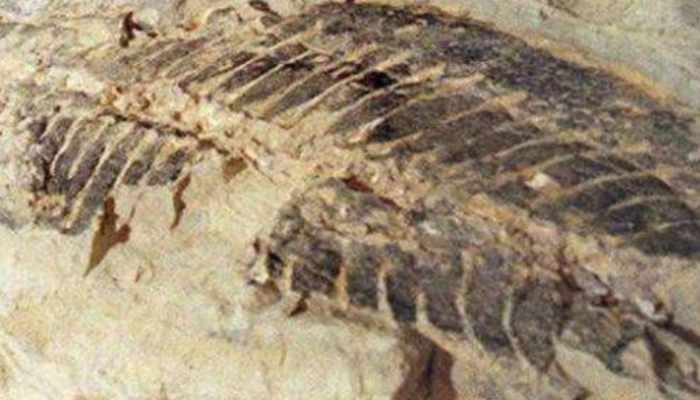
A perplexing prehistoric relic accidentally unearthed by an Australian poultry farmer back in the 1990s has finally been identified by scientists as a robust amphibian armed with tusks and formidable dental features, BBC reported Wednesday.
The fossil, which dates back 240 million years, was stumbled upon by Mihail Mihailidis as he was cleaning a substantial sandstone slab initially intended for use as a garden retaining wall. Presented to the Australian Museum in 1997, this remarkably well-preserved specimen has baffled researchers who have dedicated nearly three decades to deciphering its enigmatic origins.
Lachlan Hart, a paleontologist from the University of New South Wales, revealed that the creature has now been classified as a "sturdy" amphibian measuring 1.2 meters (nearly four feet) from its snout to its tail. It displays a fusion of traits reminiscent of both a crocodile and a colossal salamander. Hart surmised that the creature likely hunted freshwater fish, utilizing its distinctive and formidable teeth along with a set of tusk-like projections on the roof of its mouth.
Hart added, "It's not common to encounter skeletons with both the head and body intact, and the remarkable preservation of soft tissues is an even more infrequent phenomenon."
The scientific name assigned to this remarkable find is "Arenaerpeton supinatus," a label that researchers indicated roughly translates to "reclining sand creeper." This ancient inhabitant belongs to an extinct category of creatures known as "temnospondyls," predating the era of dinosaurs.
Scientists subjected the substantial fossil to X-ray examination with the cooperation of Australia's border enforcement agency, who allowed the use of a mammoth scanner typically employed for scrutinizing cargo for contraband.
The fossil's discovery occurred in the mid-1990s near the coastal town of Umina Beach, located approximately an hour's drive north of Sydney in the state of New South Wales. This finding garnered substantial international attention, with Time Magazine even suggesting that it could "amplify the narrative of human evolution" at the time.
Matthew McCurry, a paleontologist at the Australian Museum, expressed, "This represents one of the most significant fossil discoveries in New South Wales over the past three decades, making it an exciting prospect to formally document. It serves as a crucial fragment of Australia's fossil legacy."