First solar eclipse of 2026: Sky-gazers to witness 'Ring of Fire'
Celestial event will be seen on February 17 in parts of world

Published February 10, 2026
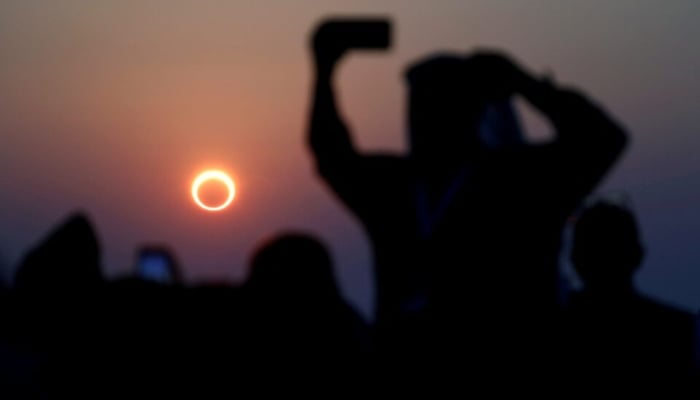
A rare celestial spectacle is set to unfold in the skies next week as the first solar eclipse of 2026 takes place on February 17, bringing with it a dramatic "ring of fire" effect.
However, only a handful of observers on Earth will be able to see it in its full glory.
The Pakistan Meteorological Department (PMD) has confirmed that the first solar eclipse of 2026 will occur on 17 February, but unfortunately, it will not be visible from Pakistan.
This spectacular astronomical event will be an annular solar eclipse, during which the moon covers the majority of the sun while leaving a glowing ring of sunlight visible around its edges.
According to the PMD, the eclipse will commence at 2:56pm (local time), reach its maximum at 5:12pm, and conclude at 7:28pm.
While the 'ring of fire' will only be observable from a remote region of Antarctica, where up to 96% of the sun will be obscured for just over two minutes, a partial solar eclipse will be visible across certain areas of Antarctica, southern Africa, and the southern tip of South America, Space.com reported.
In addition, regions over the Atlantic, Pacific, and Indian Oceans will also witness a partial eclipse.
The PMD also noted that this year, Pakistan will experience a total of two solar and two lunar eclipses, although this particular event will remain largely inaccessible to observers within the country.
Astronomers and eclipse enthusiasts worldwide are encouraged to follow the phenomenon via live broadcasts or online streaming, as the full annularity will be seen by very few people on Earth in person.