Soaring costs, fuel shortage fears drive Pakistan to electric motorbikes
"People have this fear that maybe in the near future, they might not get petrol at all," says retailer
Published April 07, 2026
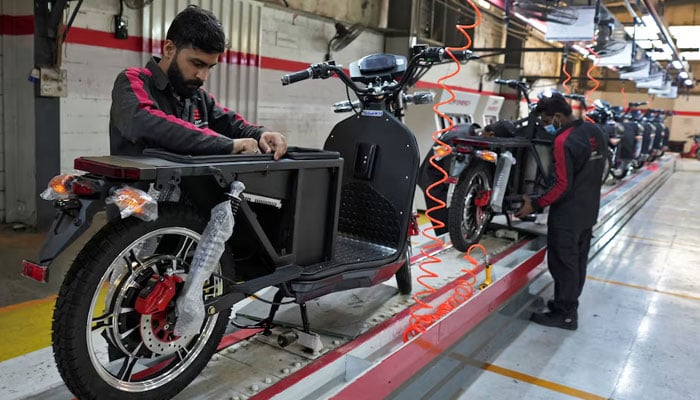
ISLAMABAD: Days after Iran effectively blocked shipping through the Strait of Hormuz following the start of US and Israeli attacks in late February, two Pakistani electric motorbike outlets 1,400 km (875 miles) away found themselves overwhelmed with enquiries.
Haseeb Bhatti, who retrofits petrol-fuelled bikes with battery-powered motors in Rawalpindi, said his March sales surged 70%.
For Ali Gohar Khan, who owns a 7-year-old electric motorbike retail franchise with branches across Pakistan, the recent surge in sales is the steepest ever.
"People have this fear that maybe in the near future, they might not get petrol at all," Khan said.
The Middle East crisis has sent global fuel prices soaring, compounding pain for Pakistanis already hit by inflation and a post-pandemic economic downturn. As the nation imports nearly all its oil through the Strait of Hormuz, shortage rumours took hold despite the government's supply assurances.
About 40% of Pakistan's petrol is used to fuel the 30 million two-wheelers and three-wheeled autorickshaws that dominate roads in a country where cars are a luxury and public transport is inadequate.
Industry officials and analysts expect the crisis to supercharge an EV rush in Pakistan, which would stand out from a broader regional surge for the availability of cheap and plentiful solar power to charge e-bikes.
A switch would also help lower oil imports and bolster foreign exchange reserves, and slash emissions in the world's most polluted country in 2025.
After the government's 18% price hike last week, a Pakistani household earning the median wage now pays 31% of its daily income for a litre of petrol - more than all but 22 of 139 countries tracked by globalpetrolprices.com and Our World in Data.
"My monthly salary is 30,000 rupees. I can barely cover expenses for my family of six with this. How am I supposed to fill my bike?" said Zahoor Ahmed, a security guard in the southern city of Karachi.
From working professionals to college students, more riders have been turning to EVs in recent months. Last year, higher petrol prices drove up EV sales nearly three-fold to 90,000 units or 5% of all two-wheelers sold, data from consultancy Renewables First showed.
This year, EVs have accounted for more than 10% of monthly two-wheeler sales for the first time, said Talha Khan, CEO at EV logistics planning company Orko, a transition he expects to accelerate as filling up with conventional fuel can be as much as 10 times more costly than charging.
"Today, the war situation is bad, so petrol prices are going up. I think this (EV) is a very reasonable thing. Everyone should buy one," said Noori Shahbaz, a housewife purchasing an electric bike in Lahore, in a country where female riders remain a small but growing minority.
Generous subsidies and interest-free loans
A typical electric two-wheeler costs around 250,000 rupees - more than half the annual per capita income for Pakistanis and 56% more than the popular petrol-fuelled Honda CD 70, which costs about 160,000 rupees.
In February, the government's Pakistan Accelerated Vehicle Electrification (PAVE) plan came into force, providing a subsidy for a fifth of the price and interest-free loans for the rest. The plan targets electric bikes and autorickshaws.
It has already received about 270,000 applications - nearly seven times PAVE's first phase target ending June - Finance Ministry adviser Adnan Pasha told Reuters, adding that the government aimed to finance 2 million EVs over five years and fund the plan with existing levies on fuel sales.
"Electrifying just 2 million vehicles could result in nearly half a billion dollars in annual savings, as we don't have to import that fuel," Pasha said.
Many Pakistanis turned to solar after IMF-driven power tariff hikes in 2023, snapping up cheap China-made panels for their homes. Now the government aims to capitalise on that boom to drive EV growth.
"Using solar can reduce electricity costs at charging stations, and make it more affordable to charge at home," Pasha said.
Ammar Habib, an adviser to Pakistan's power minister, said EVs were also "great for the grid as the steady demand from electric vehicle charging will ease some of the daytime volatility linked to solar oversupply."
Chinese players at heart of EV shift
Like its solar revolution, Pakistan's embrace of electric two-wheelers is built on Chinese brands. Scooter makers such as Yadea and Jinpeng, and e-bikes assembled locally with batteries and components from firms including AIMA and Sunra are expected to meet rising demand.
Chinese EV giant BYD, which launched its cars in Pakistan through a local partner also working with HUBCO Green to build charging stations across the country, said it plans to support broader electrification to eventually sell more passenger cars.
Pasha said the government wants local companies to build charging stations and said he expected the 45% cut to charging stations' power tariffs last year to continue boosting adoption.
However, financial incentives could come under pressure if the war drags on, while a lack of local expertise and hard-to-scale charging infrastructure are other risks for Pakistan's EV transition, said Ahtasam Ahmad, energy finance lead at Renewables First.
Good servicing networks are critical as EVs are more sensitive to potholes, which are common on South Asian roads. In neighbouring India, riding e-scooters on poorly maintained roads has caused major service backlogs.
"When Chinese players flood the market, it may look promising on paper, but with virtually no after-sales service infrastructure, they risk eroding consumer confidence in the technology," Ahmad said.