China achieves historic rocket recovery beating SpaceX at its own game, with a twist
China's Long March-10B launch marks major reusable rocket milestone
Published July 10, 2026
China has pulled off something only SpaceX has managed before and it did it in a way nobody has tried at this scale. China launched its Long March-10B rocket on Friday from the Wenchang Space Launch Site in Hainan Province.
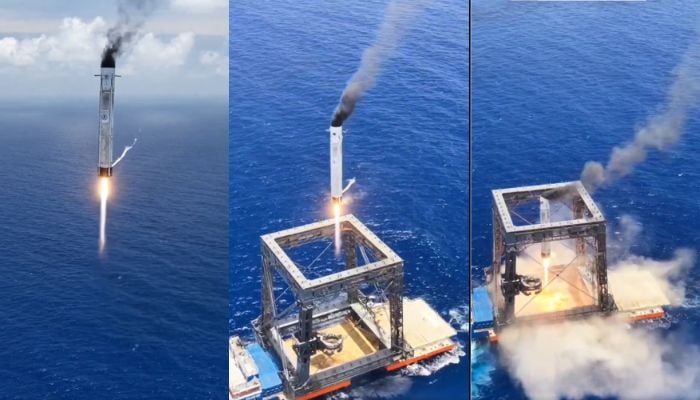
The payload was separated as planned and then the real milestone was achieved. About six minutes after the first and second stages separated, the booster came back down, marking the historic first controlled rocket recovery for China.
The feat was previously only achieved by Elon Musk’s SpaceX.
The landing was much different and what many analysts described as “more efficient” than SpaceX’s Falcon 9. The American space exploration technology company’s rocket lands upright on deployable legs, either on solid ground or a floating drone ship.
China skipped the legs entirely and designed a custom built recovery vessel, named Linghangzhe. CALT structural expert Chen Muye said the net system trims weight, boosts payload capacity and gives more room for error if the rocket doesn't land in exactly the right spot.
A spokesperson for Foreign Ministry of China, Mao Ning, shared a celebratory post on X, sharing a video of the rocket landing back in the net.
She captioned: "A historic day in China’s space program! China’s Long March-10B has successfully completed its maiden flight—and recovered its first stage via a sea-based net. This marks the country’s first-ever controlled rocket recovery. A major leap toward reusable launch capabilities."

Engineer Xu Xuelei said the ship's tower structure locks onto the deck with four massive supports. LiDAR sensors on each corner track the rocket in real time and guide cables that absorb the impact, leaving the booster hanging still at the center of the net.
The Long March-10B stands 63 meters tall and can haul 16 tonnes to low Earth orbit in reusable mode, matching the weight class of Falcon 9.
There's a longer game here too. The rocket is part of the Long March-10 family being developed for China's crewed moon missions before 2030. Beijing plans to reuse this same booster for another flight before the end of the year.
Meanwhile, a companion vehicle, the Long March-10C, is already in development with even higher payload capacity.