Brics nations call for 'maximum restraint' in Middle East amid tensions
Group expresses serious concern over deliberate attacks on civilian infrastructure and peaceful nuclear facilities
Published September 12, 2026
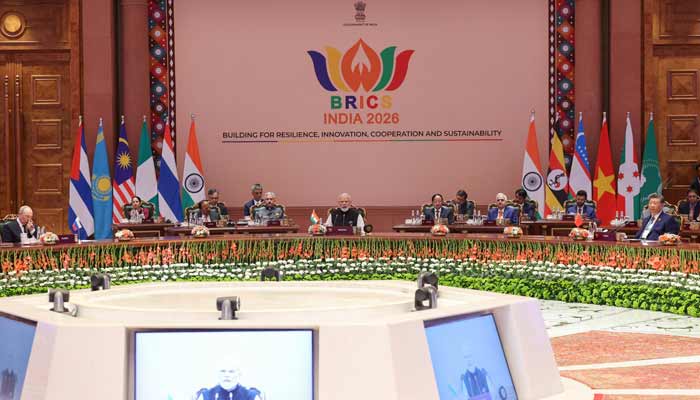
- Group says avoid actions that could further aggravate situation.
- Brics states condemn attacks on civilian, nuclear infrastructure.
- Nations call for upholding "nuclear safeguards, safety, security”.
Members of the 11-nation Brics group, including China, Russia, Iran and India, called for calm in the Middle East, in a joint statement issued on Saturday at a summit in New Delhi.
"We express deep concern over the continued escalation of tensions in Middle East/West Asia and, recalling our respective national positions, call for exercising maximum restraint, as well as avoiding actions that could further aggravate the situation," said the statement.
Foreign ministers of the Brics grouping failed to agree on a joint statement when they met in New Delhi in May, with member states Iran, Saudi Arabia and the United Arab Emirates divided over the war that began with US-Israeli strikes on February 28.
But a statement was issued at the leaders' meeting on Saturday after intense diplomatic efforts by host India.
The statement also condemned attacks on civilian infrastructure and nuclear facilities.
"We express serious concern over deliberate attacks on civilian infrastructure and peaceful nuclear facilities under full safeguards of the International Atomic Energy Agency (IAEA), in violation of international law and relevant resolutions of the IAEA," it said.
"Nuclear safeguards, safety, and security must always be upheld, including in armed conflicts, to protect people and the environment from harm."
Brics was created in 2009 as a forum for major emerging economies seeking greater influence in institutions dominated by Western powers.
Chinese President Xi Jinping, speaking on Saturday at the opening of the two-day summit, said that the Middle East war "does not serve the common interests of the international community", according to state news agency Xinhua.
Indian Prime Minister Narendra Modi, Russian President Vladimir Putin, and Iranian President Masoud Pezeshkian are all at the summit.
"We note the current global context of polarisation and distrust and encourage global action to strengthen international peace and security," the joint statement read.
"We stress the need to work together to maintain smooth flow of global trade, supply chains and energy, in accordance with applicable international law," it added.
The UAE crown prince, Sheikh Khaled Bin Mohamed Bin Zayed Al Nahyan, is also at the summit in New Delhi, as is Egyptian President Abdel Fattah al-Sisi. Saudi Foreign Minister Prince Faisal bin Farhan is expected to join later on Saturday.