Pakistan's Makkah dilemma
Rapid advance of Houthis in Yemen created an unexpected strategic test for newly concluded Makkah Joint Defence Agreement between Saudi Arabia, Turkiye and Pakistan
Published September 16, 2026
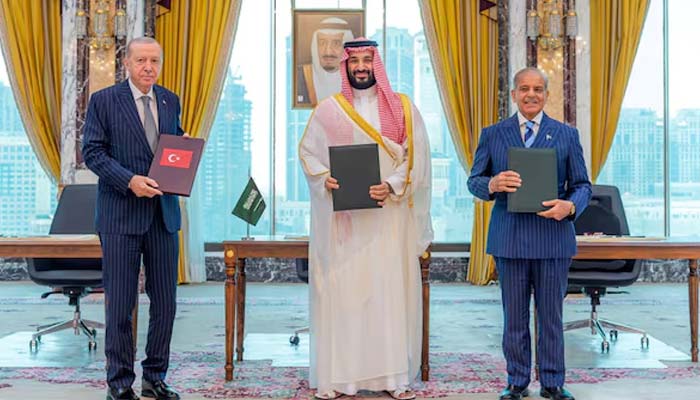
The rapid advance of the Houthis in Yemen has transformed the security situation around the Bab al-Mandab Strait and created an unexpected strategic test for the newly concluded Makkah Joint Defence Agreement between Saudi Arabia, Turkiye and Pakistan.
The Houthis’ capture of Perim (Mayun) Island, which sits strategically in the Bab al-Mandab, has given them a potentially decisive position over one of the world’s most important maritime chokepoints. More disturbing for Saudi Arabia is the Houthi declaration that the waterway will remain open to international shipping except for Saudi vessels.
The ongoing development raises a fundamental question: if the Houthis deliberately prevent Saudi shipping from using Bab al-Mandab, would this amount to an armed attack on Saudi Arabia under the Makkah Agreement? And, if so, what would Pakistan be expected to do as a signatory? Several factors surrounding the question require explanation.
First, the question could not have arisen at a more sensitive moment. The Makkah Joint Defence Agreement, signed on August 7 by Saudi Arabia, Turkiye and Pakistan, provides that an armed attack against any one of the three countries shall be regarded as an attack against all. The Foreign Office spokesperson has stressed that the agreement is defensive in nature and is intended to strengthen collective deterrence against external aggression. It also explicitly links collective defence to the inherent right of individual and collective self-defence under Article 51 of the UN Charter. The Houthi advance therefore presents the first major practical test of this new arrangement.
Second, Bab al-Mandab connects the Red Sea with the Gulf of Aden and the Indian Ocean. Its importance extends far beyond Yemen and Saudi Arabia. Any sustained disruption of the strait affects shipping between Asia and Europe through the Suez Canal and has immediate consequences for energy prices, insurance premiums and global supply chains.
The present crisis is particularly serious because the Strait of Hormuz is already severely disrupted. Bab al-Mandab has consequently become an important alternative route for Saudi oil exports to Asian markets. The Houthi advance threatens to close that alternative as well. According to recent reporting, disruption of Bab al-Mandab could affect a significant portion of global oil flows and international trade. The capture of Perim Island is therefore not simply another development in Yemen’s long-running civil war. It gives the Houthis a strategic position from which they can threaten maritime traffic passing through the strait.
Third, significantly, the Houthi position is not necessarily a threat to international shipping as a whole. It is the reported distinction between international shipping and Saudi shipping. This is strategically important. A general threat to navigation can be presented as an attempt to influence the international system or to deter military intervention. A policy specifically targeting Saudi vessels, however, is much easier to interpret as coercion directed against the Saudi state. For Riyadh, the danger is therefore twofold: the Houthis could threaten Saudi territory and infrastructure while simultaneously restricting the Kingdom's maritime access to Asian markets.
Fourth, can the Makkah Pact be invoked? The answer is not straightforward. The Makkah Agreement says that an armed attack against one of its members shall be considered an attack against all. It does not say that every hostile act, economic measure or threat automatically triggers collective military action. Pakistan itself has emphasised that the agreement is defensive and not directed against any particular country.
The situation would be fundamentally different, however, if Houthi forces were to fire missiles or drones at Saudi commercial vessels, seize Saudi ships, mine the international waterway, or use force systematically to prevent Saudi vessels from exercising their freedom of navigation. Such conduct could give Riyadh a much stronger basis to argue that it is facing an armed attack requiring collective self-defence. Hence the Makkah Agreement could acquire real operational significance.
Fifth, regarding Pakistan’s involvement, it would be wrong to assume that the agreement automatically requires Pakistan to send combat troops to Yemen. Pakistan interprets the Makkah Accord as a framework for collective defence and deterrence. Its practical response could therefore take several forms, depending on the nature and scale of the attack. These could include intelligence sharing, surveillance, air-defence assistance, protection of Saudi infrastructure, maritime security cooperation, naval deployment, logistical support and, if circumstances warranted, direct military action.
Sixth, Islamabad's greatest challenge may not be military but diplomatic. The Houthis are closely aligned with Iran. Any direct Pakistani military action against them could therefore be interpreted in Tehran as indirect participation in a confrontation with Iran. This would place Pakistan in an uncomfortable strategic position. On one side is Saudi Arabia, with which Pakistan enjoys exceptionally close political, economic and defence relations and with which it has now signed a collective-defence agreement. On the other is Iran, Pakistan's immediate neighbour with whom Islamabad has been trying to maintain constructive relations despite regional tensions. Pakistan would therefore have to take measures to prevent the Makkah Agreement from becoming a mechanism for confrontation with Iran.
As regards the maritime dimension, Pakistan has already made clear that attacks against Pakistani vessels or maritime interests would constitute a serious national-security concern. Pakistan has an obvious economic interest in freedom of navigation through Bab al-Mandab. Pakistani trade with Europe and the Middle East depends heavily on secure maritime routes. A prolonged closure or selective blockade would increase freight, insurance and energy costs for Pakistan at a time when its economy can ill afford another external shock.
For Pakistan, the dilemma is particularly acute. While it is committed to Saudi Arabia under the Makkah Agreement, its national interest requires avoiding another open-ended war in Yemen and preserving workable relations with Iran. Pakistan must reduce the risk of war engulfing Saudi Arabia and Makkah Pact partners. The main issue is whether Islamabad can defend its ally, protect freedom of navigation and preserve the credibility of collective defence without being drawn into another war in Yemen or a wider confrontation with Iran.
Bab al-Mandab may thus become the first real test not only of the Makkah Agreement, but of Pakistan's diplomatic ability to balance strategic commitments with the imperatives of national interest.
The writer is a former ambassador of Pakistan to Iran and the UAE. He is also a former special representative of Pakistan for Afghanistan and currently serves as a senior research fellow at the Islamabad Policy Research Institute (IPRI).
Disclaimer: The viewpoints expressed in this piece are the writer's own and don't necessarily reflect Geo.tv's editorial policy.