Egyptian farmer uncovers Colossal statues of Ramses II beneath his cucumber field
Farmer’s pink stone find leads archaeologists to 28-ft Ramses II statue
Published October 28, 2026
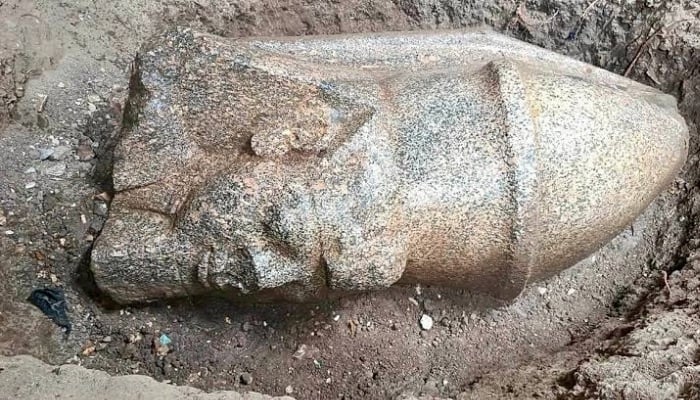
A cucumber farmer in Egypt’s Nile Delta has helped archaeologists uncover the remains of two colossal royal statues, including one identified as Pharaoh Ramses II, in a find that experts say could reshape understanding of the area’s ancient history.
Khaled al-Shahat was tending his land in the village of Behbeit El-Hagar when he stumbled upon a pink granite stone covered in hieroglyphic inscriptions, according to the Egyptian Ministry of Tourism and Antiquities.
He alerted local authorities, who sent a team from the Supreme Council of Antiquities. The Supreme Council of Antiquities sent a team to conduct a rescue excavation.
Archaeologists recovered a five-ft tall head depicting Ramses II wearing the double crown of Upper and Lower Egypt, along with part of the statue’s back pillar bearing one of his royal names.
On the basis of the head’s proportions, it is estimated that the complete statue, including its base, may have originally stood nearly 28ft tall.
They also found part of a second statue measuring nearly eight feet long, missing its legs and base, but with facial features that closely resemble the first. A separate pink granite block, about four feet long, carries inscriptions including the titles “King of Upper and Lower Egypt” and “Son of Ra.”
Ramses II was an Egyptian pharaoh who ruled between 1279 and 1213 B.C., and he has been noted as being one of the greatest builders of the New Kingdom era. It is thought by some scholars that Ramses II may be the unidentified pharaoh that faced off against Moses in the Book of Exodus.
The Behbeit el-Hagar is more famous for its ruined temple that is dedicated to the goddess Isis. Further excavations are being carried out to find out how the newly found fragments connect with each other as well as with the rest of the site.
Minister of Tourism and Antiquities Sherif Fathy thanked the farmer for informing him about the discovery, and al-Shahat, along with his wife, received a free trip to carry out Umrah.