'Made history': Pakistan cheers as astronaut Zeeshan Ali flies pioneering mission
Muhammad Zeeshan Ali, a PAF pilot and payload specialist, is first foreign astronaut to fly on Chinese space mission
Published November 25, 2026
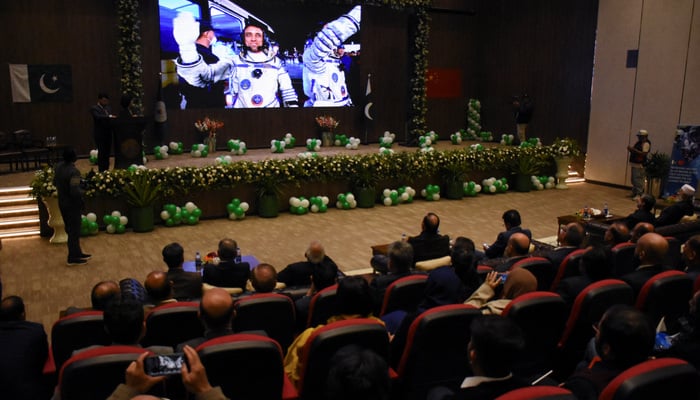
Cheers erupted in the packed auditorium of Islamabad's space agency before dawn on Wednesday as a Pakistani astronaut cleared the launch tower on a groundbreaking mission thousands of kilometres away in northwest China.
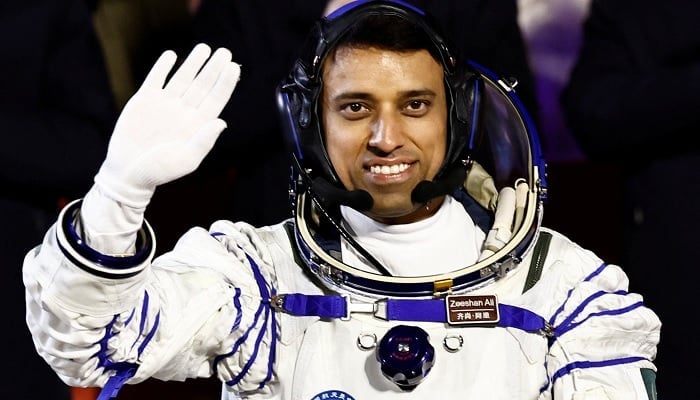
Muhammad Zeeshan Ali, a Pakistan Air Force (PAF) pilot and payload specialist, is the first foreign astronaut to fly on a Chinese space mission and also the first non-Chinese national to board the Tiangong space station.
As Pakistan's national anthem rang out at the Islamabad headquarters of the national space commission, hundreds of scientists, students and officials — many of whom had gone without sleep — watched Ali lift off on a big screen aboard the Shenzhou-24 alongside two Chinese crewmates.
"I feel goosebumps just seeing the launch," Zainab Abbasi, a physics and astronomy student, said after watching the launch at the Space and Upper Atmosphere Research Commission (Suparco) building in the Pakistani capital.
"I could have never imagined that so soon in my life I would see a Pakistani astronaut go to space," said Abbasi, a keen amateur astronomer.
Ali is the first Pakistani to reach orbit, though adventurer Namira Salim travelled to space on a commercial suborbital flight in October 2023.
Ali will spend one week in orbit and return on the Shenzhou-23 spaceship, which is already docked at the Tiangong station.
'Our astronaut'
Muhammad Yousaf Khan, the head of Suparco, said he had been worried that there would be few attendees given the 5:18am launch time.
"But now I see there isn't a seat left," he said, pointing to the crowded room where many audience members were clutching Pakistani and Chinese flags.
"That shows how attached everyone is to our astronaut, this mission and the hard work behind it," he added.
While Pakistan's space agency has launched six satellites in the past 30 months, Khan said Ali's lift-off had set pulses racing in a special way.
"With every launch our hearts were pounding, hoping it would succeed and the satellite would do everything it was designed for. But today we all feel something different," he added.
The space agency chief said Ali would carry out four experiments in orbit — among them studies of microalgae, self-healing materials for spacecraft and growing quinoa beyond Earth.
These were chosen from more than 300 proposals for spaceflight experiments sent in by Pakistani universities, Khan explained.
The selection process for astronauts was gruelling, with more than 50 candidates screened.
19 of them were then sent to China for tests and two were eventually picked: Ali from the Pakistan Air Force and Khurram Daud from the navy, Suparco said.
'Made history'
Their training, which included centrifuge and underwater drills, ran about seven months instead of the planned six.
Pakistan's space programme began in 1961, and its first rocket, Rehbar 1, blasted off the following year.
Now it is partnering extensively with close ally China to achieve its spaceflight goals.
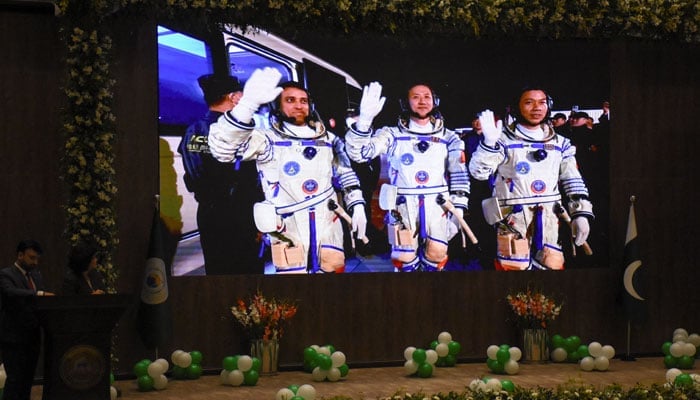
The two countries signed a deal in February 2025, setting up a Chinese government training programme for Pakistani astronauts.
Asked whether Pakistan would build its own technology or keep depending on China, Professor Raza Akbar of the Institute of Space Technology (IST) said developing any independence from Beijing would be "a gradual process".
"Initially we collaborate... we get the technology, we get the mentorship, and collectively we develop," he added.
Invoking a frequently repeated description of Pakistan's friendship with China as being higher than the Himalayas, Akbar said: "The maximum height (of the mountain range) is nine kilometres. Today we have reached 400 kilometres."
Amna Ijaz Aziz, also from the IST, struggled for a moment to express how she felt about Ali's achievement.
"You've made history for all of us," she said.
"I'm already seeing your name, and children learning about you in our future classes."