Nasa's asteroid-deflection test leaves giant crater, sends hundreds of boulders drifting in space
New images from European Space Agency's Hera spacecraft show one side of the asteroid flattened by collision
Published November 26, 2026
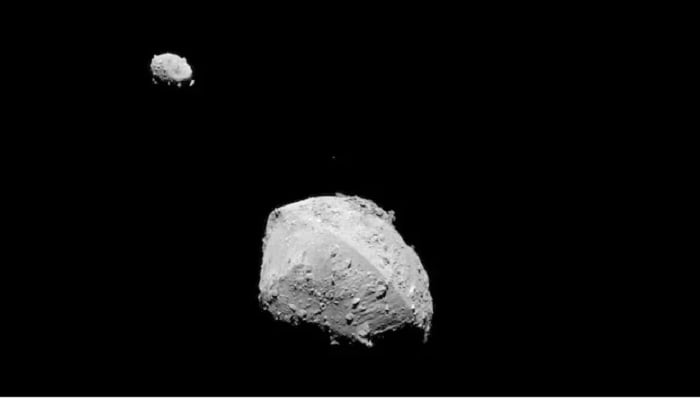
Nasa's 2022 planetary defence experiment left one side of the asteroid Dimorphos flattened and covered by a stadium-sized crater, with the space rock now tumbling chaotically and hundreds of boulders floating around it, new images released by the European Space Agency (ESA) showed on Wednesday.
The images, captured by ESA's Hera spacecraft, offer the clearest close-up assessment yet of the physical damage caused when NASA's Double Asteroid Redirection Test (DART) spacecraft deliberately smashed into Dimorphos in September 2022.
"The side impacted is now completely covered by a crater, with the visual impression that a piece of the asteroid was cut off by the impact. We do not see evidence for major changes on the site opposite to the DART impact. The combination of those two observations is surprising," Michael Kueppers, ESA's Hera mission scientist, told Reuters.
The enormous crater covers nearly the entire front-facing side of Dimorphos, an oblong-shaped asteroid measuring about 151 metres (495 feet) across, which orbits the much larger asteroid Didymos.
Kueppers said Dimorphos was now rotating in an unpredictable manner, with hundreds of boulders drifting around the asteroid system.
The findings provide scientists with a more detailed understanding of how a high-speed spacecraft collision can physically alter an asteroid, helping assess the effectiveness of using kinetic impactors to deflect space rocks that could threaten Earth.
The two asteroids are classified as near-Earth objects, although neither poses a threat to Earth. They are currently about 193.5 million kilometres from the planet.
Before the new images became available, observations had already confirmed that DART successfully altered Dimorphos's orbit around Didymos, shortening its orbital period by approximately 33 minutes. The experiment demonstrated that a spacecraft could change the trajectory of an asteroid, potentially offering a way to deflect one heading towards Earth.
However, the extent of the physical damage caused by the collision remained unclear.
ESA said the latest images showed that the rest of Dimorphos had not undergone comparable visible changes, with boulder-covered regions away from the impact site appearing largely unchanged from images captured before the collision.
The images also revealed hundreds of previously unidentified boulders, some several metres across, surrounding the two-asteroid system. Scientists are investigating their origins and will need to account for them as Hera moves closer to the objects.
Hera, a spacecraft roughly the size of a small car, is currently observing Didymos and Dimorphos from a distance of about 25 to 30 kilometres. It is scheduled to approach within approximately 13 kilometres next month to obtain higher-resolution images.
In January, the mission is due to deploy two shoebox-sized miniature satellites, known as CubeSats, which will move closer to the asteroids to investigate their surface and internal structure.
Hera mission manager Ian Carnelli unveiled the images at the Museum für Naturkunde in Berlin, in its dinosaur hall, highlighting the threat posed by asteroid impacts. An asteroid collision 66 million years ago triggered a mass extinction on Earth, wiping out the dinosaurs.
The DART spacecraft, short for Double Asteroid Redirection Test, struck Dimorphos on September 26, 2022, at a speed of approximately 22,530 kilometres per hour.
"We knew that the DART mission impacted Dimorphos successfully and that it changed its orbit. But we did not know what happened to Dimorphos itself," Kueppers told Reuters.
He said understanding the physical consequences of the collision and characterising the asteroid would be essential before the kinetic-impact technique could be deployed against another space rock on a potential collision course with Earth.