Parents of ailing one-year-old await Indian medical visas
Ayaan was six months old when his primary care doctor Dr Zaheer Ahmed told the parents that his congenital heart ailment requires urgent surgery
Published March 28, 2018
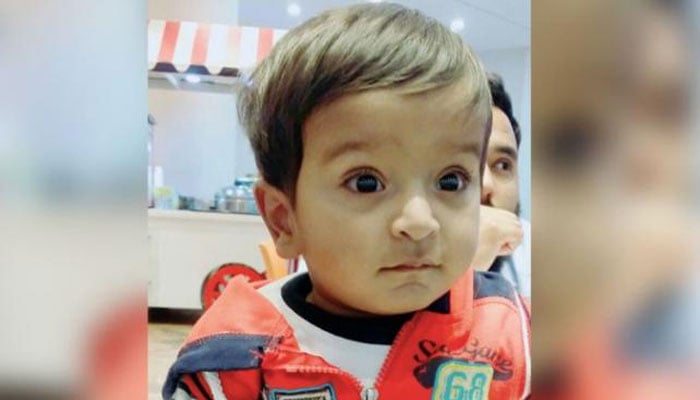
ISLAMABAD: Parents of ailing one-year-old Muhammad Ayaan Asad Khan are still waiting for the response from Indian High Commission on their medical visa request, The News reported on March 23.
The Paediatrics Cardiology department at the All India Institute of Medical Science gave ailing one-year-old Muhammad Ayaan Asad Khan in Pakistan an appointment for March 23, 2018 but the parents, Asad Ikram and Hadia Izhar, who sent in their Indian visa applications on March 1, 2018, are still waiting for the approval on their request.
Ikram, a sales and marketing executive with a trade company, said he has visited the Indian High Commission in Islamabad three times with the necessary documents, twice taking little Ayaan with him.
“His growth has halted since the past three months. We are desperate to take him for the surgery,” he told The News’ reporter Zoya Anwer. “He turns blue because of lack of oxygen in his body.”
The one-year-old still weights just 8.2 kg, which is on the lower side for his age.
“He is very cranky at night because of sleeplessness, but we are far more worried about the fact that he doesn’t walk or crawl. He started to stand on his feet with balance but hasn’t even been doing that for the past few days,” says the baby’s mother.
An only child, Ayaan was six months old when his primary care doctor Dr Zaheer Ahmed told the parents that his congenital heart ailment requires urgent surgery.
The condition is Tetralogy of Fallot (TOF), which means there are four hindrances to the flow of blood to his heart: a hole between the heart’s ventricles, the thickening of a muscle surrounding the lower right chamber, blood from both ventricles entering a displaced aorta (the largest artery) and an obstruction in the flow of blood between the heart and lungs.
In Pakistan, children with such ailments are usually treated after they are at least a year old.
Ikram and Hadia also consulted paediatric cardiologists at the National Institute of CardoVascular Diseases (NICVD) and Aga Khan University Hospital (AKUH), who seconded Dr Ahmed’s advice for surgery at the earliest. They suggested hospitals in India that could more efficiently handle the case.
“We request the Indian High Commission, especially Sushma Swaraj, India’s Minister of External Affairs, to look into our child’s case because he needs to be treated urgently,” Ikram said. “Each day is more difficult than the one before.”
While doctors in Pakistan do successfully conduct paediatric heart surgeries, it will be a while before the eco-system around such surgeries is developed to provide the necessary post-operation care for babies with complicated heart ailments like Ayaan and Maier. In this scenario, observers say that not providing medical visas in a timely manner can lead to tragic consequences especially for little patients.