US president says second Venezuela strike possible if interim govt doesn't cooperate
Trump's comments to reporters aboard Air Force One raise possibility of further US military interventions in Latin America
Published January 05, 2026
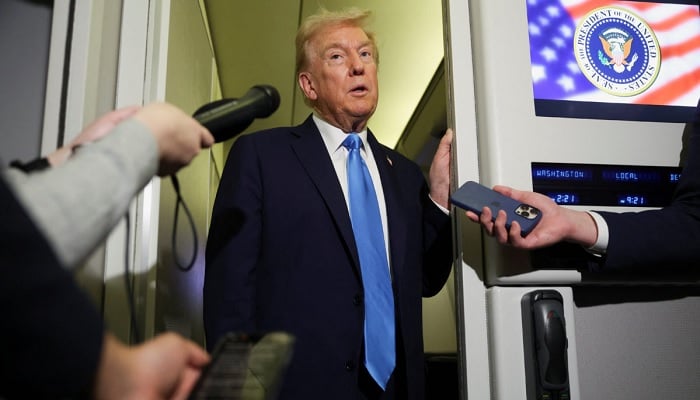
- Trump suggests military action on Colombia, Mexico also possible.
- Says Venezuelan immigrants in the US were also a factor in raid.
- Caracas streets quiet amid anxiety over next developments.
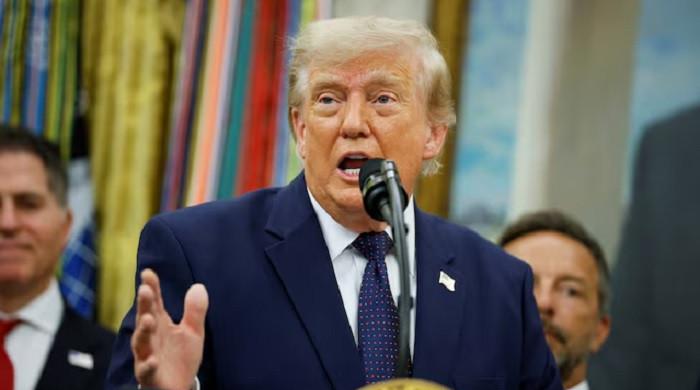
US President Donald Trump said on Sunday that the United States might launch a second military strike on Venezuela following the capture of President Nicolas Maduro if remaining members of the administration do not cooperate with his efforts to get the country "fixed."
Trump's comments to reporters aboard Air Force One raised the possibility of further US military interventions in Latin America and suggested Colombia and Mexico could also face military action if they do not reduce the flow of illicit drugs to the United States.
"Operation Colombia sounds good to me," Trump said. He also said that Cuba, a close ally of Venezuela, "looks like it's ready to fall" on its own without US military action.
Maduro is in a New York detention centre awaiting a Monday court appearance on drug charges. His capture by the United States has sparked deep uncertainty about what is next for the oil-rich South American nation.
Trump said his administration will work with remaining members of the Maduro regime to clamp down on drug trafficking and overhaul its oil industry, rather than push for immediate elections to install a new government.
Top officials in Maduro's government are still in charge and have called the detentions of Maduro and his wife Cilia Flores a kidnapping.
"Here, there is only one president, whose name is Nicolas Maduro Moros. Let no one fall for the enemy’s provocations," Interior Minister Diosdado Cabello said in an audio recording released by the ruling PSUV socialist party.
Images of the 63-year-old Maduro, blindfolded and handcuffed, stunned Venezuelans. The operation was Washington's most controversial intervention in Latin America since the invasion of Panama 37 years ago.
Defence Minister General Vladimir Padrino said on state television the US attack killed soldiers, civilians and a "large part" of Maduro's security detail "in cold blood." Venezuela’s armed forces have been activated to guarantee sovereignty, he said.
The Cuban government said 32 of its citizens were killed during the raid.
Vice President Delcy Rodriguez — who also serves as oil minister — has taken over as interim leader with the blessing of Venezuela's top court and has said Maduro remains president.
Rodriguez has long been considered the most pragmatic member of Maduro's inner circle. But she has publicly contradicted Trump's claim that she is willing to work with the United States.
Trump said Rodriguez may pay a higher price than Maduro "if she doesn't do what's right," according to an interview with The Atlantic magazine on Sunday.
The Venezuelan communications ministry did not immediately respond to a request for comment on that remark.
'A quarantine on their oil'
Trump's administration has described Maduro's capture as a law-enforcement mission to force him to face US criminal charges filed in 2020, including narco-terrorism conspiracy. Maduro has denied criminal involvement.
But Trump also said US oil companies need "total access" to the country's vast reserves and suggested that an influx of Venezuelan emigrants to the United States also factored into the decision to capture Maduro.
"What really played (into the decision to capture Maduro) is the fact that he sent millions of people into our country from prisons and from mental institutions, drug dealers, every drug addict in his country was sent into our country," Trump said.
The Venezuelan government has said for months that Trump was seeking to take the country's natural resources, especially its oil, and officials made much of a previous Trump comment that major US oil companies would move in.
“We are outraged because in the end everything was revealed — it was revealed that they only want our oil,” Cabello said.
Once one of the most prosperous nations in Latin America, Venezuela's economy tanked in the 2000s under President Hugo Chavez and nosedived further under Maduro, sending about one in five Venezuelans abroad in one of the world's biggest exoduses.
US Secretary of State Marco Rubio said Venezuela's next leader should keep Venezuela's oil industry out of the hands of US adversaries and stop drug trafficking, and cited an ongoing US blockade on tankers.
"That means their economy will not be able to move forward until the conditions that are in the national interest of the United States and the interest of the Venezuelan people are met," he said on ABC's "This Week."
Muted streets
Some Maduro supporters gathered at a government-sponsored protest march on Sunday afternoon in Caracas.
Once ruled by Spain, Venezuela's "people must not surrender, nor should we ever become a colony of anyone again," said demonstrator Reinaldo Mijares. "This country is not a country of the defeated."
Maduro opponents in Venezuela have been wary of celebrating his seizure, and the presence of security forces seemed, if anything, lighter than usual on Sunday.
Despite a nervous mood, some bakeries and coffee shops were open and joggers and cyclists were out as usual. Some citizens were stocking up on essentials.
“Yesterday I was very afraid to go out, but today I had to. This situation caught me without food, and I need to figure things out. After all, Venezuelans are used to enduring fear," said a single mother in oil city Maracaibo who bought rice, vegetables and tuna.
To the disappointment of Venezuela's opposition, Trump has given short shrift to the idea of 58-year-old opposition leader and Nobel Peace Prize winner Maria Corina Machado taking over, saying she lacked support.
Machado was banned from standing in the 2024 election but has said her ally Edmundo Gonzalez, 76, who the opposition and some international observers say overwhelmingly won that vote, has a democratic mandate to take the presidency.
Looming questions
US Senate Democratic leader Chuck Schumer said the White House has failed to say how long the US intends to be in Venezuela and how many American troops might be required.
"The American people are worried that this is creating an endless war — the very thing that Donald Trump campaigned against," Schumer said on ABC's "This Week." He said lawmakers would weigh a measure to constrain further Trump administration action in Venezuela, though its prospects could be uncertain given that Congress is controlled by Trump's Republicans.
While many Western nations oppose Maduro, there were many calls for the US to respect international law, and questions arose over the legality of seizing a foreign head of state.
The UN Security Council planned to meet on Monday to discuss the attack. Russia and China, both major backers of Venezuela, have criticised the US.