Trump tempers expectations of a Middle East deal with Iran
Blockade will remain in full force until agreement is reached, certified and signed, says US president
Published May 25, 2026
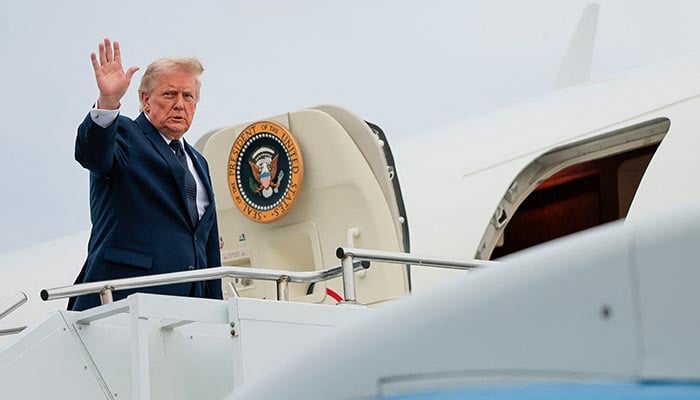
- Trump says informed representatives not to rush into deal.
- Tasnim says key clauses of possible deal remained "unresolved".
- Talks on nuclear issue deferred for 60 days after any deal: Iran.
US President Donald Trump tempered expectations of a Middle East deal by saying he had told his negotiators not to "rush," even after both Tehran and Washington signalled progress towards an agreement to end the war.
The United States and Iran have observed a ceasefire since April 8 while mediators push for a negotiated settlement, although Iran has imposed controls on Gulf shipping and the US has blockaded Iran's ports.
The war erupted after the United States and Israel attacked the Islamic Republic on February 28, and Iran responded with missile and drone attacks across the region.
"I have informed my representatives not to rush into a deal in that time is on our side," Trump said in a social media post Sunday.
"The Blockade will remain in full force and effect until an agreement is reached, certified and signed," he added.
Earlier, Trump had posted that the deal "has been largely negotiated, subject to finali[s]ation between the United States of America, the Islamic Republic of Iran and the various other Countries."
Iran's Tasnim news agency said Sunday its information was that key clauses of a possible agreement remained "unresolved at this time," including the issue of frozen Iranian assets.
Nuclear issue
US Secretary of State Marco Rubio, meanwhile, told The New York Times that an agreement with Iran had garnered regional support but a nuclear deal couldn't be achieved "in 72 hours on the back of a napkin."
"Right now, we have seven or eight countries in the region that are endorsing this approach, and we´re prepared to move forward on this approach," he said.
Earlier, Rubio had said a bargain could be struck to end the regional war as early as Sunday.
But Trump again reined in expectations, posting on social media that "If I make a deal with Iran, it will be a good and proper one" and adding: "It isn't even fully negotiated yet."
Staunch Trump ally Israeli Prime Minister Benjamin Netanyahu said Sunday that he and the president had agreed that "any final agreement with Iran must eliminate the nuclear threat entirely."
'Lasting peace'
Iranian officials confirmed the existence of a draft agreement but stressed that — despite the long-standing US demand for an end to its uranium enrichment — talks on the issue of Iran's contested nuclear programme have been deferred for 60 days after any deal.
Iranian President Masoud Pezeshkian told state television that Tehran was "still prepared to assure the world that we are not seeking nuclear weapons," but it was unclear if this promise would be enshrined in the text of the deal.
According to Iran's Fars news agency, "sanctions on oil, gas, petrochemicals and their derivatives would be temporarily lifted during the negotiation period so that Iran can freely sell its products."
Leaders from Saudi Arabia, the United Arab Emirates, Qatar, Egypt, Jordan and Bahrain, as well as representatives from Turkey and Pakistan, joined a call with Trump to discuss the deal on Saturday.
Pakistan, which mediated historic face-to-face negotiations between US and Iranian delegations in April, hopes to host another round of talks "very soon," Prime Minister Shehbaz Sharif said.
He said Chief of Army Staff and Chief of Defence Forces Field Marshal Asim Munir, who visited Tehran on Friday and Saturday, also joined the call, which "provided a useful opportunity... to move the ongoing peace efforts forward to bring lasting peace in the region."