Pakistan's economy size reaches 'highest-ever' level but misses growth target
FinMin Muhammad Aurangzeb says GDP size surpasses $450 billion, registers 3.7% growth
Published June 11, 2026
- Economy missed its projected growth target of 4%, says FinMin.
- Economy performed well despite Middle East crisis. Aurangzeb.
- Planning minister says reducing imports remains govt's priority.
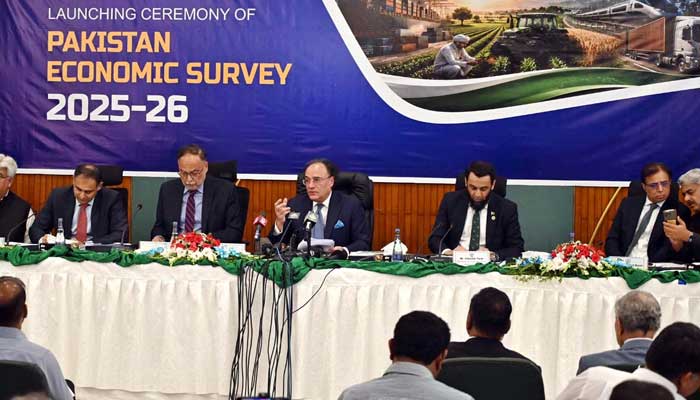
ISLAMABAD: Pakistan’s gross domestic product (GDP) hit its highest-ever size, but the South Asian nation missed its growth target due to external shocks, Finance Minister Muhammad Aurangzeb said on Thursday.
“The GDP […] hit $452.1 billion, which is the highest ever in the country’s history,” the finance czar told a press conference in Islamabad as he unveiled the Economic Survey 2025-26, ahead of the upcoming fiscal year’s budget.
The GDP, valued at current market prices, reached Rs126.9 trillion ($452.1 billion), showing 11.3% increase from the previous year’s Rs114.0 trillion ($ 408.2 billion).
Flanked by his cabinet colleagues, the FinMin also told journalists that the nation — hit severely by an energy crisis due to Middle East tensions — missed its projected growth target of 4% despite recording its highest GDP growth of 3.7% in four years.
Aurangzeb said Pakistan’s economy performed well despite internal and external challenges, including the ongoing crisis in the Middle East.
The minister said the economy faced uncertainty at the start of the fiscal year, while monsoon rains also affected economic activity.
He added that the imposition of tariffs by the United States on various countries further contributed to uncertainty in the global economic environment.
Despite these challenges, the minister said the country’s economy delivered a better-than-expected performance and the government succeeded in navigating multiple crises during the year.
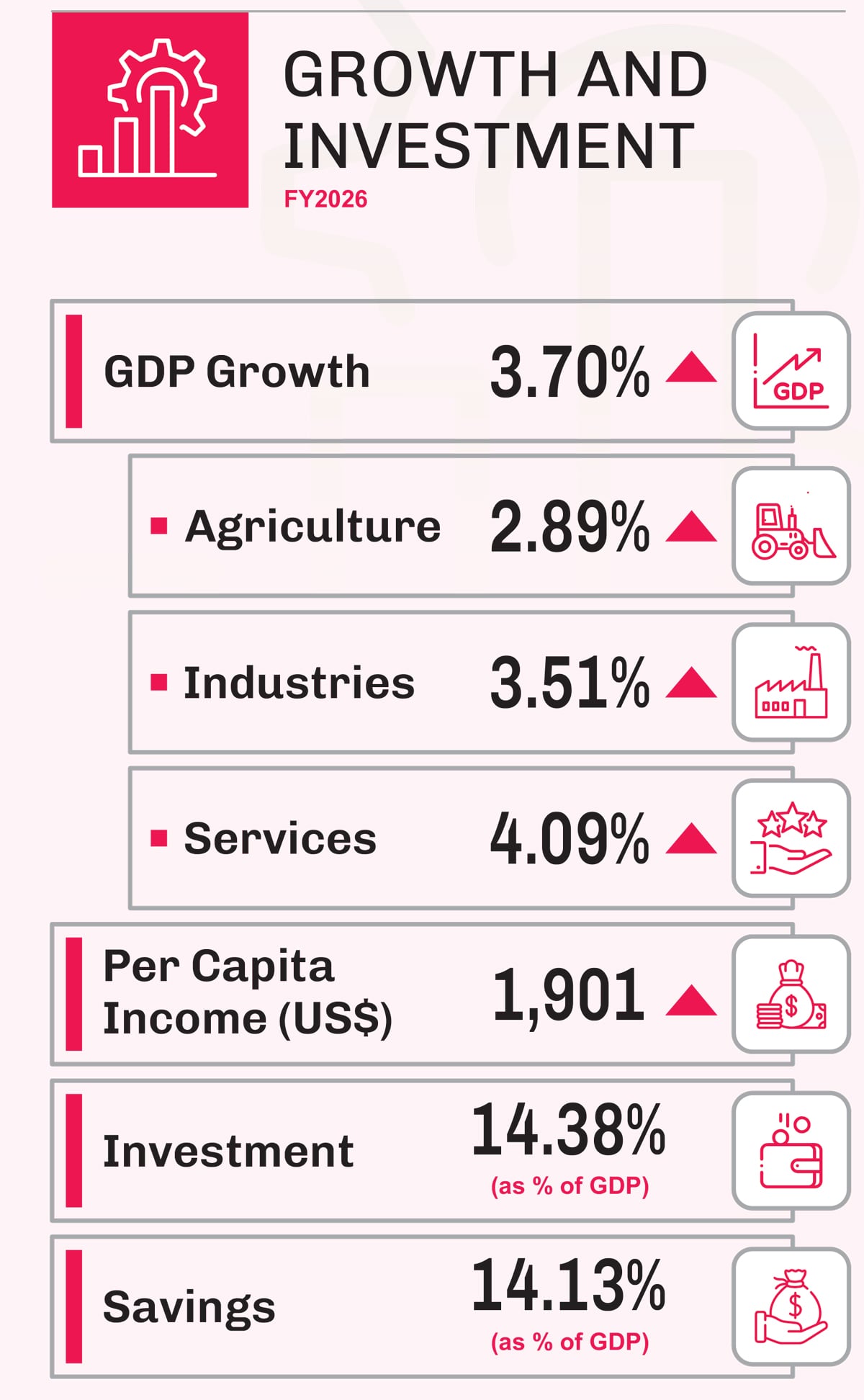
Aurangzeb said Pakistan recorded an economic growth rate of 3.7% during FY2025-26. He noted that global uncertainty had also affected international economies and that the government had expected growth to exceed 4% during the fiscal year.
Middle East crisis
Referring to developments in the Middle East, the finance minister said Pakistan’s economic performance remained strong despite the regional crisis. He added that gross domestic product (GDP) growth could have surpassed 4% had the situation in the Middle East not emerged.
The minister said the size of Pakistan’s economy had crossed $452 billion, reaching $452.1 billion during the fiscal year. He added that per capita annual income increased from $1,751 to $1,901.
Providing sector-wise details, Aurangzeb said the cement sector posted growth of 10%, while the fertiliser sector expanded by 17%. The petroleum sector recorded growth of 5%, he added.
The finance minister further said Pakistan’s current account remained in surplus by $72 million during the July-March period of the fiscal year.
Aurangzeb said positive trends were recorded across 16 sectors, including food and textiles, while 16 of the country's 22 manufacturing sectors showed improvement during the fiscal year. He added that demand for goods increased significantly, with the digital economy playing an important role in supporting economic activity. The services sector recorded growth of 4.9%, he said.
'Inflation declined significantly'
On the fiscal front, the finance minister said Pakistan maintained a surplus position and showed improvement due to fiscal discipline. He said the fiscal deficit stood at 0.7%, while the primary balance remained in surplus. During the July-March period, the primary surplus was recorded at 3.2% of GDP.
Aurangzeb said inflation had declined significantly from the highs seen in recent years, with average inflation recorded at 6.7% during the July-May period. He added that Federal Board of Revenue (FBR) revenues increased by 10.1%, while remittances also posted substantial growth.
The finance minister said foreign exchange reserves stood at around $17.1 billion and were expected to reach $18 billion by the end of June. As of May 29, 2026, reserves had reached $17.2 billion, reflecting a 49% increase on an annual basis. He added that Pakistan had an import cover of 2.75 months.
Highlighting external sector performance, Aurangzeb said overseas Pakistanis sent a record $33.9 billion in remittances during the July-May period, while inflows reached a historic monthly high of $4.3 billion in April 2026. He thanked overseas Pakistanis for their continued contribution to the economy and said remittances played an important role in economies around the world.
The minister said information technology and technology-related exports reached $3.8 billion during the July-April period. Exports generated by freelancers amounted to $959 million, approaching the $1 billion mark, he added. He further said deposits under the Roshan Digital Account initiative had reached a record $12.7 billion.
Aurangzeb said the Pakistan Stock Exchange's investor base had surpassed 563,000, while a record 11 new companies had been listed on the exchange so far this year. He added that more than 39,000 new companies had been registered in the country, taking the total number of registered companies to over 297,000.
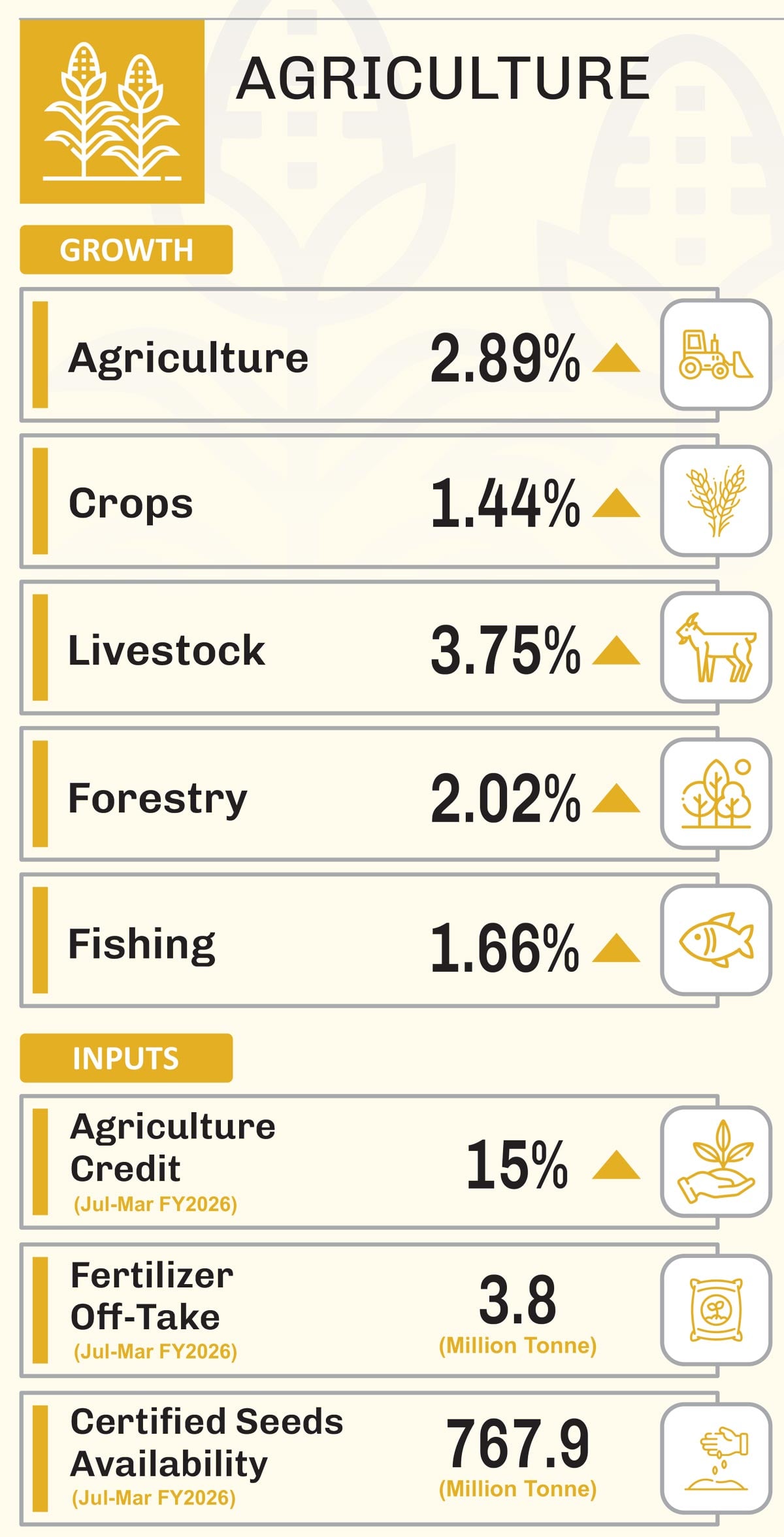
According to the finance minister, private sector credit increased by 934 billion rupees during the July-March period, while agricultural financing reached 2.162 trillion rupees over the same period.
He said the budget allocation for the Benazir Income Support Programme (BISP) had been increased to 722.5 billion rupees to support low-income families. Aurangzeb added that work had been accelerated on the privatisation of state-owned entities, including Pakistan International Airlines (PIA), First Women Bank Limited (FWBL) and power distribution companies (DISCOs).
The minister said the government had also initiated a rightsizing exercise, including the merger of ministries and the closure of several departments, among them the Pakistan Public Works Department (PWD).
Aurangzeb said the country's literacy rate had reached 63%. He also acknowledged the support provided by the United Arab Emirates over an extended period, describing it as an important partner for Pakistan.
The finance minister said remittances had exceeded $33 billion during the first 10 months of the current fiscal year, while foreign exchange reserves were projected to reach $18 billion by the end of June.
'Growth hinges on stability'
Planning Minister Ahsan Iqbal said Pakistan had not been able to build an export-led economy, stressing that sustainable economic growth depended on continuity in policies and political stability.
The minister said long-term economic progress could only be achieved through consistent policymaking and a stable political environment.
FBR Chairman Rashid Mahmood Langrial said revenue collection stood at $32.6 billion in June 2024, increasing to $41.9 billion in June 2025 and $46.4 billion in June 2026. He said revenue collection had increased by $14 billion over the two-year period, reflecting growth of 46%.
Langrial said tax collection in June 2026 amounted to 46.4 billion rupees. He added that revenue collections had increased by 46% over the past two years.
Planning Minister Iqbal said reducing imports remained a government priority. He said Pakistan needed to move forward with a positive outlook and added that the country was on a path of recovery and improvement.
Iqbal said Pakistan had not been able to build an export-led economy. He added that continuity of policies and political stability were the foundation of economic development.
Meanwhile, Finance Minister Aurangzeb said information technology exports were expected to reach $4.5 billion. He added that imports had increased by $1 billion due to machinery imports, describing machinery imports as a positive development.