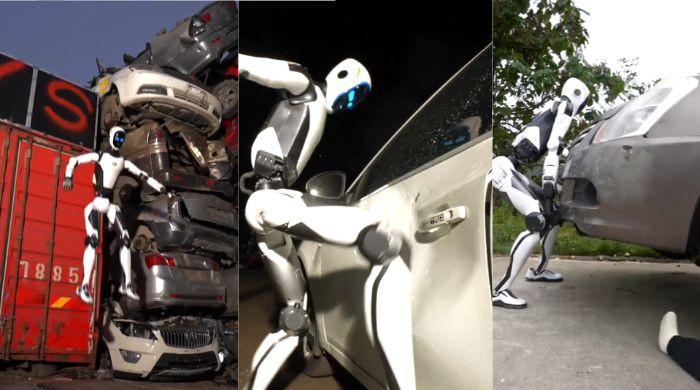
Chinese military intensifies push for war-ready robots: What's changing
State-owned defense firm Norinco has publicized its Fuxi humanoid, describing it as suited for sentry duty
Published September 07, 2026

Robots that danced, boxed and raced at last month’s World Humanoid Robot Games in Beijing are now drawing serious attention from China’s military planners.
Just days after the event wrapped up, the People’s Liberation Army’s official newspaper urged researchers to move advanced humanoid technology from labs and demonstration stages onto training grounds for use as robotic combatants.
A Reuters examination of more than 100 military procurement notices, academic papers, patents and official records shows the defense establishment is actively exploring how these machines could support or join troops in future operations.
Chinese manufacturers already dominate global humanoid robot production, accounting for roughly 95 percent of shipments in 2025. That industrial base gives the PLA ready access to hardware while it develops military-specific applications focused on perception, manipulation and training data. Work in this area picked up noticeably in 2025 and 2026.
One August 2025 study from researchers at the National University of Defense Technology outlined a possible urban assault scenario. Six “combat robots” , a mix of humanoids, robot dogs and unmanned vehicles,would split into two teams and work alongside ground forces to clear an occupied building floor by floor.
The paper projected the necessary technology could be available within five to 10 years but did not detail weapons, rules of engagement or how civilians would be handled.
Other military materials describe robots infiltrating behind enemy lines to map areas and locate targets, or performing security patrols and identity checks at bases. A July 2025 PLA Daily article suggested roles could eventually expand from support missions toward primary combat tasks, including limited authority to engage verified targets under human oversight.In December, the PLA’s Eastern Theater Command released an AI-generated video depicting humanoid and quadruped robots overwhelming defenses in a hypothetical conflict involving Taiwan.
Procurement records reflect the interest. In 2025 the PLA sought to buy a humanoid robot along with installation and training support. Another notice requested an “embodied humanoid robot intelligent perception and dexterous operation system.”
This year the military budgeted roughly $300,000 for equipment to gather and label camera, radar and motion data that would help robots navigate varied terrain.
State-owned defense firm Norinco has publicized its Fuxi humanoid, describing it as suited for sentry duty, reconnaissance and hazardous tasks and capable of remote teleoperation by a human controller.
No evidence has emerged that China has fielded an armed humanoid with an operational unit. The machines remain power-hungry and struggle outside carefully controlled settings. Battlefield conditions introduce variables that current systems handle poorly, according to robotics experts.
China is not alone in the pursuit. The U.S. Army last year launched a competition for militarized humanoid capabilities that could perform reconnaissance, security, obstacle clearing and urban missions alongside soldiers. Finalists are expected to demonstrate systems this year. Analysts note that the American robotics sector still lags China in practical two-legged and four-legged platforms.
Experts remain cautious about near-term battlefield use. Dennis Hong of UCLA said robots’ greatest value may lie in going where humans should not, making them expendable when necessary. Malcolm Davis of the Australian Strategic Policy Institute said humanoids are not practical combat systems today but could become relevant in five to 10 years.
Taiwanese researcher Juo-Min Chou observed that improved balance, perception and endurance might one day let humanoids operate in buildings, tunnels or ships, though simpler wheeled or tracked robots would remain cheaper and more practical for many logistics and reconnaissance jobs.