Elon Musk's flying car is fake? AI scientist proves with calculations
Roadster demonstrated brief airborne manoeuvres, not conventional flight over long distances
Published October 19, 2026
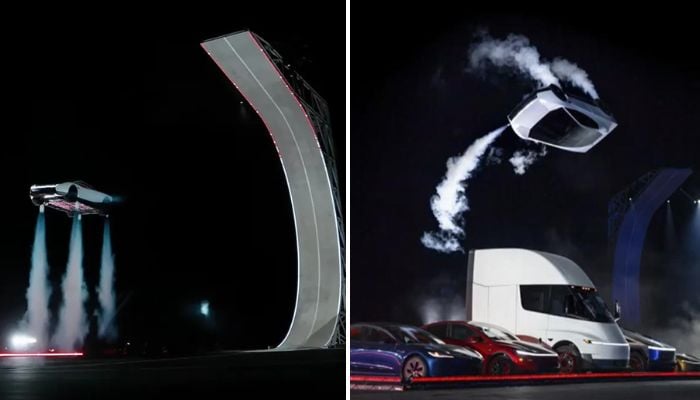
Elon Musk's newly unveiled flying Tesla Roadster has sparked a heated debate after prominent artificial intelligence scientist Yann LeCun used calculations to question whether the futuristic vehicle could actually fly for more than a few seconds.
LeCun, a computer scientist known for his pioneering work in AI, challenged Musk's claims after Tesla demonstrated the Roadster performing aerial stunts at a SpaceX facility in Texas on October 15.
The car was seen driving upside down, flipping through the air and landing on its wheels using compressed-air thrusters.
But LeCun questioned whether the technology could work in an ordinary car.
In a post on X, he estimated that even if compressed air accounted for half the vehicle's weight, it would provide less than 10 seconds of useful thrust, possibly closer to five seconds.
He suggested the demonstration vehicle might therefore be a lightweight shell carrying large compressed-air tanks rather than a practical passenger car.
Musk responded with a joke instead of directly addressing the calculations, prompting another sarcastic reply from LeCun.
The scientist compared the Roadster's propulsion system to a three-second burst of high-pressure gas, referring to a hypothetical 600-litre tank operating at 700 bar.
However, the calculations do not prove Tesla's demonstration was fake.
The event was livestreamed and witnessed by spectators, with independent recordings supporting the authenticity of the footage.
What remains uncertain is whether Tesla can turn the technology into a vehicle capable of sustained flight.
The Roadster demonstrated brief airborne manoeuvres, not conventional flight over long distances.
Tesla has indicated that production could begin in 2028, although the flying version has not been approved for public roads.