Scientists discover where Earth's water came from, it's not what we thought
The results indicate that formation of water may be a natural process for rocky planets.
Published October 28, 2026
Scientists may have finally found an answer to one of the biggest mysteries surrounding our planet: Where did Earth's water come from?
For decades, scientists believed that much of the water covering nearly 71% of Earth's surface was delivered by asteroids, comets and other objects that collided with the planet billions of years ago.
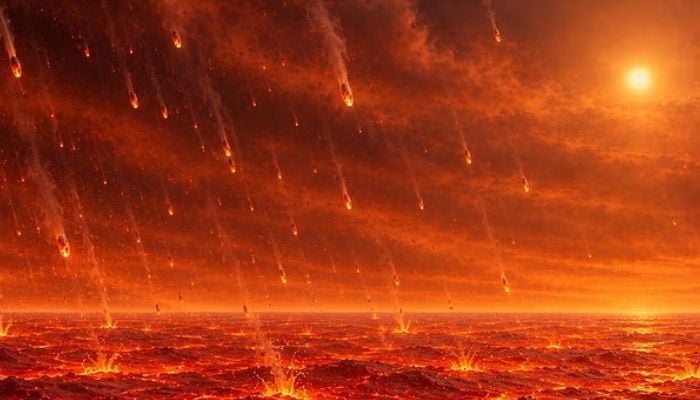
A new study points to Earth actually forming much of its own water during its formation 4.5 billion years ago, rather than using material from out-of-the-way cosmic sources.
Researchers from the University of New Mexico discovered that chemical reactions between rocky particles and hydrogen in Earth's early atmosphere could have generated water in just minutes.
The results, published in the scientific journal Nature Geoscience, were obtained from lab experiments on silicate rocks heated to temperatures between 1,200°C and 1,400°C.
In the experiments, the scientists subjected the rocks to exposure with hydrogen in conditions that mimic those that occurred when the Earth was being formed.
They discovered almost 80% of the iron oxide in the samples had been reduced to metallic iron with water vapour as a by-product.
One of the authors of the study Professor Zachary Sharp said the results indicate that formation of water may be a natural process for rocky planets.
The finding might also have consequences for the hunt for alien forms of life.
Chemical reactions could have taken place on other Earth-size planets around other stars, in a manner that is similar enough to create water without the need for collisions with icy objects.
Very interestingly, the results also contradict the commonly held view that the Earth had to obtain the water that is necessary for life from an outside source.
But scientists have not yet been able to calculate just how much of Earth's current water supply came from this process, and therefore, it is not possible to rule out that asteroids and comets were other sources.