China launches Shenzhou-24: What is the mission aimed at?
Shenzhou-24’s landing is planned for first half of 2027
Published November 25, 2026
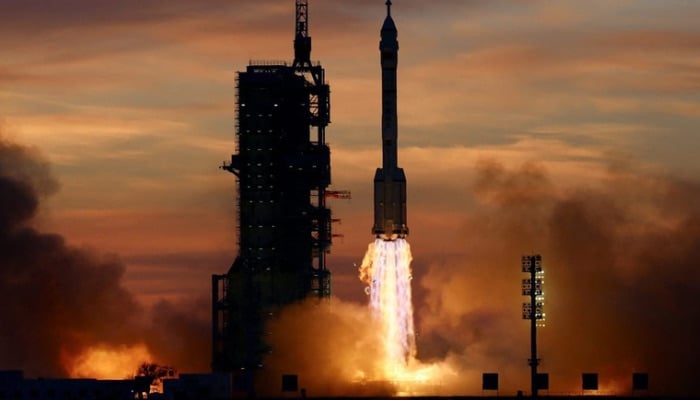
China launched the Shenzhou-24 crewed mission on November 25, 2026, sending a new crew to the Tiangong space station as part of Beijing’s broader push towards independent human spaceflight, scientific research, and a future crewed Moon landing.
The spacecraft was launched by a Long March 2F rocket from the Jiuquan Satellite Launch Centre in northwestern China.
Main tasks of the mission include rotation of the crew in Tiangong, support for its operations and maintenance, and completion of over 90 scientific and technological experiments.
Overall, the Shenzhou missions are aimed at reaching several basic goals. First, this program ensures China's independent human spaceflight capabilities that allow launching and returning astronauts from space independently. In addition, this program maintains Tiangong as a long-term national laboratory in low Earth orbit where rotation of crews and maintenance of station systems take place. Finally, it allows conducting scientific research in space life sciences, aerospace medicine, microgravity physics, combustion and new propulsion technologies.
Outside of low Earth orbit, the Shenzhou program forms a vital part of China's plans for the future. This program will evolve into further exploration of cislunar space and a landing on the Moon by 2030, with international collaboration becoming increasingly important, highlighted by the participation of the first foreign astronaut on board Shenzhou-24.
The Shenzhou is still China’s only spacecraft used for crewed missions, despite the fact that it is due to be replaced by the new Mengzhou. Having made 23 missions since it was launched in 1999, the Shenzhou program is a key aspect of China's plans for sending astronauts to the Moon.