Pak-India foreign secretary-level talks on Jan 15
Decision finalised in Nawaz-Modi Lahore talks; no one-on-one meeting held; Rawalpindi was in the loopISLAMABAD: Prime Minister Nawaz Sharif and Narendra Modi didn’t have a one-on-one meeting...
Published December 26, 2015
Decision finalised in Nawaz-Modi Lahore talks; no one-on-one meeting held; Rawalpindi was in the loop
ISLAMABAD: Prime Minister Nawaz Sharif and Narendra Modi didn’t have a one-on-one meeting during the latter’s brief surprise visit to Lahore on Friday and no particular and contentious issue was discussed between them as they drew up a guideline for their respective foreign secretaries who will have talks in Islamabad next month.
The two prime ministers also determined the date for the one-day meeting, which will take place in the middle of next month (January 15).
The visit predominantly had social overtones and helped in developing a further personal rapport between the two leaders. Highly-placed diplomatic sources told The News here on Saturday that Prime Minister Nawaz Sharif received the call from his Indian counterpart just before midday on Friday and later had discussions with important people who matter here and in Rawalpindi.
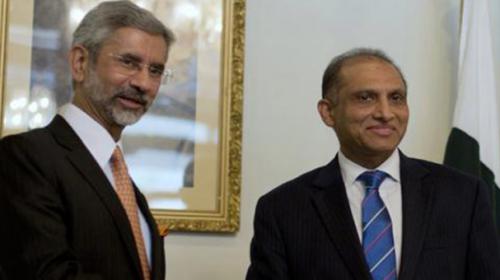
Foreign Secretary Aizaz Ahmad Chaudhary, who was present during the engagements of the Indian prime minister in Lahore, told this scribe that it was a goodwill visit and one shouldn’t read beyond that. There was no agenda for the meeting since it wasn’t a structured visit but the two prime ministers emphasized the need for improving ties between the two countries and sorting out their differences.
Chaudhary disputed Indian media reports that Prime Minister Nawaz Sharif had invited Modi to visit Lahore. “The call was made by Modi from Kabul to greet Prime Minister Nawaz Sharif on his birthday and in the course of the conversation, Modi expressed the desire to visit him (on Friday). The prime minister told him that he was in Lahore and not in Islamabad. On this, the Indian prime minister said that he could come to Lahore and that wish was greeted by Nawaz Sharif in his traditional manner,” Aizaz Chaudhary insisted.
Federal Minister for Finance Senator Muhammad Ishaq Dar told this scribe that the trip by the Indian prime minister had been hailed by the saner elements in both countries.
Dar was also present at the Lahore residence of Prime Minister Nawaz Sharif during the visit of the Indian prime minister. He said that both the prime ministers very fondly talked of former Indian Prime Minister Atal Bihari Vajpayee who laid the foundation stone of the present Indian High Commission compound in Islamabad as the foreign minister of his country and was later the first Bhartiya Janata Party (BJP) premier who visited Pakistan in 1999 and visited the Minar-e-Pakistan, the site where the resolution for the creation of Pakistan was adopted by the Muslims of India in 1940.
Prime Minister Nawaz asked Modi to convey his good wishes and birthday greetings to Vajpayee as he shares with him the birthday on December 25.
Narendra Modi told the host prime minister that as soon he lands in New Delhi he would go straight to Vajpayee’s residence to felicitate him on the birthday and he would convey the sentiments of Nawaz Sharif as well. The two prime ministers also decided to follow the policy of having normal neighbourly ties that was agreed with Atal Bihari Vajpayee way back in 1999.
In the meanwhile, sources said that Narendra Modi also visited the elderly mother of Nawaz Sharif inside the residential compound where he touched her feet out of esteem and sought her blessings.
First Lady and wife of Prime Minister Begum Kulsum Nawaz, Ms Maryam Nawaz Sharif and granddaughter of the prime minister Ms Meharun Nisa were also present there.
The Indian prime minister offered good wishes to Ms Mehrun Nisa who was being wedded on the following day. He stayed in the inner enclosure of the compound for less than 10 minutes, the sources pointed out.
The sources said that no extensive menu was made for the Indian prime minister as he had one glass of water, a cup of tea without sugar, one vegetable samosa and two egg pakoras.
The visit was sudden and for the reason Secretary to Prime Minister (SPM) Fawad Hasan Fawad, Military Secretary (MS) Brigadier Akmal Aziz, Chief of Protocol Tasawar Khan Lodhi, Adviser to the PM for Foreign Affairs Sartaj Aziz, Special Assistant to PM (SAPM) for Foreign Affairs Syed Tariq Fatemi, National Security Adviser (NSA) to the PM Lieutenant General (retd) Nasser Khan Janjua and a number of other senior officials couldn’t reach Lahore to join the prime minister on the occasion. Incidentally, Foreign Secretary Aizaz Ahmad Chaudhary was in Lahore to attend the commemoration of his son’s wedding anniversary and he had hosted a dinner for his personal guests on the same evening. He was available to the prime minister by virtue of his presence in Lahore, the sources added.
The sources said that Pakistan’s high commissioner for India Abdul Basit Khan is in Islamabad and he is rushing back to New Delhi so that he could take the Kashmiri leadership into confidence about the upcoming talks of the foreign secretaries slated in Islamabad for next month.
The Indian media has reported that Indian Foreign Secretary S Jaishankar will travel to Islamabad to hold talks with Aizaz Chaudhary on 15th January. The meeting will discuss modalities of bilateral comprehensive dialogue which was announced during the visit of Indian External Affairs Minister Sushma Swaraj to Islamabad earlier this month.
On December 23, the neighbouring country had proposed talks between their foreign secretaries to discuss all the outstanding issues in the middle of January.
The peace process was set in motion when the prime ministers of the two countries met in Paris on November 30 on the sidelines of the Climate Change Conference, which was followed by the national security advisers’ meeting in Bangkok a week later. Later, the Indian external affairs minister visited Pakistan to attend the Heart of Asia Conference.
The prime ministers of the two countries held talks in Lahore and decided to open ways for peace for the “larger good” of the people of the two countries.
Modi soon after returning to New Delhi on Friday evening tweeted that he was personally touched by Pakistan Prime Minister Nawaz Sharif’s gesture of welcoming him at the airport and also seeing him off. “Am personally touched by Nawaz Sharif Sahib’s gesture of welcoming me at Lahore airport and coming to the airport when I left,” Modi said in the tweet. Modi also said that he had spent a warm evening with the Sharif family at their family home. “Nawaz Sahib’s birthday & granddaughter’s marriage made it a double celebration,” he added.
Terming as very touching Sharif’s affection towards BJP veteran and former Prime Minister Atal Bihari Vajpayee, he tweeted: “He (Sharif) recalled their interactions & asked me to convey his regards to Atalji.”
Modi’s Friday visit has also evoked positive reactions across the globe with US, China and UN saying that the ‘improved ties between the two countries will benefit the entire region’. Another Indian media house has revealed Modi flew to Moscow on one aircraft, then to Kabul and Lahore on another.
Was Prime Minister Narendra Modi’s trip to Pakistan really impromptu or a well thought out strategy to foster peace between the warring neighbours? The media raised this question.
An indication that the schedule for Modi’s stopover in Pakistan had been planned in advance could be gauged from his change of aircraft at Moscow where he was on a two-day visit.
The prime minister switched his Air India One (AI-001) for the Indian Air Force’s customized 46-seater Boeing business jet. The IAF aircraft is used by the president, the vice-president and the prime minister for flying within India and to neighbouring countries. So even as Modi tweeted, just before his departure from Kabul on Friday afternoon, that he was going to ‘drop by’ in Lahore for a meeting with Prime Minister Nawaz Sharif who was overseeing his granddaughter’s (Maryam Nawaz’s daughter) wedding, preparations seemed to have been made much earlier by the Indian authorities.
One explanation could be that Air India One, a Boeing 747-400, does not have protection against incoming missiles — something that may have weighed on the minds of the security agencies considering that the Indian prime minister was to fly over conflict zones in Afghanistan. The Boeing business jet, one of three inducted in 2009, flown by the IAF pilots from the force’s communication squadron, is equipped with electronic countermeasures that can protect the aircraft from incoming missiles.
The rupees two billion, ECM suite has a missile advanced warning system that sets off an alarm in the cockpit when a radar locks onto the aircraft. The aircraft can then launch chaff and flares to decoy incoming missiles.—Originally published in The News