Pakistan's prospects for strong, sustainable growth 'still seem distant', ADB warns
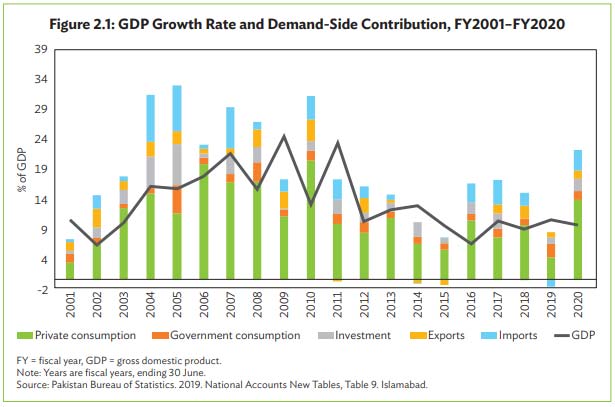
ADB says Pakistan's economic growth has been characterised by 'boom-and-bust cycles'
Published February 03, 2022
- ADB says Pakistan's economic growth has been characterised by “boom-and-bust cycles”.
- Identifies lack of exports as a major reason behind instable economic growth.
- "Pakistan’s monetary policy has been prone to political influence,” it says.
Pakistan’s economic performance over the past several decades has been “episodic” and the prospects for strong, sustainable, and inclusive growth “still seem distant”, the Asian Development Bank (ADB) warned.
In its report titled ‘Economic Corridor Development (ECD) in Pakistan: Concept, Framework, and Case Studies’, the Manilla-based lender noted that economic growth has been characterised by “boom-and-bust cycles”, and the country has not been successful in sustaining its episodes of high growth.
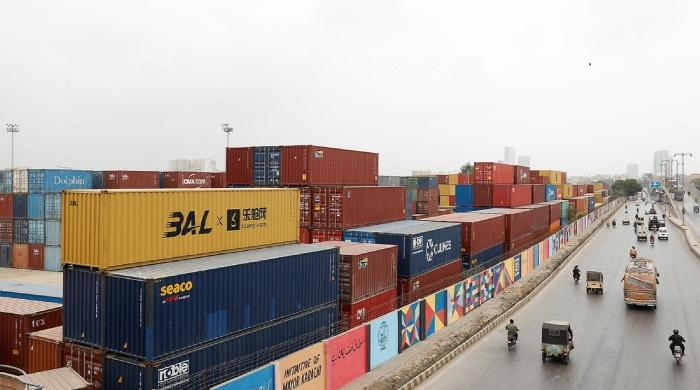
Highlighting the reason behind instable economic growth, the ADB identified lack of exports as a major reason. “Pakistan’s economy is characterised by a lack of exports. Its major exports are low value-added items like textile and foods,” it stated, adding that the composition of export items has remained stagnant since the mid-1980s.
The study examined how Pakistan could address economic challenges through ECD, proposing horizontal and vertical interventions to achieve structural transformation.
It is pertinent to mention here that the horizontal intervention involves improving regulatory framework for the business environment, increasing infrastructure investments, and enhancing market access and compliance.
Meanwhile, vertical interventions, on the other hand, include promoting entrepreneurship and innovation for industrial diversification, promoting linkages across private sector players, and increasing value addition through human capital development.
In the foreword, ADB Central and West Asia Department Director General Eugene Zhukov noted that Pakistan had not yet been able to attain a sustained growth path "to move beyond its historic lacklustre and stop-and-go pattern, characterised by 'booms and busts' every three to four years".
"Through market reforms, Pakistan needs to transform its economy into an export-led growth trajectory. In addition to improving the economy’s competitiveness and productivity with a vibrant private sector, it is critical to attracting domestic and foreign investments to support this transformation," he said.
The official went on to say that Pakistan had already adopted and implemented an ECD-focused strategy as part of its core development and growth framework.
"ECD can be one of the most credible ways to help the government achieve its socio-economic objectives of reaching the upper-middle-income status by 2025," Zhukov said.
However, he cautioned that private sector development and a fair and efficient tax system were also required for transforming the economy to export-led growth.
The study highlights that Pakistan should focus on three pillars and four drivers to successfully implement ECD; the three pillars are:
- Infrastructure development
- Urban development
- Industrial development.
However, these developments go hand in hand and do not occur in a particular sequence. There are four key drivers for ECD:
- Economic aspects of local competitiveness;
- Institutions and regulations;
- Inclusion of environment-friendly and gender equality conditions and sustainability of poverty reduction;
- External factors of FDI and remittances.
Instead of promoting one sector over another, this study recommends a systematic framework to identify the constraints on private sector development.

“The government should address impediments and correct market failures by formulating policies rather than subsidising one sector at the expense of the other,” it noted, adding that the first step of ECD in Pakistan is to identify necessary transport corridors.
Four pilot corridors to operationalise ECD include:
- Motorway M4,
- National Highway N70,
- National Highway N50,
- Expressway E35.
It noted that these transport corridors have economic potential for better scale and diversification. To unleash that potential, the government needs to invest in public infrastructure.
“Another important policy intervention is to streamline trade facilitation processes that harmonise customs procedures and transit rules to achieve the smooth flow of freight traffic along domestic and international routes,” it said.
Pakistan needs to enhance its productivity
The Manilla-based lender stressed that Pakistan needs to enhance its productivity and competitiveness in a highly competitive and evolving global landscape by achieving an export- and manufacturing-based structural transformation.
It suggested that Pakistan will need to:
- Develop credible regulatory frameworks and sound fiscal, monetary, industrial, and trade policies;
- Promote efficient financial intermediation;
- Deliver critical infrastructure and services;
- Enhance institutional effectiveness
Pakistan’s monetary policy is prone to political influence
The ADB noted that historically, Pakistan’s monetary policy has been “prone to political influence, which can crowd out private sector borrowing and investment.”
“The government’s decision to amend the State Bank of Pakistan (SBP) Act for upholding its autonomy, mandate, and governance is a step in the right direction,” it noted.
The amended act seeks to:
- Make domestic price stability as a primary objective of the monetary policy;
- Prohibit the financing of the public sector debt;
- Remove quasi-fiscal operations following a phase-out period;
- Introduce statutory mechanisms to allow sufficient capitalization and profit retention;
- Secure stronger protection of the personal autonomy of senior officials;
- Enhance roles of external auditors, the audit committee, and the internal audit function;
- Promote mutual decision-making at the executive level;
- Provide stronger oversight by the board