Pakistan committed to tax reforms, institutional modernisation, FinMin assures World Bank
Finance minister praises WB's continued engagement and constructive support across multiple reform areas
Published May 18, 2026
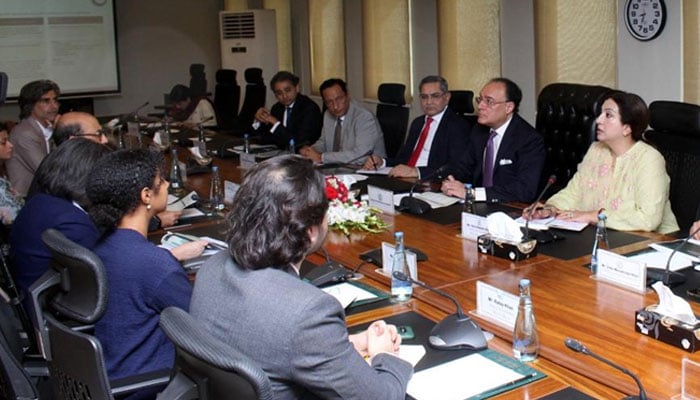
- FinMin meets World Bank team led by Bolormaa Amgaabazar.
- Finance czar lauds WB’s continued engagement with Islamabad.
- Says Pakistan’s macroeconomic indicators improved last year.
Federal Minister for Finance and Revenue, Senator Muhammad Aurangzeb on Monday reiterated that the government remained fully committed to the broader tax administration transformation agenda and institutional modernisation efforts.
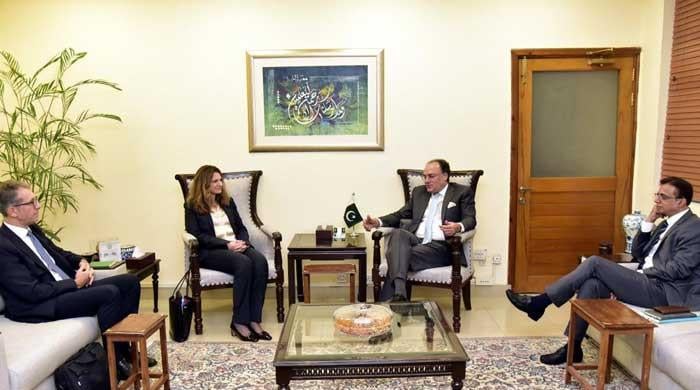
The finance czar made the remarks during his meeting with a World Bank (WB) team led by its Country Director in Pakistan Bolormaa Amgaabazar at the Finance Division today.
During the meeting, the finance minister highlighted progress being made in automation, digitisation, simplification of procedures, and technology-driven monitoring systems.
The minister appreciated the WB's continued engagement with Islamabad on economic reforms and institutional development.
He acknowledged the WB's support across key reform areas and emphasised the importance of close coordination and technical collaboration to support implementation of the government’s economic priorities and reform agenda.
The meeting reviewed progress on a range of ongoing reform initiatives and technical assistance programmes being supported by the WB, including public financial management reforms, institutional capacity building, debt management, and private sector development, according to a X post shared by the Ministry of Finance.
Discussions also covered implementation timelines, coordination mechanisms, and operational arrangements relating to various reform-linked initiatives and technical support programs, it added.
The finance minister emphasised the importance of ensuring that technical assistance programmes remain focused, specialised, and aligned with clearly defined reform objectives.
He underlined the government’s preference for high-quality international expertise, practical implementation support, and knowledge transfer aimed at strengthening institutional capacity within the public sector.
The finance minister further noted the importance of developing sustainable in-house expertise and enhancing the government’s ability to independently manage and implement complex reform initiatives over time.
Discussions also focused on the government’s ongoing efforts to transform the Federal Board of Revenue (FBR) through reforms centered around people, processes, and technology.
The WB team shared updates regarding its ongoing technical support relating to the medium-term revenue strategy (MTRS), tax policy office (TPO), and FBR transformation initiatives.
Both sides exchanged views on strengthening coordination, accelerating implementation, and ensuring that reform measures remain aligned with broader fiscal and governance objectives, it added.
The finance minister emphasised the importance of operationalising reforms in a manner that supports transparency, efficiency, and improved taxpayer facilitation.
The meeting also covered broader structural reform priorities aimed at promoting sustainable and export-oriented economic growth.
The finance minister particularly emphasised the government’s focus on deepening domestic debt and capital markets, reducing overreliance on bank financing, and expanding market-based financing avenues. Discussions also covered ongoing work relating to debt market development, investor outreach, and measures aimed at enhancing Pakistan’s investment profile and access to international financial markets.
The participants further exchanged views on labor market reforms, vocational skills development, overseas employment opportunities, workforce competitiveness, and ongoing analytical work relating to right-sising, public sector efficiency, and long-term growth and jobs strategy.
The finance minister appreciated the WB's continued engagement and constructive support across multiple reform areas.
Both sides reaffirmed their commitment to continued collaboration and close coordination in advancing Pakistan’s economic reform agenda, strengthening institutional capacity, and supporting sustainable and inclusive economic growth.
FinMin, AIIB president discuss economic reforms
Separately, the finance minister held a meeting with a delegation of the Asian Infrastructure Investment Bank (AIIB) led by its President Zou Jiayi and discussed infrastructure financing, economic reforms.
Welcoming the delegation, the FinMin appreciated AIIB’s continued partnership with Pakistan in supporting infrastructure development, economic reforms, and long-term development financing, said a news release.
The minister thanked AIIB for its support in the successful issuance of Pakistan’s Panda Bond through AIIB-backed guarantee arrangements, noting that the successful transaction reflected growing investor confidence in Pakistan’s economic outlook and reform trajectory.
The AIIB President also congratulated the government on the successful issuance of the Panda Bond.
She observed that the issuance demonstrated the important role multilateral development institutions can play in strengthening the financial capacity of member countries and facilitating access to diversified sources of financing.
She also appreciated the strong market response and favorable pricing outcome achieved through the transaction.
During the meeting, the finance minister said Pakistan’s macroeconomic indicators had shown marked improvement over the past year as a result of stabilisation measures and ongoing structural reforms.
He highlighted positive trends in inflation, external sector stability, fiscal management, and market confidence, while emphasising the government’s commitment to sustaining macroeconomic stability and transitioning toward export-led, productivity-driven, and inclusive economic growth.
Both sides reviewed ongoing and planned investments across strategic sectors including transport connectivity, energy transition, water resource management, urban infrastructure, digital connectivity, and climate-resilient development initiatives.
The minister emphasised that the government is prioritising projects capable of strengthening regional connectivity, enhancing economic competitiveness, and supporting sustainable growth.
The meeting also focused on strengthening strategic cooperation between Pakistan and AIIB through a structured multi-year financing pipeline aligned with national development priorities.
Discussions covered opportunities for enhanced collaboration in project preparation, implementation readiness, institutional capacity building, and mobilisation of long-term development financing.
Participants further exchanged views on expanding Pakistan’s investment landscape through innovative financing mechanisms and broader private sector participation.
The finance minister emphasised the importance of developing domestic capital markets, diversifying financing instruments, strengthening debt and equity markets, and encouraging greater institutional investment to support infrastructure and development financing requirements.
The AIIB delegation also shared an overview of the bank’s ongoing engagement in Pakistan and discussed avenues for further collaboration in support of the country’s long-term development priorities.
Discussions focused on enhancing cooperation in infrastructure connectivity, energy sector development, climate policy-based financing, and emergency financing mechanisms.
The minister also briefed the delegation on the government’s broader reform agenda, including taxation reforms, energy sector restructuring, state-owned enterprise reforms, institutional modernisation, and measures aimed at improving implementation effectiveness across ministries and public sector institutions.
He emphasised that strengthening governance, transparency, technological integration, and policy coordination remained central pillars of the government’s reform strategy.
Aurangzeb reaffirmed the government’s commitment to policy continuity, timely implementation of reforms, and maintaining a stable, transparent, and investment-friendly environment to support sustainable economic growth and long-term development partnerships.