Anti-Japan protests across China on war anniversary
BEIJING: Thousands of anti-Japan protesters rallied across China over a territorial row on Tuesday, a key historical anniversary, as Japanese firms including car giant Toyota shut or scaled back...
Published September 18, 2012
The demonstrations came after several days of protests, some of them violent, over disputed islands in the East China Sea that have raised international concerns and fears of conflict between two of the world's top three economies.
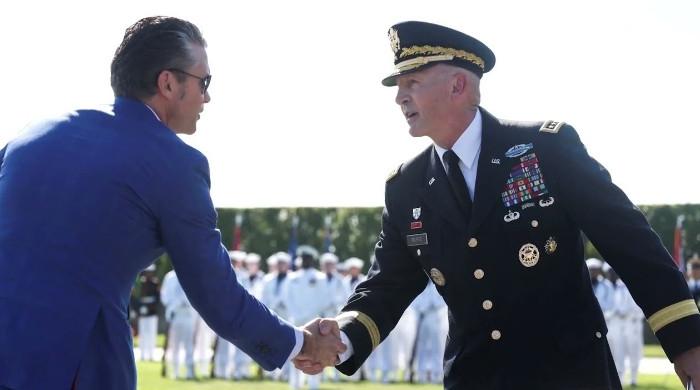
US Defense Secretary Leon Panetta, who is currently on a trip that takes in both Asian giants, was to call for calm in meetings with Chinese officials, after warning of the risk of a "misjudgment" that "could result in violence".
The islets, known as Senkaku in Japan and Diaoyu in China, are uninhabited but situated in rich fishing waters and said to sit atop valuable natural resources. They are controlled by Japan but claimed by China and Taiwan.
Toyota, the world's biggest automaker, declined to offer specifics on shutdowns at its three assembly plants and six other factories in China, saying only that it viewed "employees' safety to be top priority".
"Some (factories) will operate and some will not," a spokesman said.
Honda Motor, which makes about 970,000 vehicles a year in China, said it had closed all five of its plants in the country for Tuesday and Wednesday, while Nissan -- which has China as its biggest market -- temporarily shut two of three factories.
Electronics giants Canon and Panasonic have also said they were temporarily shutting some China operations, and a group of Japanese business leaders headed by Toyota's chairman said it may cancel a trip to China because of the dispute.
China and Japan have close trade and business ties, with numerous Japanese companies investing in their larger neighbour and two-way trade totalling $342.9 billion last year, according to Chinese figures.
But the two countries' political relationship is often tense due to the territorial dispute and Chinese resentment over past conflicts and atrocities.
Tuesday marked the September 18, 1931 "Mukden Incident" in which Japanese soldiers blew up a railway in Manchuria as a pretext to take control of China's entire northeastern region, which is commemorated every year in China.
Chinese state television showed sirens being sounded at 9:18 am -- symbolising the date -- as a reminder to "remember the history and not forget national disgrace", it said.
Armed police were deployed in force at protests across the country, with some marchers carrying portraits of longtime leader Mao Zedong and urging Beijing to stand up to its historic rival.
Outside the Japanese embassy in Beijing more than 1,000 protesters faced off against riot police six rows deep.
Some threw eggs and plastic bottles at the building and a few scuffles broke out with officers at the gate of the compound.