UAE, Saudi Arabia seek over 1.5 million workers despite AI surge
Countries and workers who invest in training and reskilling will be better positioned to benefit from job creation, says report
Published December 25, 2025
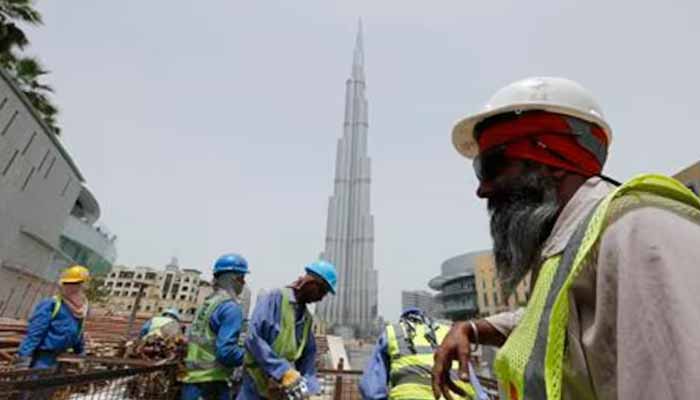
DUBAI: The booming job markets of the United Arab Emirates and Saudi Arabia are expected to generate demand for more than 1.5 million additional workers by 2030, despite rapid growth in artificial intelligence (AI), according to a global workforce study released in 2025.
The research shows that although AI is changing how businesses operate, it is not reducing the overall need for human workers in the Gulf. Instead, strong economic growth, major development projects and expanding public and private services are driving sustained demand for labour in both countries.
In Saudi Arabia, workforce demand is being driven by the kingdom’s Vision 2030 economic reform programme, which includes large investments in construction, infrastructure, tourism, manufacturing, logistics and new economic zones.
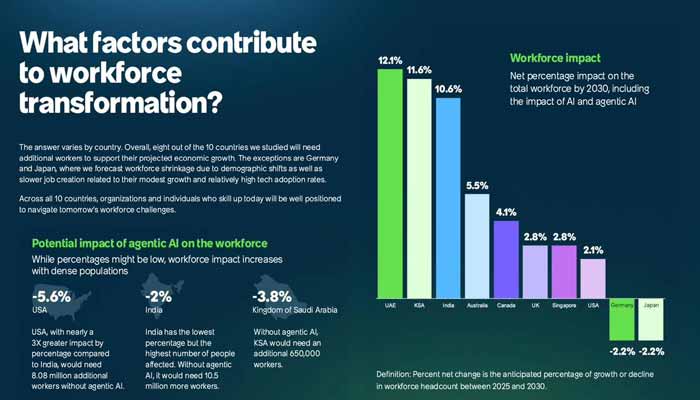
The study estimates that without productivity gains from AI, Saudi Arabia would need around 650,000 additional workers to support its expansion plans. Even after accounting for automation, the kingdom is expected to face a significant labour gap in the coming years.
In the United Arab Emirates, workforce demand is projected to rise even faster.
The report estimates that the UAE’s total workforce could grow by 12.1% by 2030, making it one of the fastest-growing labour markets among the countries studied.
“This 12.1% increase in the human workforce represents one of the highest percentage increases among the markets studied, while Saudi Arabia is projected to see workforce growth of 11.6%, compared with much slower expansion in major economies such as the United States (2.1%) and the United Kingdom (2.8%),” the report said.
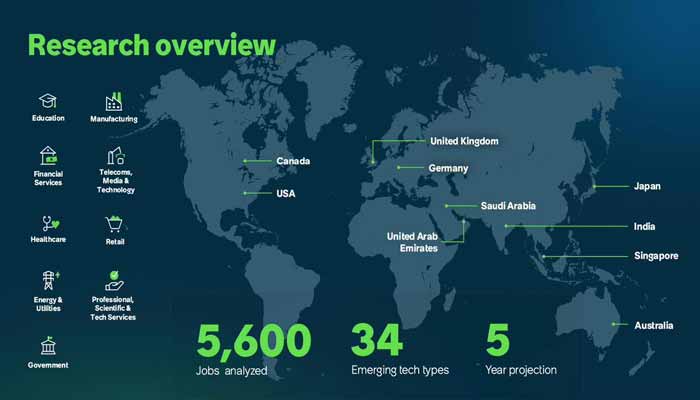
The analysis was conducted by ServiceNow, a US-based enterprise software company that provides digital workflow and automation platforms to governments and large organisations, and Pearson, a UK-based global education company specialising in learning, skills development and workforce assessment.
According to the study, the UAE’s strong focus on technology, artificial intelligence and digital transformation of services is expected to create jobs rather than eliminate them.
As government departments and private firms modernise operations, demand is increasing for workers in manufacturing, education, retail, healthcare, financial services and technology-related services.
The report found that AI is mainly expected to automate routine and repetitive tasks, while human workers will remain essential for roles requiring technical expertise, supervision, customer interaction, problem-solving and service delivery.
Key sectors expected to continue hiring in both the UAE and Saudi Arabia include construction, transport, logistics, healthcare, hospitality, retail, education, energy, financial services and information technology. For Pakistani workers, the findings are particularly significant.
Millions of Pakistanis are already employed in the UAE and Saudi Arabia, mainly in construction, transport, retail, healthcare and technical occupations.
The study suggests that job opportunities for overseas workers will continue, especially for those with trade skills, technical training, digital literacy and service-sector experience.
Based on its analysis of thousands of job roles and millions of job advertisements, the report concludes that AI will support productivity but will not fully close workforce shortages created by rapid economic growth in the Gulf.
The study adds that countries and workers who invest in training and reskilling will be better positioned to benefit from job creation, as technology reshapes work but continues to rely heavily on human labour.