What if US still opts for regime change in Iran?
One must laud Trump's courage in rethinking and coming up with a better-advised strategy for dealing with Iran.
Published January 17, 2026
The US attack on Iran is off the shelf, for now. The aggressive tone of President Donald Trump is temporarily muted. Yet, the clouds of war are still hovering over the Middle East.
It is time to deeply analyse why President Trump, who was on the brink of waging war, took a step back?
And what if "the most unpredictable president of the United States" opts again for regime change in Iran? First, who convinced President Trump not to wage war?
Were diplomatic efforts by Egypt, Oman, UAE, Saudi Arabia and Turkiye played the pivotal role as it is claimed by the media? Or Israeli Prime Minister Benjamin Netanyahu persuaded President Trump to postpone strikes — something also being claimed by other outlets.
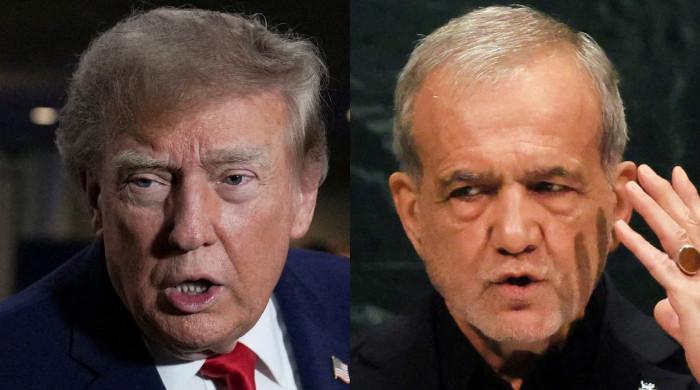
"Nobody convinced me. I convinced myself… I greatly respect the fact that all scheduled hangings, which were to take place yesterday, have been cancelled by the leadership of Iran…. That had a big impact… Thank You," admitted President Trump.
At first glance, President Trump appears right. The world knows how Netanyahu had desperately tried to convince Washington to attack Tehran.
On December 29, 2025, he met the US president for the fifth time since Donald Trump had taken the oath of office for the second time.
After that Mar-a-Lago meeting, President Trump was asked if he would back an Israeli strike on Iran.
"If they will continue with the missiles, yes. The nuclear? Fast. OK? One will be: Yes, absolutely. The other is: We’ll do it immediately."
Well, Iran has not announced stopping its missile programme. Should the situation still be taken as the US preparing for an attack on Iran, as "Yes, absolutely?"
Or something else has convinced President Trump to avoid going all out against Iran at this moment of time?
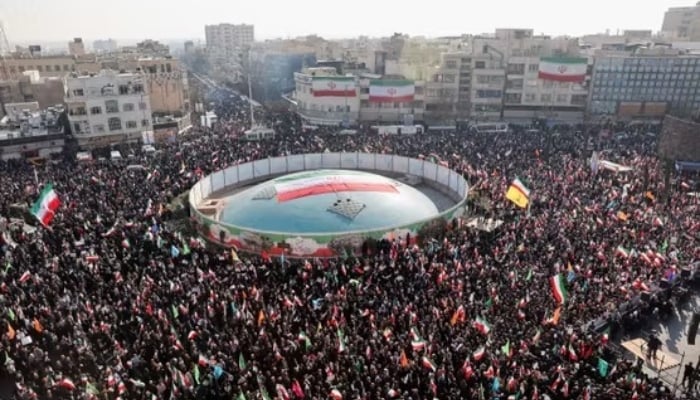
The answer apparently lies in the pro-government protests that drew millions of people in Tehran and other cities. The crowd had thousands of women and children, not to mention elderly Iranians of all walks of life.
The show of force continued for a few days as the Iranian government calibrated funerals of the victims who, as per Foreign Minister Abbas Araghchi, had died at the hands of "Daesh-style" rioters. The dead included children, women and doctors.
Amnesty International claimed that "since 28 December, the escalating lethal repression to crush the mostly peaceful uprising has led to the unprecedented loss of life during protest dispersals, with the death toll rising to 2,000 by official admission".
It will remain debatable who killed whom. What is undeniable is the fact that no sane Muslim can burn mosques, desecrate the Holy Quran —something that happened across Iran.
Had the protesters vented their anger against the government officials or religious clerics, the situation might have gathered some momentum.
With videos of protesters throwing Molotov bombs at mosques, straight shooting and lynching, the Iranians were reminded of what had earlier happened in Iraq and Syria.
President Trump, who had openly encouraged Iranians to "keep protesting", "take over institutions" as "help was on its way", didn’t know that his calculations were wrong.
President Trump overlooked that this country of plus 93 million people has pre-dominantly Shia-Muslim population (almost 90-95% as per government claims). Naturally, this ratio would reflect in every institution, in every cadre.
Even if the majority of Iranians were against the government policies, the "Daesh-style terrorist operations" proved counter-effective.
The people saw a bigger threat emerging at their doorsteps. Forgetting economic woes, people rallied back to those whom they had started protesting against since December 28, 2025.
Unprecedented violence also strengthened the resolve of the armed forces and police. Most of them were born after the 1979 revolution and had grown up "indoctrinated" under that philosophy. It would not be a surprise that some of them would have played a role in crushing ISIL in Iraq.
Iran roughly boasts a strength of 190,000 Islamic Revolutionary Guards (IRGC), 90,000 full-time uniformed personnel, 300,000 reservists and 360,000 police force.
One can imagine how far sighted approach it would be to expect them to accept Daesh-style violence or a "regime change" for that matter.
The Iranians also know well what has happened after violent protests resulted in regime change in some of the Middle Eastern countries.
Be it Yemen, Syria or Libya, all are being fragmented on different grounds. The lives of common people are ruined in these countries.
The majority of Iranians saw that horrible story being replayed. Probably, that is the reason why, despite encouragement, no one in Iran is protesting against the government anymore.
At the top of it, the government is threatening "US allies of retaliation" if they fail to "prevent a Washington attack on Iran" from their territories.
In a nutshell, one blunder or "Fool’s Mate" has resulted in checkmate.
The US strategy has also alerted many countries that border Iran.
Russia is already losing Central Asian countries to the United States. It would not be likely to have a volatile situation at the Iran-Azerbaijan or Iran-Armenia border.
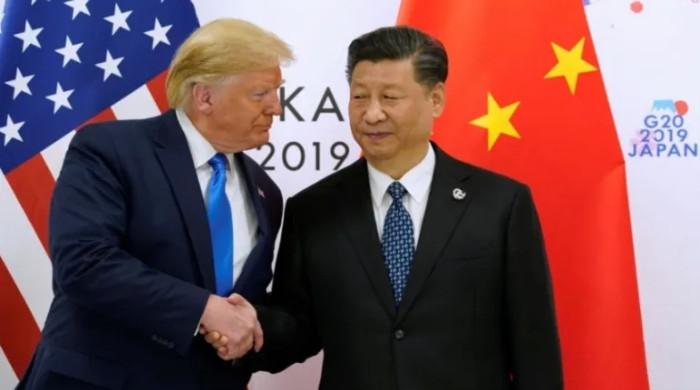
China has recently lost Venezuela. An effort to change the regime in Iran means another massive cut in subsidised oil supply.
Trukiye has issues with the bordering Kurdish population, while Pakistan can have a spillover effect in Balochistan where Indian sponsored separatists’ movement is taking its toll.
In the end, one must laud the courage of President Trump, who has convinced himself to stop here, rethink and come up with a better advised strategy on dealing with Iran.
And, for Tehran, it is not the time to remain overconfident. The clock is ticking. The window of opportunity is closing fast. It must find a way out to address the economic woes of its nation.
Tehran must see who can be a real friend who can come in need. A bold decision must be taken, even if Tehran comes to the conclusion that it has a better future by establishing closer ties with Beijing, Moscow or even Washington.
After all, it is said that "first comes food, then morality". At the top of it, "a hungry stomach has no ears".
The author is Controller News at Geo News. He posts on X at @NasimHaider2 and can be reached at [email protected]