From soap to stress, the madness of modern skincare
Is staying natural the only option if skincare adds to your anxiety and frustration?
Published January 17, 2026
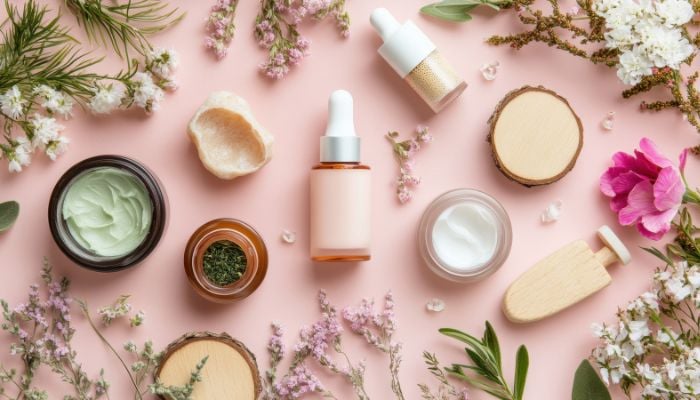
In the past, skincare meant washing one's face with soap and water, and applying some cold cream that belonged to one's mother. Just like everything else, skincare has evolved as well. Now, taking care of the skin means using cleansers, toners, serums, acids, oils, retinols, sunscreen, and more.
Skincare is no longer about just personal hygiene. It’s become a lifestyle, an endorsement, and for many women, a form of self-care. There has been a dramatic rise in women and young girls adopting skincare routines. Once considered a luxury, it is now part of everyday life for millions worldwide. From teenagers experimenting with glow-up products to adults investing in anti-aging products — everyone seems obsessed with skincare.
Old-school glow vs Gen Z glass skin
We spoke to a few mothers and their daughters to see what skincare meant for our mothers and what it means to women today.
Aasia Aslam, 57, said, “I have never applied anything in my life. When we used to wash our faces, it was with soap, and that too maybe once a week. We never cared enough about our skin to even think about skincare.”
Although her daughter, Atiqa Aslam, 27, unlike her, seems to take care of her skin very well.
“I wash my face with a face wash every morning, and if I go out, I never leave without sunscreen. At night, I cleanse my face thoroughly and then usually use a Niacinamide serum.
“These days, I’m also thinking about getting laser treatments for my facial hair,” she said.
Skincare isn’t confined to just products; now, different procedures like laser, hydra-facials, carbon peel, micro-needling, glowing drips, Botox, fillers, and many more are also up for grabs today.
Masooma Bashir, 26, believes facial hair growth among women has become quite common due to hormonal imbalance.
"I didn’t have much facial hair, but still, I decided to mess with my face, mainly because at the time I could afford it, so I went ahead and got Laser facial hair removal done… After that, I was getting hyperpigmentation on the sides of my face, so I went for a carbon peel.
“It made absolutely no difference for me, though they say you only notice results after three or four sessions, and apart from that, I recently started using a brightening serum.
“Otherwise, I only apply hyaluronic acid on my face. Most importantly, I never skip sunscreen and moisturiser, and I also used a Niacinamide serum for a while, which gave me good results.”
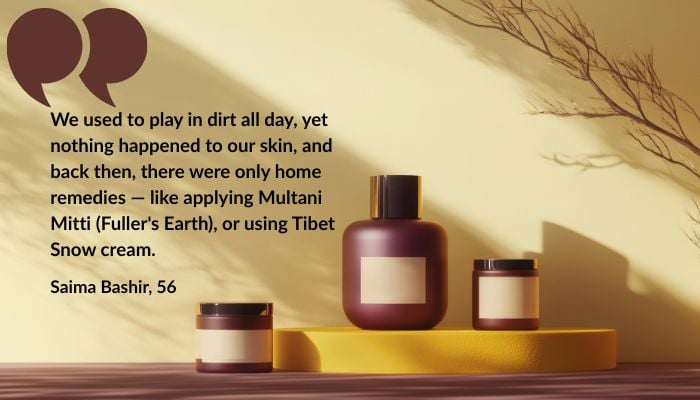
On the other hand, her mother, Saima Bashir, 56, told us, “We were naturally beautiful, we didn’t need it.”
“We used to play in dirt all day, yet nothing happened to our skin, and back then, there were only home remedies — like applying Multani Mitti (Fuller's Earth), or using Tibet Snow cream."
She recalls that the only “makeup” she had was Tibet Snow and a Medora lipstick.
“There was also an old cream called Seven Days. It was very common in households.
“Apart from that, there was the blue tin of Nivea cream, and of course, traditional remedies like cleansing with raw milk, or rubbing tomato on the skin.
“That was the entirety of our skincare routine, nothing more.”
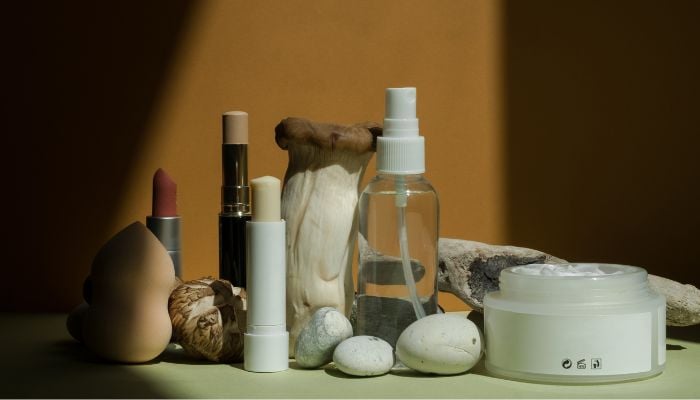
From serums to laser treatments, today’s skincare is a full-time commitment for many women like Samra Khalid, 31, who doesn’t take any chances when it comes to her skin.
“In the mornings, I use a 20% vitamin C serum, and on top of that, sunscreen.
“I used to use a local sunscreen before, but now I’m using a Korean one.
“Meanwhile, at night, I apply 0.5% retinol, but earlier, I had used 0.5% retinol mixed with shea butter [of some local brand].
“Retinol reacts differently on every skin type, so I’ve now shifted to pure 0.5% retinol, but if you’re a beginner, you should start with 0.2% so you can see how your skin responds. I’m currently at 0.5%, and I’ll continue using it until I finish this container — then I’ll move on to the 1% version.”
“At night she uses an oil-to-milk cleanser, followed by another cleansing gel, and finally the retinol,” Samra said.
Her mother, Yasmeen Khalid, 59, never really cared about these things.
Blame it on the algorithm
Social media has played its part in turning a simple washing and moisturising routine into an elaborate seven- to ten-step ritual. Before you commit to these routines, keep in mind that they can push you towards bankruptcy, because they are so glowingly expensive.
Local skin care brands are also stepping into the market at the speed of light, including many of those claiming to be selling organic products. There used to be only a few brands in the market before, now, though, there are hundreds of skincare brands trying to convince customers that "their products are the solution to all skin problems".
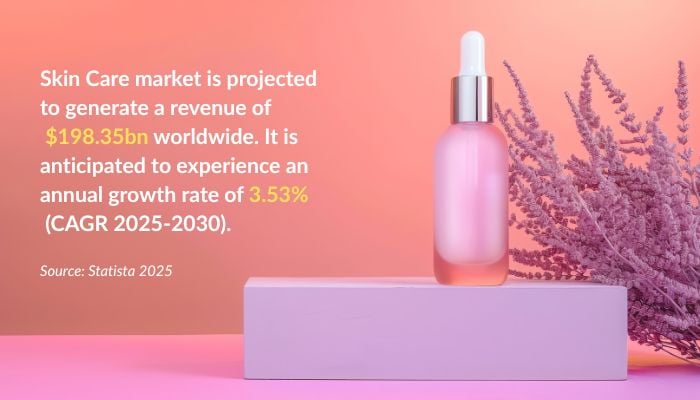
As per the Statista’s 2025 data, the Skin Care market is projected to generate a revenue of $198.35 billion worldwide. It is anticipated to experience an annual growth rate of 3.53% (CAGR 2025-2030).
But it’s true, marketing campaigns have gotten so persuasive that women find it hard to resist the urge to click "buy now". The remaining push comes from flash sales, bundle deals, and influencer discount codes. Whatever these brands are doing to lure people in, it’s working. At the same time, many influencers and celebrities have launched their own skincare lines. Seeing well maintained, glowing celebrities and influencers share their skincare routine, women are tempted to follow the same, in hopes to get similar glow.
K-beauty takeover
Any discussion on skincare is incomplete without mentioning Korean skincare, and the craze of glass skin. In recent years, Korean beauty brands have made a powerful entry into Pakistan’s skincare market. K-beauty’s promise of “glass skin” has captivated young consumers who binge on both K-dramas and K-skincare reviews. Social media influencers have fuelled the trend, raving about innovative formulas, cute packaging, and multi-step routines.
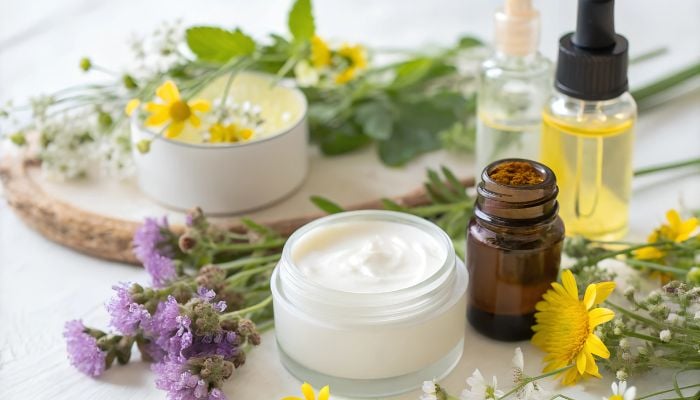
In a country where "fair skin tone" still quietly dictates the definition of beauty, Korean skincare has become the new fairy godmother, promising every mother-in-law’s dream of a daughter-in-law with flawless, fair, glass skin straight out of a K-drama.
With e-commerce making these imports just a click away, Korean skincare is no longer an occasional splurge; instead, it’s quickly becoming a staple on Pakistani vanities.
The unspoken pressure
Sadly, all this skincare chaos has created an undue pressure on women to always look good, always follow the trend, and look well maintained, specially on those who are unable to afford it.
Rabia Anum, an entrepreneurial journalist who runs her own salon, also shared the same view. “Back in the day, women did everything with what they had at home. I’ve seen my grandmother using beetroot for cheeks and lips.
“And they didn’t have this constant pressure to look beautiful.
“It is our own self-perceived emotion that women look beautiful only when they appear more 'girly,' and more 'feminine'. There’s this unspoken label that a woman has to look a certain way to be considered one.”
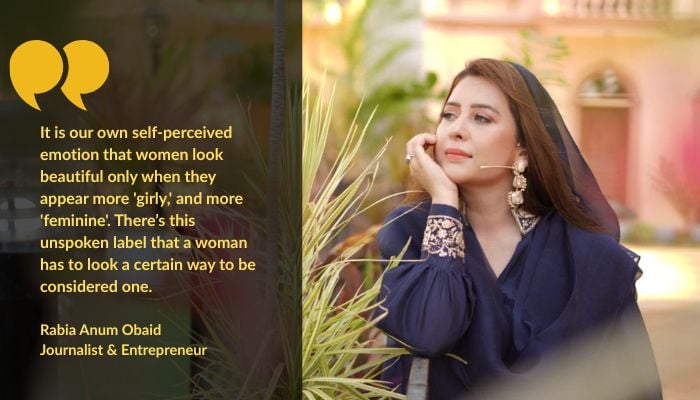
She explained that these days women drink more water, go on walks, and exercise, all in the name of skincare. This is something anyone could manage. “While those who can afford have got a full lineup, ten-step routines for the morning and another dozen for the night.”
She agreed that this has become a huge pressure, not just on women but also on men, because if a man’s partner is well-maintained, talented, and looks like a “perfect queen,” he inevitably feels the pressure to keep up along with her.
But if a girl’s complexion or skin tone doesn’t match today’s so-called “beauty standards,” then forget about marriage, most people won’t even want to be friends with you.
“The other day, a girl told me that she was one of the brightest and most talented students in her class, yet no one interacted with her, simply because of her skin tone,” Rabia added.
If you ever wonder whether you need a 12-step skincare routine, the answer is… by all means if it makes you happy and satisfied. But if it adds to your anxiety and frustration because of how expensive the products are, then stay natural. You do not have to be part of this never-ending competition.