EU-India FTA blunts Pakistan's tariff edge in Europe's textiles market
Pakistan and India compete directly in EU market, each exporting $7bn worth of textiles and apparel annually

Published January 29, 2026
- Pakistan retains GSP+ duty-free access on 66% lines.
- EU absorbed $8.8bn of Pakistan's exports in FY2025.
- Textiles face competition on price, scale, and speed.
ISLAMABAD: Pakistan’s longstanding tariff advantage in the European textile market has been sharply narrowed after the conclusion of the EU-India Free Trade Agreement (FTA), a development that could put the country’s biggest foreign-exchange earning sector, textiles and apparel, under added pressure, The News reported.
The European Union remains Pakistan’s most important export destination, taking 27.2% of total exports worth about $8.8 billion in FY2025. The reliance is even greater in textiles, with nearly 39% of Pakistan’s textile exports, around $7 billion, going to the EU market, the report said.
A senior official at the Ministry of Commerce said the EU-India deal is under review and could materially impact Pakistan’s exports. Once it takes effect, Pakistani and Indian goods would face similar customs duties in the EU, according to the official.
Pakistan currently enjoys unilateral duty-free access on 66% of EU tariff lines under the GSP+ scheme, with over 90% of its exports entering the EU through GSP+ and Rice Tariff Rate Quota (TRQ) regime. Pakistan has benefited from GSP+ since January 1, 2014, and has successfully undergone nearly five review cycles.
At present, approximately 89% of Pakistan’s textile and apparel exports to the EU enter duty-free, giving exporters a meaningful cost advantage. Pakistan and India are direct competitors in the EU market, each exporting roughly $7 billion worth of textiles and apparel annually.
The competition spans ready-made garments, home textiles, cotton-based products and value-added apparel. Until recently, Pakistan enjoyed a relative edge, as India relied on the EU’s standard GSP framework, under which several textile and apparel products faced duties of up to 12%.
India’s gradual graduation from standard GSP — culminating in the suspension of its preferences in January 2026 — was expected to weaken its market access and allow Pakistan to consolidate its advantage. That window has now decisively closed.
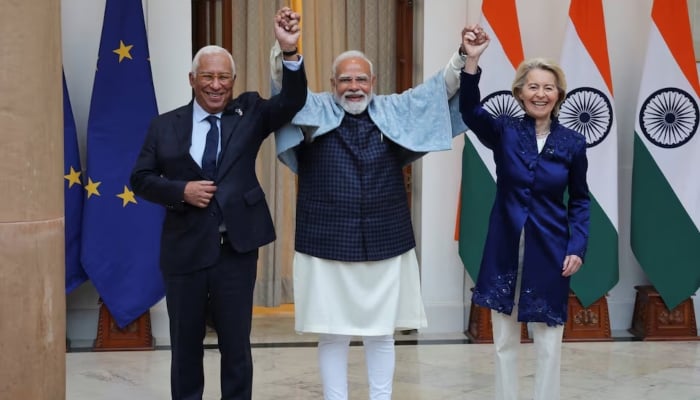
Under the EU-India FTA concluded in January 2026, New Delhi has secured immediate duty-free access for 100% of its textile and apparel tariff lines. Pakistan, by contrast, remains limited to duty-free access on only 66% of tariff lines under GSP+.
The agreement covers all major textile and apparel categories, including yarn, cotton yarn, man-made fibre apparel, ready-made garments, men’s and women’s clothing and home textiles.
Beyond textiles, the deal grants India near-zero tariff access across almost the entire EU market. Tariffs have been eliminated on leather and footwear (previously up to 17%), nearly all electronics exports (previously up to 14%), gems and jewellery, most chemicals, rail products and ships, and seafood, where duties were as high as 26%. Trade analysts stress that this is not incremental liberalisation but full-spectrum preferential access.
Consequently, Pakistan’s GSP+ advantage is effectively neutralised in sectors where Indian products already meet EU technical, sanitary and phytosanitary (SPS), environmental, social and governance (ESG) and regulatory compliance standards. India’s scale, vertically integrated supply chains and policy-backed export financing further amplify its competitiveness.
In practical terms, the disappearance of the preference margin in textiles and apparel means that competition in the EU will now be driven by price, scale, speed and reliability.
In leather and footwear, Pakistan loses its tariff shield not only against India but also against Vietnam and other FTA-enabled competitors. In chemicals and engineering goods — areas Pakistan has targeted for export diversification — India gains a decisive edge. In seafood and value-added agricultural products, India moves ahead on both tariff elimination and compliance readiness.
With tariff advantages now neutralised, the only remaining lever for Pakistan to compete with Indian products in the EU market is cost correction. This requires an immediate reduction in energy prices, aligning electricity and gas tariffs for the industrial sector with those in regional competitors such as India, Bangladesh and Vietnam.
Trade experts caution that the EU-India FTA effectively wipes out Pakistan’s GSP+ cushion and could accelerate a shift in EU sourcing patterns unless Pakistan urgently upgrades competitiveness, moves into higher-value products and improves regulatory alignment.
Critically, the agreement is not just about tariffs. It provides India with deeper regulatory alignment, pathways for mutual recognition, stronger supply-chain credibility and long-term investment certainty — factors that increasingly dominate EU procurement decisions.
Pakistan, by contrast, continues to rely largely on cost arbitrage, low-to-mid value exports, fragmented compliance systems and weak global branding. In a post-FTA environment, these vulnerabilities become more pronounced, widening the competitiveness gap rather than narrowing it. Analysts argue that if Pakistan is to retain relevance in the EU market, structural shifts are unavoidable.
Dr Khaqan Najeeb, former Adviser at the Ministry of Finance, said the agreement does not pose an immediate disruption, but it will gradually alter competitive dynamics in the European market. Potential impact areas include textiles and apparel, which dominate Pakistan’s exports to the EU, as well as leather, footwear, select agro-products and fisheries, where product overlap with India is significant.
The EU has granted a transition for GSP+ until the end of 2027, but the new legislative process for a fresh GSP+ scheme could begin anytime in the second half of 2026. Textile sector leaders expressed concern that the latest EU-India deal might negatively impact Pakistan’s exports. They cited that while the US has imposed increased tariffs on India, Pakistan faces a tariff of 19%.
However, India has absorbed higher tariffs by reducing its cost of doing business and adjusting its currency, whereas Pakistan has been unable to take a similar advantage due to its higher business costs—especially energy—and increased tax burden. Additionally, the stable exchange rate has reduced incentives for exporters.
Pakistan intends to apply for the new GSP+ scheme but will need to undertake vigorous lobbying in Brussels, both in the Commission and parliament. Stringent conditions—particularly regarding climate, human and political rights, and freedom of speech—are expected to be attached to the new trade incentives for recipient countries.