Polls show once-banned Jamaat‑e‑Islami nearing power in Bangladesh
JI chief Shafiqur Rahman rose from near obscurity to be serious contender for prime minister
Published February 10, 2026
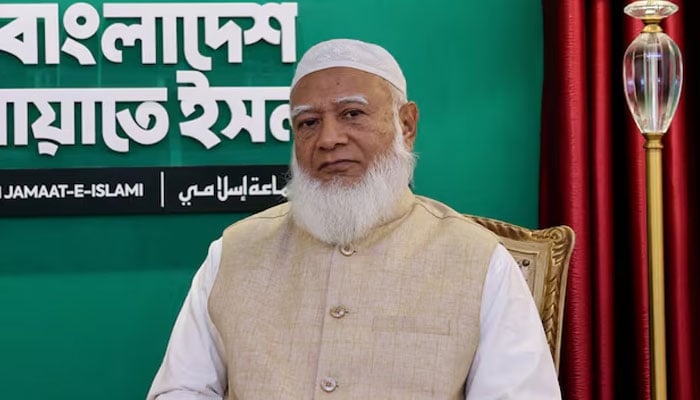
- Rahman widely expected to be PM candidate of JI-led alliance
- Polling on February 12 after uprising ousted former pm Hasina.
- JI is in a close fight with Bangladesh Nationalist Party.
DHAKA: Shafiqur Rahman has long been on the margins of Bangladeshi politics, but his face now appears on posters and billboards across Dhaka, urging voters to elect the country’s first Jamaat‑e‑Islami‑led government in a general election on Thursday.
The 67‑year‑old doctor and JI chief has risen from near obscurity to be a serious contender for prime minister.
A JI-led coalition is expected to put up a close fight against the Bangladesh Nationalist Party in the upcoming elections.
Bangladesh votes on February 12 in its first national election since a Gen Z‑led uprising toppled former prime minister Sheikh Hasina in 2024.
Opinion polls suggest the once‑banned JI is heading for its strongest performance yet.
Under Hasina, authorities cracked down on the party, jailing top JI leaders, sentencing some to death, banning the party, and driving it underground.
Rahman was arrested in 2022 and jailed for 15 months.
But the 2024 uprising changed JI and Rahman’s fortunes.
Days after Hasina fled to India in August that year, an interim government led by Nobel laureate Muhammad Yunus eased curbs on the party and a court in 2025 lifted the ban, allowing the party, long forced to meet discreetly, to re‑emerge.
“We tried to raise our voice, but repeatedly it was suppressed,” Rahman told Reuters in December. “(After the uprising) we got a chance to come again to the surface.”
Family of doctors
Born in 1958 in the northeastern district of Moulvibazar, Rahman began his political life in a leftist student organisation before joining Islami Chhatra Shibir, the JI’s student wing.
He formally joined JI in 1984 and unsuccessfully contested national elections in 1996, 2001 and 2018. He became the chief of the party in 2020.
His wife, Amina Begum, served in parliament in 2018 and is also a doctor, like their two daughters and a son. Rahman is the founding chair of a family-owned hospital in the northeastern district of Sylhet.
JI describes its leader as a humble and sincere person who "leads a modest, disciplined life grounded in simplicity and approachability".
Analysts say Shafiqur Rahman capitalised on the political vacuum after the uprising.
“In the month after the uprising, there was no visible leader in Bangladesh. Tarique Rahman was in exile in London,” said Dhaka University professor Shafi Md Mostafa.
“(Shafiqur) Rahman travelled across the country, gained media attention, and, within barely two years, became a frontrunner," said Mostafa.
On the campaign trail, his speeches have resonated with some voters, presenting JI as a clean, moral alternative guided by Islamic values. In December, the party allied with the Gen Z National Citizen Party, widening its appeal among younger and less‑conservative voters.
Seen by some as a more moderate face of the JI, Rahman has tried to soften the party’s image by stressing governance, anti‑corruption and social justice. He has also promised equal treatment for all religions.
Rahman says JI is "moderate, we are flexible, we are reasonable".
“But our principles are based on Islamic values, Quranic values," he said. "The Quran is not only for Muslims, it is for the whole creation.”