Finance ministry denies reports of paying up to 8% interest on external loans
Of the total external public debt, nearly 75% comprises concessional, long-term financing from lenders, says ministry
Published February 22, 2026
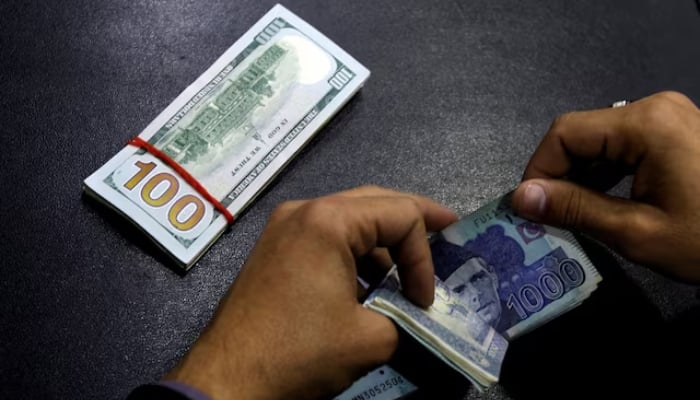
- Average cost of external public debt around 4%: ministry.
- Ministry says total external debt, liabilities stand at $138bn.
- About 7% of external debt consists of commercial loans.
The Ministry of Finance on Sunday dismissed reports that Pakistan was paying interest of up to 8% its external loans, saying the reports required contextual explanation to ensure an accurate understanding of the country's external debt profile.
The ministry's clarification comes following recent press commentary regarding the country’s external debt position and associated interest payments.
"The overall average cost of external public debt is approximately 4%, reflecting the predominantly concessional nature of the borrowing portfolio," the ministry said in a statement.
The ministry noted that the figures presented in the commentary required "contextual explanation" to ensure an accurate and comprehensive understanding of the external debt profile.
Pakistan's total external debt and liabilities currently stand at $138 billion, it said.
This figure, however, encompasses a broad range of obligations, including public and publicly guaranteed debt, debt of Public Sector Enterprises (both guaranteed and non-guaranteed), bank borrowings, private-sector external debt, and intercompany liabilities to direct investors.
The finance ministry emphasised distinguishing the aggregate figure from external public (government) debt, which amounts to approximately $92billion.
Of the total external public debt, nearly 75% comprises concessional and long-term financing obtained from multilateral institutions, excluding the International Monetary Fund (IMF), and bilateral development partners.
"Only about 7% of this debt consists of commercial loans, while another 7% relates to long-term Eurobonds," the ministry said.
"In light of this composition, the claim that Pakistan is paying interest on external loans 'up to 8%' is misleading," it added.
The overall average cost of external public debt is approximately 4%, reflecting the predominantly concessional nature of the borrowing portfolio.
With respect to interest payments, public external debt interest outflows increased from $1.99bn in the fiscal year 2022 to $3.59bn in the fiscal year 2025, representing an increase of 80.4%, not 84% as reported, the finance ministry clarified.
In absolute terms, interest payments rose by $1.60bn over this period, not $1.67 billion, it said.
Citing the State Bank of Pakistan’s records, the ministry provided a breakdown of the total debt servicing payments to specific creditors during the period under reference.
Of these, the IMC received $1.50bn, of which $580 million constituted interest; Naya Pakistan Certificates payments totaled $1.56bn, including $94 million in interest; the Asian Development Bank received $1.54bn, including $615m in interest; the World Bank received $1.25bn, including $419m in interest; and external commercial loans amounted to nearly $3bn, of which $327m represented interest payments.
Noting that the interest payments have increased in absolute terms, the ministry said that the rise cannot be attributed solely to an expansion in the debt stock.
Although the overall debt stock has increased slightly since FY2022, the additional inflows have primarily originated from concessional multilateral sources and the IMF's Extended Fund Facility (EFF) under the ongoing IMF-supported programme.
During 2022–23, Pakistan faced heightened balance of payments pressures, which led to foreign exchange reserves falling below one month of import cover.
In response, the government entered into an IMF EFF arrangement and mobilised financing from multilateral and other concessional partners.
These measures played a critical role in rebuilding foreign exchange reserves and strengthening the country’s external account position.
The government remains committed to prudent debt management, transparency, and the continued strengthening of Pakistan's macroeconomic stability.
The finance ministry emphasised that accurate representation of debt statistics was essential to informed public discourse, urging stakeholders to consider the full context of Pakistan’s external debt structure and evolving global financial conditions.