EVs alone won't fix the problem
Efficiency reduces energy intensity but does not automatically reduce foreign exchange exposure
Published April 24, 2026
Pakistan’s dependence on imported oil is often described as an energy problem. That framing is too narrow. It is, in reality, a structural feature of the economy — embedded in commuting patterns, freight logistics, and urban design.
As a result, every spike in global oil prices quickly translates into macroeconomic stress, widening external deficits, and fuelling inflation.
Electrification of transport is increasingly presented as the solution. Replace petrol with electricity, and Pakistan can reduce its import bill while absorbing surplus power capacity. The arithmetic appears compelling. But it rests on an incomplete diagnosis and, in some cases, a misleading comparison.
Three realities are often underplayed. First, Pakistan's electricity system remains partly dependent on imported LNG and coal. Second, electric mobility is not just a fuel substitution but a shift from oil dependence to battery dependence. Third, the narrative assumes that operational savings automatically translate into foreign-exchange savings, ignoring capital imports and replacement cycles.
Electrification is not a simple swap. It is a restructuring of dependence. Transport is almost entirely oil-based. Petrol powers motorcycles and cars, while diesel underpins freight trucks that carry goods across the economy.
This creates a dual vulnerability: households face petrol shocks, while freight costs transmit diesel prices into food inflation and industrial inputs. Pakistan is structurally exposed to global oil markets beyond its control.
Electricity is more flexible. It is generated from hydropower, nuclear, solar, wind, domestic gas, and imported fuels. But diversification is not the same as autonomy. Flexibility does not eliminate external dependence. Electrification replaces a single-point vulnerability with a multi-source system. But this only improves resilience if dependencies are not recreated elsewhere.
Electric vehicles are far more energy-efficient than internal combustion engines. Petrol engines waste most energy as heat, while electric motors convert a far higher share into motion. Even with some imported fuel in electricity generation, energy per kilometre falls sharply. This is the strongest technical argument for electrification.
But it is often misread as a macroeconomic solution for reducing import dependency. Efficiency reduces energy intensity; it does not automatically reduce foreign exchange exposure.
If electricity demand grows through imported LNG, coal, or new capacity with embedded foreign exchange costs, the external gain becomes uncertain. The assumption of 'idle capacity utilisation' also needs caution. Pakistan's power system has surplus capacity, but it is locked into high-fixed-cost contracts.
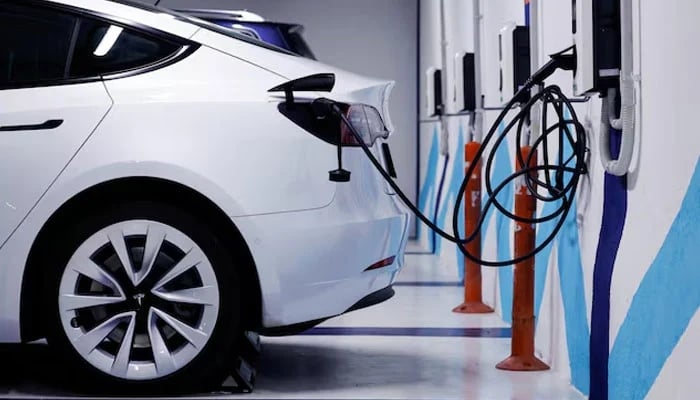
EV charging may improve utilisation, but it does not remove capacity payments or structural inefficiencies. Gains are therefore conditional, not automatic. At this point, the battery issue becomes decisive. An electric vehicle is not just a different drivetrain; it is a battery-centred system in which cost, supply chains, and external dependencies converge.
In Pakistan's dominant motorcycle segment, batteries account for a large share of vehicle cost and most imported value. Unlike petrol bikes, which create continuous fuel imports, electric bikes require upfront battery imports, periodic replacement, and ongoing reliance on global cell supply chains, even if assembly is local.
The same challenge is magnified in freight. Diesel trucks are the backbone of logistics, moving agricultural goods, industrial inputs, and imports across long distances. Electrifying this segment is not incremental; it requires high-capacity batteries, corridor-based charging infrastructure, and grid stability at scale.
These systems are capital-intensive and heavily import-dependent in the early stages. Without a freight transition strategy, electrification risks remaining confined to urban mobility while leaving the most oil-intensive segment untouched.
This shifts dependence from a flow problem to a stock-and-cycle problem. It also exposes a weakness in narratives focused on running-cost savings. Those savings are real at the user level, but they do not automatically translate into macroeconomic relief if freight and battery supply chains remain externally anchored. A cheaper vehicle is not necessarily part of a system that reduces oil dependence at scale.
Vietnam illustrates this clearly. Its transition to electric two-wheelers is often seen as a cost-driven success, but the real lesson is sequencing. It began with imported batteries and components while building assembly capacity and supporting domestic firms. Over time, it gradually increased local integration. Dependence was managed and reduced through industrial policy, not eliminated through adoption alone.
China represents a different scale. Its battery ecosystem is vertically integrated across raw materials, cell production, vehicle manufacturing, and supply chains. This was not market-driven but the result of long-term industrial strategy, scale and state-backed finance. The point is not replication — Pakistan cannot replicate it — but contrast. Without at least partial capability building, countries risk permanent dependency at the most critical node of the value chain.
For Pakistan, the key issue is the net foreign-exchange impact. Electrification reduces oil imports but increases exposure to battery imports, freight electrification costs, global supply chains, and replacement cycles. The outcome depends on whether savings from reduced fuel imports exceed the costs embedded in batteries, trucks and grid upgrades.
That balance can be positive, but only under conditions: high utilisation of two- and three-wheelers, a phased freight transition, falling battery costs and gradual domestic value addition. Without these, gains remain limited.
Constraints are real. Pakistan lacks lithium reserves and a mature battery or electric freight ecosystem. Fiscal space is tight, and institutions are uneven. But it also has advantages: a large two- and three-wheeler market, a vast trucking sector under cost pressure, existing assembly capacity, and strong incentives to reduce oil imports. The question is whether electrification is treated as an industrial transformation or a fragmented substitution.
In the short term, battery cell imports are unavoidable. But Pakistan can still localise battery-pack assembly, develop battery-management expertise, standardise formats, and build repair and refurbishment systems. These steps determine whether value capture increases or remains externally concentrated. Recycling is particularly important.
As battery stock grows, so does the potential to recover valuable materials domestically, creating a partial hedge against imports.
Business models will matter. Battery-swapping systems, if standardised early, can centralise ownership, enable bulk procurement, improve utilisation, and lower upfront costs. But they require coordination and regulatory clarity; otherwise, fragmentation will erode scale advantages, especially in freight, where standardisation is more difficult but more impactful.
Electrification also cannot succeed in isolation. Without broader system reform, gains will be capped. Urban mobility must shift toward mass transit. Freight must gradually move from road to rail to reduce diesel dependence and improve efficiency. The power sector must evolve through time-of-use pricing, renewable expansion, and improved grid management.
Financing mechanisms such as micro-leasing and pay-as-you-go systems will determine whether adoption is broad or narrow. The bigger risk is not failure but underperformance where electrification grows in cities but leaves freight, logistics and structural oil dependence largely intact. This pattern is already visible globally, where technology adoption outpaces system transformation.
Electrification is therefore not simply fuel substitution. It is a structural transition that reduces energy intensity, diversifies sources, and enables industrial upgrading across both consumer and freight systems. But it only delivers systemic benefits if managed as such. Oil dependence is rigid and externally determined.
Battery and freight dependence are more complex but more shapable if policy, scale and coordination are aligned. The choice is not between dependence and independence. It is between a static system locked into a single vulnerability and a dynamic system capable of evolving toward resilience.
Electrifying transport without addressing batteries, freight and system integration risks shifting from one trap to another. Done with intent, it offers a rare opportunity to reshape Pakistan’s economic trajectory. The constraint is not technology. It is execution and coherence.
The writer is former head of Citigroup’s emerging markets investments and author of ‘The Gathering Storm’.
Disclaimer: The viewpoints expressed in this piece are the writer's own and don't necessarily reflect Geo.tv's editorial policy.
Originally published in The News