Pakistan's lost children
Twenty-five million children between the ages of five and sixteen are not in school
Published May 19, 2026
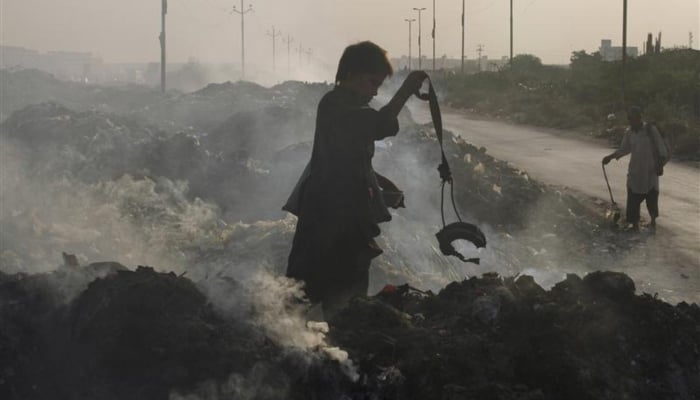
Pakistan carries a wound that rarely makes front pages. Twenty-five million children between the ages of five and sixteen are not in school. That is roughly the entire population of Australia sitting outside the gates of an education system that was supposed to be their ladder out of poverty.
We have known this number for years, recited it in policy documents, invoked it in donor meetings, and then watched it barely move. The reason, in large part, is that knowing how many children are out of school is a very different problem from knowing where they are and why they cannot be reached.
A World Bank working paper published in March 2026 has begun to close that gap in a way that should fundamentally change how provincial governments and education-focused NGOs think about their work. Using satellite imagery, machine learning, government school census data and publicly available location data on private schools, the researchers have built a granular, community-level map of Pakistan's education landscape across all four major provinces. It is, bluntly, the most actionable dataset on out-of-school children this country has ever had at the national level.
The link between being out of school and staying poor is not complicated. A child who never learns to read cannot fill out a job application. A girl kept home cannot become the nurse or entrepreneur her community needs. Research consistently shows that each additional year of schooling raises individual earnings. Across a household, across a generation, those returns compound into something transformative.
Pakistan's out-of-school crisis is not merely a social failure. It is an economic self-inflicted wound, trapping families in cycles in which poverty breeds illiteracy and illiteracy reproduces poverty. What makes this trap so persistent is the mismatch between where the problem sits and where solutions have been aimed. National averages mask brutal local realities. Balochistan has nearly 64% of its school-age children out of school. In Sindh, the figure is 47%. But even within these provinces, the distribution is deeply uneven, and that unevenness is precisely what planners have lacked the data to address.
The World Bank paper introduces three ideas that deserve to become standard vocabulary in every provincial education department and NGO in the country. The first is accessibility, which is not simply whether a school exists nearby, but whether children can realistically reach it given distance, terrain, and the school's capacity relative to the population.
The research assigns an Accessibility Index to every square kilometre of the country. Nationally, only 51% of Pakistan's school-age population lives in areas with good school accessibility, and in Balochistan that figure drops to 40%. For girls in remote areas and children from lower-income families, long travel distances are not an inconvenience. They are a decisive deterrent. Knowing exactly which communities fall below the accessibility threshold allows governments to target transport subsidies, girls' hostels, and satellite schools with precision rather than guesswork.
The second idea is what the researchers call whitespace, referring to population clusters of roughly 1,500 people where no school exists at all. Nationally, 37% of the population blocks have no school. These are not areas of low demand. They are areas of no supply. For NGOs deciding where to establish community schools or support private providers, a whitespace map is invaluable. It tells you not where schools are struggling, but where there are none.
The third is catchment area analysis, which examines which school serves which community and how that changes when a school is damaged or closed. This is where the paper's application to the 2022 floods becomes especially striking. The research estimates that those floods disrupted the schooling of approximately 3.5 million children, substantially higher than the government's initial count of 2.6 million, because the earlier assessment excluded private schools entirely. In districts like Khairpur Mirs, Jacobabad, and Naushero Feroze, the share of children without a school nearby increased by more than 45, 31 and 28 percentage points, respectively – virtually severing entire communities from education overnight.
Provincial education departments now have the ability, for the first time, to stop treating out-of-school children as an aggregate problem and start treating them as a geographic one. The data can tell a district education officer in Sindh which specific union councils have the highest concentration of out-of-school children, which communities lack a school within a reasonable distance and which might benefit more from a demand-side intervention such as a conditional cash transfer or fee waiver rather than new construction.
For NGOs working on enrolment, the implications are equally direct. This research offers a starting coordinate. The private sector also has a role. The paper reveals that private schools already serve 49% of enrolled students nationally, far more than official statistics had ever acknowledged. Understanding where private providers have not gone, and why, is a question worth asking seriously.
Pakistan is not short of commitment to education. It is short of precision. This research provides that precision. The question now is whether provincial governments have the will to integrate satellite-derived evidence into their annual planning cycles, and whether NGOs and donors have the honesty to redirect resources toward the coordinates these maps reveal.
Twenty-five million children are not an abstraction. They are in specific villages, specific streets, specific homes, many of them less than a day's drive from the offices of the people who could change their lives. We have the map now. What we do with it is on us.
The writer is a postgraduate student at Harvard University.
Disclaimer: The viewpoints expressed in this piece are the writer's own and don't necessarily reflect Geo.tv's editorial policy.
Originally published in The News