The petrol bomb is dead
New pricing mechanism is fundamentally different way of absorbing volatility
Published July 24, 2026
There's a peculiar ritual that used to play out every week in Pakistan. A notification would drop late on Friday night, television screens would be awash in a single phrase: 'petrol bomb'.
Anchors would shout it, tickers would flash it and for a news cycle or two, the entire national conversation would collapse into outrage over a number nobody had time to actually understand.
That ritual is now over. And instead of asking why it took this long to kill it, a chorus of analysts has decided to spend its energy criticising the funeral. What actually changed: For years, fuel prices were set monthly, then fortnightly, then every week, announced late Friday night, based on a five-day Platts average. The mechanics of that system guaranteed volatility: a week of accumulated global price movement, compressed into a single adjustment, dropped on consumers all at once, right before the weekend news cycle. When oil markets moved sharply as they tend to during any war and the result wasn't a price change. It used to be a shock.
The new mechanism replaces this with daily pricing based on a seven-day Platts average. That's not a cosmetic tweak; it's a fundamentally different way of absorbing volatility. Instead of one larger jump every Friday, the market now sees small, incremental movements at a time, spread across every single day. The averaging window is actually wider than before, which means the daily number is smoother, even though it's now recalculated far more often.
In other words: the same total price movement now happens gradually, invisibly, in the background – instead of violently, once a week, on Friday-night primetime.
The real story nobody's telling: Critics have focused almost entirely on the inconvenience of daily pricing that businesses can't plan for, the friction pump owners face, and the need to upgrade IT systems. Fair points and worth solving. But this framing misses what the policy is actually designed to fix and it's not just headline management. It kills the hoarding incentive.
Under the old system, everyone knew when a big price increase was coming. Pump owners would order more than usual from OMCs, who would pull more product from refineries, not because demand had increased, but because everyone wanted to buy low and sell high a few later. When a decrease was expected, the exact opposite happened: orders dried up and everyone ran their inventory down to avoid a loss.
This is textbook hoarding behaviour and it was baked into the fortnightly/weekly system by design, not by any individual's bad faith. Daily pricing removes the arbitrage window entirely. There's no '1-2 weeks of certainty' to exploit, because tomorrow's price is barely different from today's. The incentive to stockpile ahead of a hike, or starve the market ahead of a cut, simply disappears. It ends the inventory-gain-loss circus.
Every price cycle used to produce its own sub-genre of news: OMCs 'profiteering' off inventory gains, or crying foul over inventory losses, depending on which way the fortnightly number moved. That entire storyline was a byproduct of the lag between purchase price and sale price under infrequent adjustments. Shrink that lag to a day and the storyline shrinks with it. It solves supply interruptions.
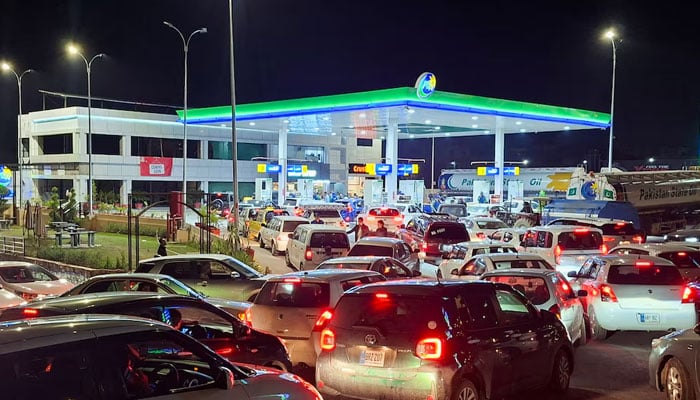
This is the part that deserves more attention than it's getting. Supply disruptions at the pump, those long queues that periodically paralyse traffic in metropolitan cities due to anticipated price movements. Daily pricing removes the anticipation. If there's no advantage to be gained by delaying or accelerating supply, there's no reason for supply to be delayed or accelerated. This isn't a minor efficiency gain; it's the elimination of a recurring, entirely artificial supply crisis.
The bigger picture: Daily pricing isn't the end goal; it's the on-ramp to deregulation, where the real consumer benefit shows up. Right now, fuel pricing in Pakistan is uniform: the same product, the same price, everywhere. That's not how competitive markets work in most other liberalised sectors. Look at telecom — multiple providers, different price points, different service bundles and consumers choosing based on value. There's no structural reason fuel retail can't eventually look similar, with OMCs competing on price and service rather than operating as a single administered monopoly-in-disguise.
But won't the OMCs just form a cartel?: This is the objection raised most often, and it's the one with the weakest legs to stand on because it ignores who else is in the market. Government-owned OMCs and refineries collectively hold roughly half the market share. That's not a marginal player; that's a price anchor. In a deregulated environment, if a private OMC tries to price above the government-owned benchmark, it simply loses customers to the OMC selling at the government rate.
Fuel is close to a textbook price-sensitive commodity; the product is functionally identical at nearly every station, so there's little to differentiate on besides price. That dynamic makes sustained cartelisation extremely difficult because any coordinated overpricing is immediately undercut by the state's own retail footprint.
Ogra's role in this new phase isn't to vanish; it's to shift to its actual role instead of fixing prices. It enforces licensing compliance, ensuring that anyone entering this more competitive market meets the standards required to operate.
The criticism that's missing the point: None of this means implementation has been flawless. Some OMCs and dealers' concerns about consultation, system upgrades and cash-flow adjustment are legitimate operational issues that deserve a real transition plan, not dismissal. Businesses genuinely relying on stable input costs to price their products have a fair complaint about short-term volatility.
But there's a difference between critiquing execution and rejecting the idea. Most of the loudest reactions have blurred that line by treating a mechanism that structurally reduces price shocks, kills hoarding and prevents supply disruptions as if it were the problem, rather than the fix for problems Pakistan has lived with for decades.
The writer is a corporate leader with over two decades of experience in Pakistan's corporate and energy sectors. He tweets/posts @UsamaQureshy
Disclaimer: The viewpoints expressed in this piece are the writer's own and don't necessarily reflect Geo.tv's editorial policy.
Originally published in The News