ADB assures full support for flagship ML-1 as Ahsan Iqbal seeks fast-track progress
Planning minister urges ADB to establish dedicated financing window for climate adaptation and resilience
Published October 01, 2026
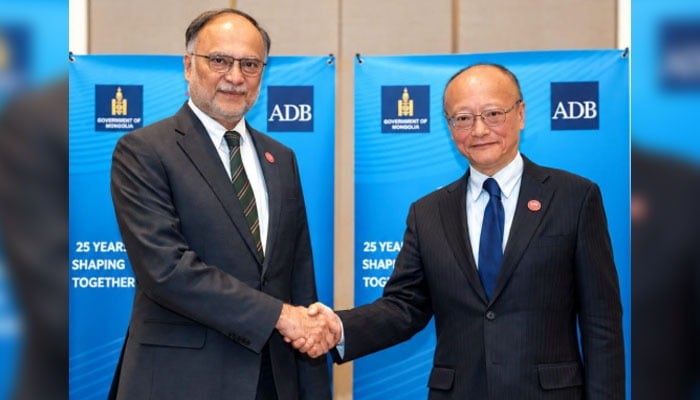
- Iqbal says low-emission, climate-vulnerable states face severe financing gaps
- Pitches AI, modern data systems to map vulnerabilities, target funds.
- Proposes competitive regional financing window for Carec nations.
Federal Minister for Planning, Development and Special Initiatives Ahsan Iqbal has called on the Asian Development Bank (ADB) to establish a dedicated financing window for climate adaptation and resilience in highly vulnerable countries, beyond existing country allocations.
The minister made the proposal during a meeting with ADB President Masato Kanda on the sidelines of the 25th Carec Ministerial Conference in Ulaanbaatar.
Ahsan Iqbal said global financial institutions needed to move beyond the traditional post-war reconstruction framework to address emerging challenges, particularly climate vulnerability.
Referring to Pakistan’s experience of devastating floods, he said climate-vulnerable countries that contributed minimally to global carbon emissions often faced severe financing gaps when disasters struck. He proposed that the new ADB financing window use artificial intelligence and modern data systems to identify vulnerabilities and channel funds more effectively.
The minister also proposed a competitive regional financing window for Carec countries, enabling member states to jointly develop projects with regional impact and seek financing on a competitive basis.
He highlighted Pakistan’s critical minerals potential, saying the country was moving from “pit to product” by promoting value addition and welcoming joint ventures in copper, antimony, chromite and rare earths.
He proposed establishing a Carec Critical Minerals Investment and Value-Chain Platform and invited Carec businesses to participate in the Pakistan Minerals Investment Forum in Islamabad on November 12–13, 2026. He said Pakistan could serve as a southern gateway connecting Central Asia’s critical minerals to global markets.
Ahsan Iqbal also stressed the strategic importance of the ML-1 railway modernisation project and conveyed Prime Minister Shehbaz Sharif’s message to expedite procedural formalities to enable groundbreaking at the earliest.
Kanda assured the minister that the ADB was fully committed to ML-1 as a flagship project and would provide all possible support to move it forward.
The two sides also agreed to explore joint studies on an export accelerator programme to identify product and market gaps and support Pakistan’s ambition of increasing exports to $100 billion by 2035. They also agreed to explore a study on better storage and utilisation of floodwater.
Ahsan Iqbal stressed the need to strengthen regional connectivity through integrated rail and road networks, particularly by linking Turkmenistan, Afghanistan and Pakistan, which he said could provide Carec countries with greater access to Gwadar Port.
Kanda acknowledged the minister’s proposals and agreed to undertake the proposed studies. He said stability, policy continuity and sustained reforms would be important for Pakistan’s development, while identifying infrastructure and human capital as key areas for ADB support.
Ahsan Iqbal acknowledged the ADB’s continued support under its Country Partnership Programme and invited Kanda to participate in the next Carec Ministerial Conference in Pakistan, as the country prepares to assume the Carec chairmanship next year.
Kanda extended ADB’s full support for Pakistan’s hosting of the conference.