The future of money, AI and the state
Debt, inflation, fiscal discipline and investment remain essential
Published October 20, 2026

I returned from two days at the IMF-World Bank Annual Meetings in Bangkok with a clear conviction: the future of finance is becoming inseparable from the state’s capacity.
Debt, inflation, fiscal discipline and investment remain essential. But the programme also addresses tokenisation, agentic AI, digital infrastructure and AI’s potential to create jobs. Increasingly, these are parts of the same economic agenda.
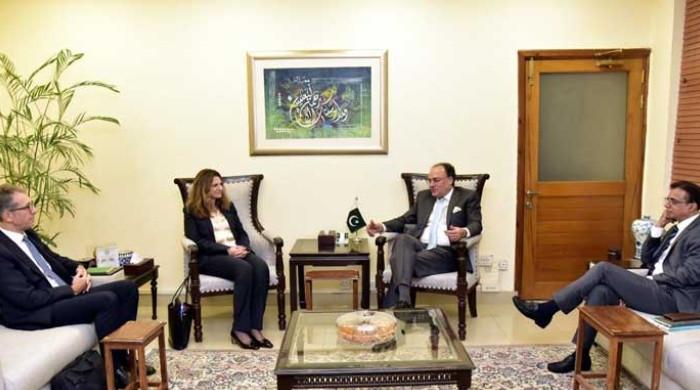
I met World Bank Vice President and Treasurer Jorge Familiar; IFC Regional Vice President Imad Fakhoury; World Bank Vice President for Digital & AI Sangbu Kim; and World Bank Group Controller Zinga Venner. We discussed digital capital markets, investment, AI-enabled regulation and blockchain-based financial transparency.
We entered those conversations with progress behind us. Pakistan has established a statutory framework for virtual assets, introduced regulatory application routes and enabled conditional banking access for licensed providers. Now we must build an environment where enterprise grows, investors have confidence and people participate with meaningful protection.
Three questions stand out: How can innovation help businesses access capital? How can regulators supervise increasingly complex markets? And how can governments know where public money goes?
On October 8, the IMF published analysis drawing on its Global Financial Stability Report chapter on tokenisation. Its assessment was neither unqualified enthusiasm nor blanket rejection: markets remain small and fragmented, constrained by legal uncertainty, interoperability and settlement.
Tokenisation connects issuance, trading, settlement and servicing through programmable ledgers. But greater speed can accelerate financial stress. The IMF emphasises enforceable rights, consistent regulation and safe settlement assets.
Pakistan must participate in this conversation. The question is not whether an asset can be tokenised, but whether holders have enforceable claims and the system works when something goes wrong.
The IMF’s New Economy Forum paired tokenisation with agentic AI. As assets become programmable and software acts on delegated instructions, who authorises actions, sets limits and remains accountable?
Regulatory capability must develop alongside technology, not after markets have scaled. In 2024, the World Bank issued a CHF200 million digital bond, using Swiss National Bank wholesale central bank digital currency for settlement, while preserving familiar custody channels.
In June 2025, IFC invested $100 million in Isbank’s digitally native note in Türkiye. Settled the same day through Euroclear’s digital infrastructure, its proceeds were intended for businesses, farmers and entrepreneurs in earthquake-affected provinces. These are earlier precedents, but they explain why engagement with Treasury and IFC matters.
For Pakistan, could a digital bond or sukuk improve settlement or investor access? Would investors buy it? Can custodians hold it? Are full costs lower, including legal and operational expenses?
Digitising debt does not make the borrower more creditworthy. Cheaper processing does not automatically mean cheaper borrowing. The objective should be better financing, with technology serving that objective.
My discussion with the World Bank Controller included blockchain-enabled financial transparency. The World Bank’s FundsChain platform helps stakeholders trace development funds and connect transactions with supporting records. In July 2026, the Bank reported that its original platform had expanded to more than 300 projects across more than 90 countries. Ethiopia’s FundsChain Evolution pilot goes further, exploring conditions embedded directly into payment flows.
Tracking money asks: Where did the funds go? Programmable controls ask: Can a payment occur only when specified conditions are met? Governments could explore this for development spending, subject to legal authority, privacy and exceptions. A blockchain does not eliminate the need for auditors or physical verification. An immutable record can preserve incorrect information, and recording a payment does not prove that a service was delivered.
A digital audit trail is valuable. It is not an audit verdict. But connecting authorisation, payment, documentation and oversight more effectively deserves serious examination.
On October 14, the IMF and World Bank Group released the Bangkok Blueprint, developed with the Bank of Thailand to address cyber-enabled fraud in digital financial services.
Its 12 key considerations across five pillars cover legal foundations, prevention, enforcement, cooperation and consumer protection. Fraud crosses financial institutions and digital platforms, demanding coordination.
For Pakistan, innovation cannot be measured only by how quickly money moves. We must ask how quickly institutions identify scams, share information lawfully, respond and help affected customers. Faster payments are not progress for someone whose savings reach a fraudster faster. At PVARA, innovation and supervision must advance together, with accountable providers and effective safeguards. Trust is not a public-relations benefit of good regulation. It is a condition that allows financial markets to grow.
The World Bank’s ‘Small AI: More and Better Jobs’ session focused on affordable applications suited to local needs. Its October economic update for the Middle East, North Africa, Afghanistan and Pakistan estimated that AI could significantly augment 13-20% of jobs, while fewer than 10% face near-term automation risk. These regional estimates are potential, not guaranteed productivity gains for Pakistan.
The report identifies gaps in local relevance and productive adoption. Urdu accounts for around 0.03% of URLs in the cited Common Crawl dataset, illustrating why local context matters, even though it doesn’t represent all AI training data.
Pakistan should avoid reducing AI policy to announcing the largest model or purchasing the most equipment. At PVARA, I want to pursue AI-assisted regulatory work: retrieving relevant laws, identifying missing application information, supporting supervisory analysis and preserving institutional knowledge securely. The aim is not to transfer public authority to an algorithm. It is to give accountable officials better tools.
Data-centre investments demand reliable power, connectivity, cooling, customers and commercial viability. Available electricity alone is not an investment proposition.
The objective is not simply to own more technology. The objective is to generate more economic value from it.
Pakistan’s virtual-assets framework, application pathways and regulatory sandbox provide a foundation, not proof of successful commercial use cases. We need to test where these tools can support credible capital-market instruments, reliable payments, stronger public oversight and useful institutional AI. That requires PVARA to work with the Ministry of Finance, the State Bank, the SECP and other relevant institutions.
Technology does not replace macroeconomic stability, sound institutions or investor confidence. Our ambition should be to strengthen them. That is my principal takeaway from Bangkok.
The importance of a tokenised instrument is whether it enables a useful transaction under credible rules. The importance of AI is whether it helps an institution perform its job safely. The importance of international engagement is what its knowledge and relationships enable us to build.
Pakistan’s opportunity is to make capital easier to mobilise, public money harder to misuse, and institutions more capable ofserving citizens. A country gains influence when it understands the systems on which it depends and builds institutions capable of shaping their development. We have begun that work.
My ambition is for Pakistan to become a country whose people help design the financial future and whose economy gives them compelling reasons to build it at home.
The writer is a minister of state and chairman of the Pakistan Virtual Assets Regulatory Authority (PVARA).
Disclaimer: The viewpoints expressed in this piece are the writer's own and don't necessarily reflect Geo.tv's editorial policy.
Originally published in The News