COP31 and Pakistan's climate reality
COP31 ended without consensus, with big holes in the cover statement
Published November 25, 2026
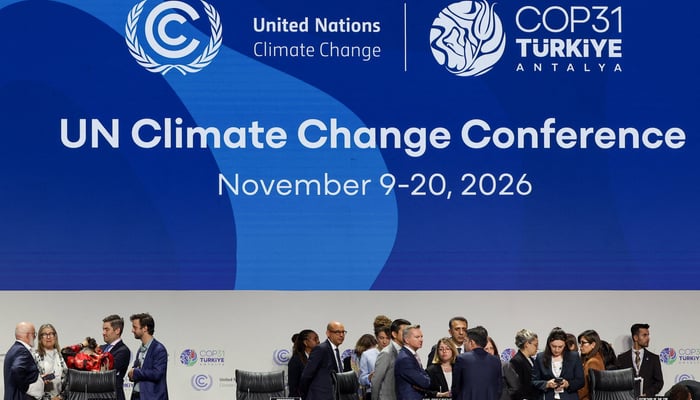
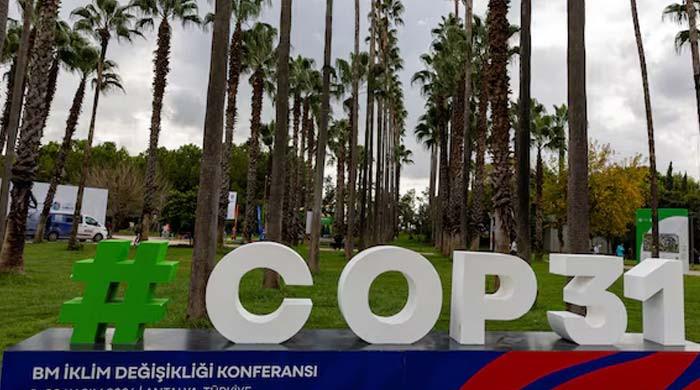
COP31 ended up being the longest COP ever, with little to show for it. Instead of hope, it generated more questions about the value of climate multilateralism in today’s disrupted world. It ended without consensus, with big holes in the cover statement.
The disappointments for developing countries were acute. Despite a major effort by the host Turkiye to convey both commitment and action, the negotiations were managed by Australia, the co-president. The sense on the ground in the last week at Antalya was that the hardest-hit nations were left paying the price for delays, divisions and a profound failure of political commitment.
At its core, the latest COP31 brought home six inconvenient truths. First, the fossil fuel lobby remained the most powerful elephant in the room. No new phase-out timetable or milestones emerged, nor was there a meaningful breakthrough on carbon capture commitments.
Nearly 130 countries demanded stronger language on transitioning away from fossil fuels, but political resistance prevailed. Despite not blocking the text, Pakistan expressed frustration with the overall negotiations, saying that “climate action is not a menu from which we can select only what suits us".
Second, climate finance remained a maze of broken promises, inadequate funding and mounting debt for vulnerable nations. Developing countries joined forces to challenge the widening gap between pledges and delivery. Yet no credible new financial breakthrough emerged.
The push for a concrete delivery plan, clear baseline and accountability framework to fulfil the COP30 pledge to triple adaptation finance by 2035, aiming for roughly $120 billion annually from a contested $40 billion baseline, fizzled out. No binding mechanism or clear baseline emerged in the Climate Finance Work Programme or Global Goal on Adaptation texts, kicking the can to COP32 in Ethiopia.
Rich nations also failed to put a figure on how much more money should be transferred to developing countries to adapt to climate change, especially on the $300 billion annual climate finance disbursement target agreed at COP29 for 2035.
For countries already confronting debt distress and recurrent climate disasters, the failure to deliver accessible finance was not simply a negotiating disappointment. It represents a direct constraint on development. For others, it represents a closed door on their path to survival.
Third, the draft agreement acknowledged the uncomfortable reality that climate action to date has failed on its most crucial goal of temperature threshold targets. Because of geopolitical tensions and major powers like the US pulling out, no action was taken to change that behaviour.
This was despite the UN’s headline warnings on the sustained overshoot of the critical 1.5C threshold, which not only raises the prospect of irreversible damage to ecosystems, water resources and human security, but leaves all those endangered in half the world, quite literally with the prospect of more boil.
Fourth, fragmented leadership and diplomatic splits weakened negotiations. The unusual division of responsibilities between Turkiye as host and COP president and Australia as president of negotiations exposed the difficulties of managing a consensus-driven process through two centres of authority. Instead of accelerating decisions, the arrangement added complexity when speed was essential.
Fifth, while renewable energy and electrification are advancing, political ambition continued to lag behind technological progress. For countries like Pakistan, the message was clear: no one is coming to rescue us with a just transition package. The good news was that Pakistan drew widespread praise as a clean energy ‘poster child’ for its grassroots solar boom, which surged from 1% to 28% of electricity generation between 2018 and 2025, and for completing over one million climate-resilient homes in Sindh.
Rather than obstructing this transition through uncertain taxation or restrictive regulation, the government should enable it, while addressing the legitimate costs of maintaining a reliable electricity grid.
Sixth, it was unclear whether the benefits of the consensus-driven process that delivered the Paris Agreement were working anymore.
The COP21 Agreement of 2015 represented a high point of climate multilateralism. Yet the international order that produced it is now fractured by geopolitical rivalries, wars, protectionism and competition for critical resources. Ultimately, the search for consensus at COP31 increasingly became a mechanism for postponing action rather than delivering it.
For Pakistan, these failures have profound national security and economic consequences. The facts on the ground are stark. As we go into a gas-strapped winter, Pakistan is already living through the climate catastrophe the world is still debating. Devastating floods, melting glaciers, deadly heatwaves, water insecurity and mounting economic losses are eroding lives, livelihoods and national resilience.
The World Bank has warned that climate-related impacts could cause losses equivalent to 18-20 per cent of GDP by 2050 without stronger resilience.
On average, Pakistan loses more than $2 billion annually because of extreme weather events. Agricultural losses associated with the 2025 floods alone are estimated at $1 billion.
Today, vulnerable economies are effectively expected to borrow money to survive a crisis they did little to create. But in this age of disruption, developing countries cannot afford to remain trapped between empty international promises and domestic paralysis.
The central challenge is to convert climate vulnerability into a new agenda for economic resilience, regional cooperation and strategic autonomy.
For Pakistan, this requires a fundamental shift in how climate policy is conceived. Climate change cannot remain the responsibility of one underfunded ministry. It must become a core organising principle of economic planning, public investment, agriculture, energy, water governance and national security.
First, Pakistan must move from reactive disaster management to anticipatory climate governance. Every major infrastructure investment, agricultural policy and urban development plan should undergo climate-risk assessment.
Floodplain encroachments, unregulated construction, groundwater depletion and weak building standards multiply the damage caused by extreme weather. Prevention must become a national investment priority, not an afterthought.
Second, developing countries must build greater financial sovereignty. Pakistan should press for grant-based adaptation finance, accessible loss-and-damage funding, debt restructuring and reforms to multilateral development banks.
But it must also develop credible domestic financing mechanisms, including climate-budget tagging, transparent resilience funds, municipal green bonds and incentives for private adaptation investment. Without institutional capacity and accountability, even available international finance will remain underutilised.
Third, the energy transition must be recognised as an economic opportunity, not merely an environmental obligation. Pakistan’s rapid solar adoption shows that citizens can lead where policy has stalled.
The challenge now is to modernise the grid, expand affordable storage, support distributed renewable energy and ensure that clean energy becomes a driver of industrial competitiveness. Punishing solar consumers to preserve an inefficient power system would be a strategic mistake.
Fourth, South Asia urgently needs a new climate cooperation framework. Glaciers, rivers, monsoons, heatwaves and air pollution recognise no national borders. Yet the region remains hostage to geopolitical rivalries, defined by India’s unilateral decision to hold the Indus Waters Treaty in abeyance.
Weaponising water in an era of growing scarcity is profoundly destabilising. Climate resilience requires basin-wide data sharing, early-warning systems and cooperation on transboundary environmental risks, even where political relations remain hostile.
Pakistan should reach out to other countries in the region to build a coalition of the willing beyond the annual COP negotiating cycle.
Pakistan should work with the G77, climate-vulnerable countries and emerging economies to pursue common positions on debt relief, technology access, adaptation finance and reform of international financial institutions. South-South cooperation can also expand affordable clean technologies, climate-smart agriculture and disaster preparedness.
Finally, climate resilience must become a measure of state capacity and commitment. Pakistan cannot demand accountability from the international system while tolerating fragmented institutions, weak enforcement and poor coordination between federal and provincial governments.
Climate adaptation requires empowered local governments, transparent expenditure, reliable data and sustained political ownership. The age of disruption demands a new climate realism: national resilience cannot be outsourced.
Pakistan needs both international climate accountability and domestic institutional reform. One is not a substitute for the other.
The world can postpone decisions. Pakistan cannot postpone the next flood, the next drought or the next glacial lake outburst.
In an age when global cooperation is becoming less reliable, resilience must become Pakistan’s most urgent national development strategy.
The writer is the chair of the Senate Standing Committee on Climate and Environment, and former federal minister of climate change.
Disclaimer: The viewpoints expressed in this piece are the writer's own and don't necessarily reflect Geo.tv's editorial policy.
Originally published in The News